
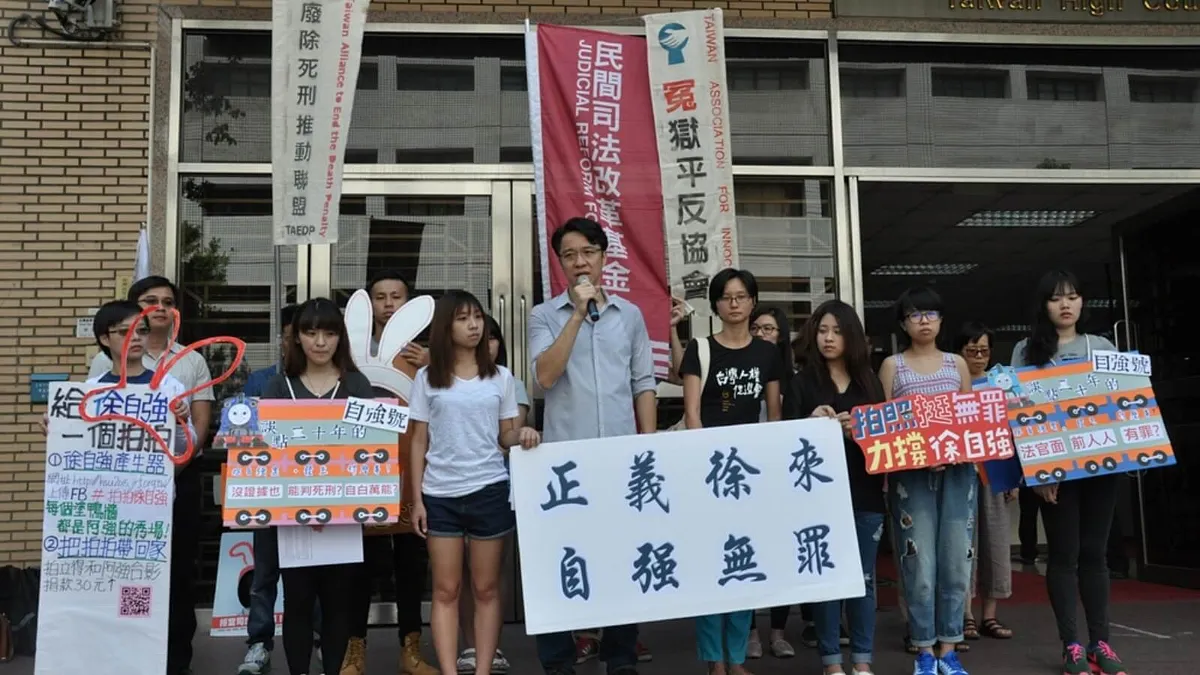
A Lifeline for the Condemned: Civil Society Court Observation Press Briefing on the Ninth Retrial of Hsu Tzu-chiang
Last edited: 2026-08-25
Twenty years ago, the Judicial Reform Foundation was established to promote Taiwan's judicial reform movement. Twenty years ago, Hsu Tzu-chiang (徐自強) was wrongfully accused, becoming an indicator case for the success or failure of Taiwan's judicial reform.
The Hsu Tzu-chiang Case Tests Judicial Reform
Over the past twenty years, judicial reform has progressed through twists and turns, and the Hsu Tzu-chiang case is no exception. Falsely implicated by Huang Chun-ch'i (黃春棋) and Chen I-lung (陳憶隆) (his co-defendants in this case) as an accomplice in kidnapping for ransom, Hsu Tzu-chiang was sentenced to death on April 27, 2000, despite the Supreme Court having remanded the case for retrial five times. Because the entire case was fraught with doubt—not only did the Control Yuan's investigation report point out problems with the judgment, but the Prosecutor-General also filed extraordinary appeals five times—it ultimately relied on Judicial Yuan Interpretation No. 582 by the Grand Justices, which ruled that the Supreme Court precedent cited in the original judgment was unconstitutional. This finally allowed Hsu Tzu-chiang to secure a retrial on May 26, 2005, and be removed from the list of death-row inmates awaiting execution. Grand Justices Interpretation No. 582 not only saved Hsu Tzu-chiang's life but itself became the most important and authoritative practical opinion on criminal evidence law in contemporary times.
Since the sixth remand, although the pro bono defense counsel has presented numerous pieces of evidence showing that Hsu Tzu-chiang was not involved, judges in successive trials have continued to cling to the contradictory confessions of co-defendants, dragging out the proceedings indefinitely. Hsu Tzu-chiang became the only defendant formerly sentenced to death to whom the "Stalking and Harassment Trial Act" (Note: referring to the Criminal Speedy Trial Act) was applied, and he was temporarily released from custody on May 19, 2012. Today, Hsu Tzu-chiang has returned to the home he was separated from for 16 years, running about to clear his name. This case has also become a benchmark case for testing whether judges uphold the "principle of presumption of innocence," receiving high public attention.
Judicial Reassignments Should Not Affect Evidence Investigation
Currently, the ninth remand has been underway for over two years, and the court has yet to fully conduct the evidence investigations requested by the defense attorneys, including crucial on-site inspections. However, on June 10 this year, the Judicial Yuan announced that Hsieh Ching-hêng (謝靜恒), the presiding judge of the collegiate bench for the ninth remand, is to be reassigned as a Supreme Court judge. We are concerned that the collegiate bench may consequently abandon important evidence investigations, proceed directly to oral arguments, and schedule a date for sentencing.
With the Hsu Tzu-chiang case in trial today, we call on the collegiate bench not to let judges' reassignments affect the rights and interests of the parties involved. Justice brooks no compromise, especially in criminal cases involving the death penalty, which must be tried with the utmost rigor. In particular, evidence investigation must implement the "principle of immediacy" and the "prohibition of prejudging evidence," and the court shall not arbitrarily dismiss the evidence investigations applied for by the defendant. If even the Hsu Tzu-chiang case could face a hasty conclusion due to judge reassignments, other cases will have even less hope of receiving proper procedural safeguards.
Huang Chun-ch'i Cannot Be Trusted; Trials Should Focus on Physical Evidence
At today's court session, the collegiate bench once again summoned Huang Chun-ch'i to testify in order to clarify the facts of the case. Over the decade since the case was remanded for retrial, Huang Chun-ch'i, as the death-row inmate whose conviction has been final the longest, hopes the court will grant him an opportunity for a retrial, yet the court has consistently refused to give Huang Chun-ch'i that opportunity. The court regards Huang Chun-ch'i as a key witness in this case, making the case the final straw for Huang Chun-ch'i to cling to for survival. The question is, is Huang Chun-ch'i's testimony really that important?
Huang Chun-ch'i is Hsu Tzu-chiang's cousin. On September 25, 1995, while making a call from a public phone booth to direct the victim's family to deliver the ransom, he was arrested on the spot by police. After his capture, Huang Chun-ch'i claimed that the crime was committed by three people, with the co-perpetrators being Hsu Tzu-chiang and Chen I-lung, leading to Hsu Tzu-chiang being sentenced to death on April 27, 2000. Because Huang Chun-ch'i's testimonies were inconsistent and contradicted the facts, he confessed to Hsu Tzu-chiang's mother on May 1, 2000, that Hsu Tzu-chiang had not participated in the crime. He claimed he falsely implicated his cousin Hsu Tzu-chiang merely to protect his fugitive older brother (Huang Ming-ch'üan), delay the proceedings, and substitute for his older brother Huang Ming-ch'üan's role in the case.
If the court intends to acquit Hsu Tzu-chiang, Huang Chun-ch'i's testimony is unimportant. This is because Hsu Tzu-chiang had long ago presented post office ATM surveillance footage and a car rental agreement affidavit from September 1, 1995, proving that he did not participate in the crime. Only if the court intends to convict Hsu Tzu-chiang would it need Huang Chun-ch'i to cooperate and testify in order to dismiss the evidence favorable to Hsu Tzu-chiang. Yet now, Huang Chun-ch'i has grasped the court's mindset, using his testimony merely as a bargaining chip. The court's investigative direction—centered on obtaining Huang Chun-ch'i's testimony—puts the cart before the horse, is of no help in discovering the truth of the Hsu Tzu-chiang case, and should instead shift its primary focus to investigating physical evidence such as alibis in order to clarify the disputes and restore Hsu Tzu-chiang's innocence.
For Hsu Tzu-chiang, although twenty years have passed, justice is still on the road. Today, all social movement groups concerned about Hsu Tzu-chiang are here to wish that Hsu Tzu-chiang's road to justice will soon reach its destination, secure a perfect acquittal, and set the most important milestone for the success of Taiwan's judicial reform.
Spokespersons
Kao Jung-chih / Executive Director, Judicial Reform Foundation
Ch'iu I-ling / Secretary-General, Taiwan Association for Human Rights
Participating Organizations
Taiwan Association for Human Rights
Judicial Reform Foundation
Taiwan Association for Innocence
Taiwan Alliance to End the Death Penalty
Press Contacts
Lawyer Kao Jung-chih, Executive Director, JRF 02-25231178
This article is an AI-generated translation of the original Chinese text. In the event of any discrepancy, the Chinese version shall prevail.