
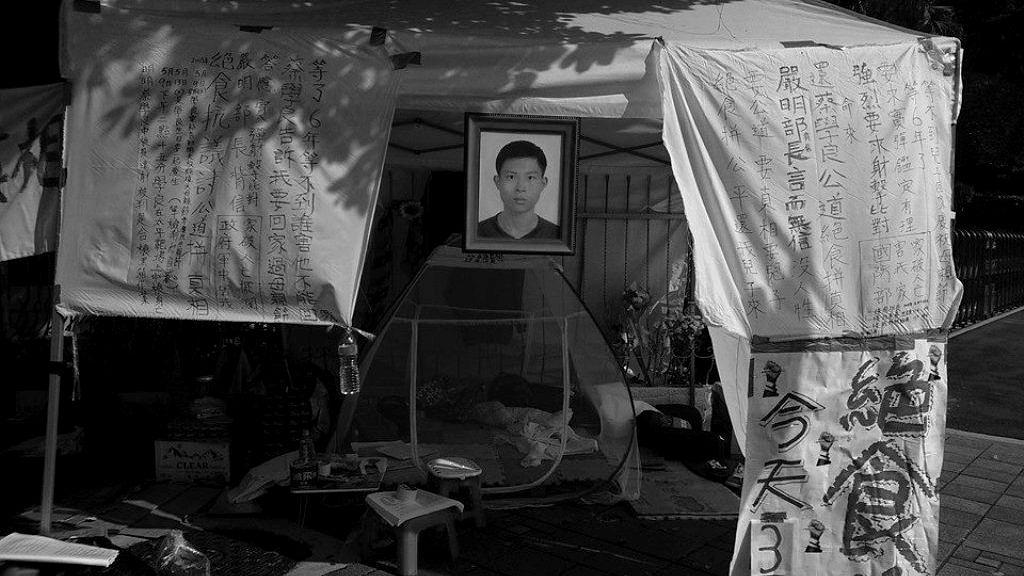
Tsai Hsueh-liang Case
Faced with the family's doubts regarding the cause of death, the military prosecutor's office simply kept demanding that Ch'en Hsueh-liang's family sign a cremation application, stating that the body could not be claimed otherwise, and that the case could still be closed even without the family's signature. Distraught at the time, Ch'en's father asked the military prosecutors whether they could apply to reopen the investigation if any doubts or new evidence were discovered later. The military prosecutors simply replied in the affirmative, stating that it was the family's right. Consequently, Ch'en's father signed the cremation application, and Ch'en Hsueh-liang's body was cremated just seven days after his death. This marked the beginning of the family's long, arduous, and painful journey in pursuit of the truth behind Ch'en Hsueh-liang's death.
Why Military Forensic Pathologists Concluded Ch'en Hsueh-liang Committed Suicide with a T65K2 Rifle

The autopsy report by military forensic pathologist Yen Kuo-shun stated that Ch'en Hsueh-liang held a T65K2 rifle with his left hand on top and right hand on the bottom, shooting himself from the upper gums through the oral cavity, resulting in suicide. The conclusion that Ch'en Hsueh-liang held the T65K2 rifle with his left hand on top and right hand on top [sic] was based on the forensic pathologist's visual determination that Ch'en's left hand had obvious gunshot residue while his right hand did not. The reasoning for concluding that Ch'en Hsueh-liang shot his oral cavity with the rifle from an extremely close range was as follows: Ch'en's mouth corners bore lacerations, indicating that he should have held the barrel with his lips, sustaining lacerations caused by the pressure explosion generated by the firing; when shot at close range by a rifle-grade firearm, its powerful firepower would shatter the skull and jawbone, producing numerous bone fragments. Cracks in the skull and jawbone as well as numerous small bright spots could be seen on Ch'en Hsueh-liang's head X-ray photographs, serving as corroboration for this assertion.
Additionally, the autopsy report noted that Ch'en Hsueh-liang left a suicide note, indicating that he committed suicide due to a pessimistic outlook.
Aside from the autopsy report, although a visual inspection of the seized rifle revealed no obvious bloodstains, according to an appraisal by the Criminal Investigation Bureau, trace amounts of blood were found on the outer and inner circumferences and the gas vents of the flash suppressor of the seized rifle. This blood matched the DNA profile of the blood on the cartridge casing found immersed in Ch'en Hsueh-liang's blood at the shooting scene, and typical back-spatter bloodstain patterns were also found inside the barrel and the chamber. The aforementioned appraisals were also used to corroborate the claim in the autopsy report that Ch'en Hsueh-liang committed suicide using the seized T65K2 rifle.
Finally, forensic pathologist Yen Kuo-shun's autopsy report was supported by forensic pathologists Hsiao K'ai-p'ing, Wu Mu-jung, and Pan Chih-hsin, as well as firearms and ballistic expert Meng Hsien-hui.
The Family's Doubts Regarding Ch'en Hsueh-liang's Suicide
Ch'en Hsueh-liang's family could not accept the autopsy report's assertion that Ch'en committed suicide. In their quest for the truth behind Ch'en Hsueh-liang's death, the family consulted experts such as forensic pathologist Kao Ta-ch'eng, forensic pathologist Lo Hsiu-hsiung, and forensic science expert Li Chun-i, who put forward scientific and forensic reasons suggesting that Ch'en Hsueh-liang may not have committed suicide with a T65K2 rifle.
1. Scientific and Forensic Reasons Deeming it Impossible to Conclude Ch'en Hsueh-liang Committed Suicide with a T65K2 Rifle
- No fingerprints, saliva, or large amounts of blood belonging to Ch'en Hsueh-liang were detected on the T65K2 rifle.
Professor Li Chun-i pointed out that although the autopsy report concluded that Ch'en Hsueh-liang held the T65K2 rifle and shot himself from the upper gums through the oral cavity, no fingerprints, saliva, or large amounts of blood belonging to Ch'en Hsueh-liang were detected on the seized T65K2 rifle, save for trace amounts of blood. If this were the case, it could not be ruled out that invisible blood micro-particles floating in the air of the shooting scene were carried by the wind and contaminated the firearm at the scene. Under these circumstances, there is a lack of clear evidence that Ch'en Hsueh-liang committed suicide with the seized rifle.
- The left hand was determined to have "gunshot residue" and the right hand not to, without submitting them for laboratory testing?!
The autopsy report concluded that Ch'en Hsueh-liang's left hand retained gunshot residue while his right hand did not, thus determining that he held the T65K2 rifle with his "left hand on top and right hand on the bottom" to commit suicide. However, whether it was Professor Li Chun-i—who questioned the autopsy report—or Professor Meng Hsien-hui and forensic pathologist Wu Mu-jung—whose arguments were closer to the autopsy report—all pointed out that determining the presence of gunshot residue actually requires laboratory testing and cannot be established by visual inspection alone; otherwise, it is difficult to determine the exact composition of the black stains on the left hand, and whether the right hand truly lacked gunshot residue. No relevant laboratory testing was conducted at the time.
- The rifle's firepower is immense, yet the wound was very small?!
Experts such as forensic pathologist Kao Ta-ch'eng, forensic pathologist Lo Hsiu-hsiung, and Professor Li Chun-i all believed that if the head was shot at close range by a rifle-grade firearm, the bullet's exit wound would typically be very large. However, the size of the bullet exit wound on Ch'en Hsueh-liang's head was only 1.2 x 0.5 square centimeters, which is inconsistent with injuries caused by close-range rifle fire.

- Ch'en Hsueh-liang's mouth corner laceration does not fit the injury pattern exclusive to rifles.
Professor Li Chun-i pointed out that not only rifles but also handguns could cause the mouth corner laceration pattern seen on Ch'en Hsueh-liang. Furthermore, Ch'en Hsueh-liang's injuries are actually more similar to typical gunshot wound patterns associated with handguns.
- Questions regarding the "flash suppressor"...
Forensic pathologist Lo Hsiu-hsiung and Professor Li Chun-i further pointed out that the T65K2 rifle is equipped with a flash suppressor; in the event of close-range firing, the flame spraying from the flash suppressor would leave petal-shaped burn marks on the lips and face. However, Ch'en Hsueh-liang's lips and face did not bear similar petal-shaped burn marks.

2. Still No Motive for Ch'en Hsueh-liang's Suicide Found to This Day
- A Mother's Inner Voice: Filial Hsueh-liang would never commit suicide!
Ch'en's mother stated that Ch'en Hsueh-liang was the only boy in the family, was very filial, and constantly kept his mother in his thoughts. Ch'en's mother mentioned that about a month before Ch'en Hsueh-liang's death, she had suffered a major traffic accident. During her hospitalization, Ch'en Hsueh-liang not only took care of his mother during his leave, but also specifically requested leave twice to return home, telling her not to overwork herself out of concern for potential sequelae from her concussion, adding that he would be a career soldier and his salary could take care of her into old age. Moreover, on the very noon of the incident, she had just spoken with Ch'en Hsueh-liang on the phone, and he had told her he would come home on the weekend to spend Mother's Day with her—how could he possibly commit suicide out of nowhere?
- Military Records and Comrades' Testimonies: Ch'en Hsueh-liang had no motive to take his own life!
The Ministry of National Defense's successive safety evaluation analysis tables also showed that Ch'en Hsueh-liang got along harmoniously with his fellow platoon members and family, possessed a gentle personality, had a simple social circle, lived under good conditions, and displayed a good learning attitude. Following Ch'en Hsueh-liang's death, four military comrades also testified that Ch'en showed no anomalies before his death. Currently, the only suspected motive that might have triggered Ch'en Hsueh-liang's suicide was that the non-commissioned officer sharing his dorm frequently scolded him; however, there is still insufficient evidence to prove that Ch'en Hsueh-liang indeed took his own life as a result of being scolded.
From a scientific perspective, whether Ch'en Hsueh-liang held a T65K2 rifle and shot himself in the oral cavity remains questionable, and since no motive for Ch'en Hsueh-liang's suicide can be found, one cannot presuppose that Ch'en Hsueh-liang left a "suicide note" and infer from it that he committed suicide. At most, it can only be said that the contents identified as a "suicide note" indeed corroborate that Ch'en Hsueh-liang was in a poor frame of mind when he wrote them.

It's just that today I suddenly wanted to die, that's all
People always have a dream, a hope
It's just that I am too dark, that's all
Human existence is of no help whatsoever to the world
To be honest, human existence merely accelerates the destruction of the world
Although the world won't feel pain, in the end the ones who feel pain are still humans
I am not dying, I am simply returning to the void
Living, to be honest, has no meaning whatsoever; the meaning of living lies only in the society (redundant character omitted, cited from original), the crowd in which one exists
I am lonely because I live beneath my own darkness
But I am no longer lonely; once I return to the void, I will become darkness, and boundless darkness will be my friend
Perhaps... I am no longer myself, but it doesn't matter
Everything in the universe arises from emptiness and should return to the void once more
To me, the meaning and essence of a black hole's existence
Are not superficial things like spacetime gates or portals, but things that shatter everything down to its most fundamental matter
An existence that dissociates all creation
I have always explored existences like gods and ghosts; perhaps they exist, perhaps they do not. In my view, so-called miracles and divine manifestations (two incorrect characters, cited from the original) are merely one of those extremely rare probabilities amidst chaos. My departure can be regarded as the implementation of verifying the theories of gods and ghosts
Mother, you gave birth to a son with bizarre thoughts, but I am pursuing a true dream
Thank you for giving birth to me and raising me
I must abandon my emotions to pursue the Great Dao
Death is truly terrifying, yet not terrifying at all
This is relative
Reasons for the JRF's Intervention and Assistance in the Ch'en Hsueh-liang Case—Assisting the Family in Pursuing the Truth through Scientific Experiments
On November 25, 2014, the JRF formed a legal team to assist with the civil appeal (second instance) state compensation litigation of the Ch'en Hsueh-liang case. The reason for providing assistance was the hope of helping the family seek the truth behind Ch'en Hsueh-liang's death through scientific experiments. Come to think of it, the official hypothesis concluding that Ch'en Hsueh-liang committed suicide with a T65K2 rifle was not supported by any experiments, yet because it was the official version of the cause of death, it was deemed correct without requiring experimental proof. In contrast, in order to overturn the existing official version, Ch'en Hsueh-liang's family proposed two sets of T65K2 rifle test-firing plans to verify whether Ch'en Hsueh-liang actually committed suicide with a T65K2 rifle.
-
Test-Firing Plan 1: Exit Wound Power Test
The first type of test-firing plan is an exit wound power test. The family requested that animal skulls be shot at close range with a T65K2 rifle to confirm whether close-range firing with a T65K2 rifle could cause a head wound as small as Ch'en Hsueh-liang's, or if the exit wound would be significantly larger.
-
Test-Firing Plan 2: Entry Wound Flame Burn Mark Test

The second type of test-firing method is an entry wound flame burn mark test. The detailed execution process of this test-firing plan was proposed by forensic science expert Li Chun-i. Based on the facts that Ch'en Hsueh-liang's teeth were struck by the bullet and driven into his skull, and that linear gunshot tattoo marks (caused by gunpowder particles striking and ejecting from the gums) were present on the outer edge of his mouth corners, Li Chun-i formulated the hypothesis that Ch'en Hsueh-liang died from being shot with "the gun pressed against his gums (not inserted into the oral cavity)."

Starting from this hypothesis, he further surmised that if Ch'en Hsueh-liang died from being shot by a T65K2 rifle with the "gun pressed against his gums," because the rifle's flash suppressor was not entirely inserted into the oral cavity, flames would spray from the flash suppressor upon firing, thereby leaving petal-shaped burn marks on the lips and face.
 Source / Gunshot wounds: practical aspects of firearms, ballistics and forensic techniques by Vincent J.M. Di Maio
Therefore, by simply test-firing a T65K2 rifle at a sheet of white paper, the flame temperature and the burn marks left on the white paper could be used to infer what kind of marks would be left on the lips and face when Ch'en Hsueh-liang was shot at close range by a T65K2 rifle. By comparing the mark pattern established through experimentation with the actual marks left on Ch'en Hsueh-liang's face, it could be verified whether Ch'en Hsueh-liang died from being shot by a T65K2 rifle with the "gun pressed against his gums."
The JRF formed the legal team to assist Ch'en Hsueh-liang's family in the civil appeal state compensation litigation precisely upon learning that Professor Li Chun-i had proposed the entry wound flame burn mark test plan, hoping to prompt the court to conduct test-firing experiments during the litigation in pursuit of the truth. Although the JRF stood on the side of supporting the family's claims during the litigation, the reason was primarily because the resource-rich and relatively powerful Ministry of National Defense refused to conduct test-firing experiments; to fight for the test-firing experiments, the JRF had to assist the family in countering the Ministry of National Defense. However, this never meant that the JRF knew what the ultimate truth was. Even if the test-firing experiments overturned the claim that Ch'en Hsueh-liang committed suicide with a T65K2 rifle, what actually happened at the scene and how Ch'en Hsueh-liang truly died still rely on the prosecutors to reopen the investigation.
Regrettably, the civil second-instance court ultimately did not commission any institution or individual to conduct test-firing experiments before concluding that Ch'en Hsueh-liang died from an accidental firearm discharge. Although Ch'en's mother was awarded NT$1.48 million in compensation, frankly speaking, to claim that an accident was the truth behind Ch'en Hsueh-liang's death also lacks the support of scientific experiments...
Conclusion: What If the Initial Death Determination Could Be Done Over...?
Tracing the root cause, the tragedy of the unclear truth behind Ch'en Hsueh-liang's death actually stems from the inadequacy of Taiwan's death investigation system and resources. It may be hard to imagine, but an "autopsy"—meaning cutting open the body to conduct a detailed examination—was actually never performed in the Ch'en Hsueh-liang case. The Ch'en Hsueh-liang case only underwent an "external examination," which is a visual inspection of the exterior of the body. The determination of the cause of death back then was also entrusted to a single military forensic pathologist, rather than being handled through a division of labor by a multidisciplinary team comprising forensic science experts, firearms experts, and other specialists.
Had Ch'en Hsueh-liang's body first undergone a 3D computed tomography (CT) scan to completely preserve the state of the body, followed by an autopsy and more comprehensive examinations—such as testing for gunshot residue on both hands, analyzing the composition of fragments inside the skull (whether they contained bullet fragments and, if so, what their material was)—rather than relying on a single military forensic pathologist's visual inspection to make a determination, perhaps the truth of Ch'en Hsueh-liang's death would not be as controversial as it is today.
Therefore, we hope that clear standard operating procedures for death investigations should be established, including what evidence should be preserved, how to preserve it, and how to conduct examinations. Furthermore, relevant professional teams and equipment should be actively established. We aspire that tragedies like the unclear truth surrounding Ch'en Hsueh-liang's death will not happen again in the future...
Chronology
| Date | Event |
| 2002.8.15 | Ch'en Hsueh-liang enrolls in the senior high school division of Army Academy Taiwan. |
| 2005.8.27 | Ch'en Hsueh-liang begins his service in the 1st Battalion, 625th Group, 954th Air Defense and Missile Brigade of the Air Force. |
| 2008.5.9 | Ch'en Hsueh-liang is shot and killed at a shooting range. |
| 2008.5.10 | The autopsy report from the Eastern Military District Prosecutors Office of the Ministry of National Defense is released; forensic pathologist Yen Kuo-shun conducts the examination and concludes that Ch'en Hsueh-liang committed suicide with a T65K2 rifle. |
| 2008.5.16 | Ch'en Hsueh-liang's body is cremated. |
| 2008.7.1 | Forensic pathologist Wu Mu-jung of the National Armed Forces Forensic Center issues a consultative opinion concluding that Ch'en Hsueh-liang's gunshot wound is an intraoral gunshot wound. |
| 2008.7.31 | The Institute of Forensic Medicine, Ministry of Justice, is commissioned to conduct an appraisal, performed by forensic pathologist Hsiao K'ai-p'ing; the appraisal conclusion is consistent with the autopsy report of the Eastern Military District Prosecutors Office. |
| 2010.4.8 | Forensic pathologist Kao Ta-ch'eng raises doubts, arguing that this case is not a suicide, but an accidental shooting incident. |
| 2010.6.18 | The Control Yuan releases an official corrective measure on the Ch'en Hsueh-liang case; Control Member Chao Chang-ping points out that the shooting range commander and supervisory officer were negligent in maintaining range safety. |
| 2010.12.13 | The family files a state compensation lawsuit with the Taipei District Court against the Ministry of National Defense as the defendant. |
| 2012.10.04 | The family submits an application to the court to conduct an exit wound power test using animal skulls. |
| 2012.12.28 | The Taipei District Court dismisses the plaintiffs' claims, holding that exit wound power tests using animal skulls would be subject to numerous interfering factors and live-fire testing is unnecessary. (Refer to Taipei District Court Civil Judgment 99-Kuo-70) |
| 2013.1.23 | Dissatisfied with the first-instance judgment, the family appeals to the Taiwan High Court. |
| 2013.6.11 | Forensic pathologist Lo Hsiu-hsiung raises doubts, inferring that this case was not caused by close-range shooting to the head with a T65K2 rifle. |
| 2013.7.4 | The Hung Chung-chiu incident occurs, sparking public concern over human rights cases in the military; subsequently, the 1985 Citizens Alliance is also founded in response to the Hung incident. |
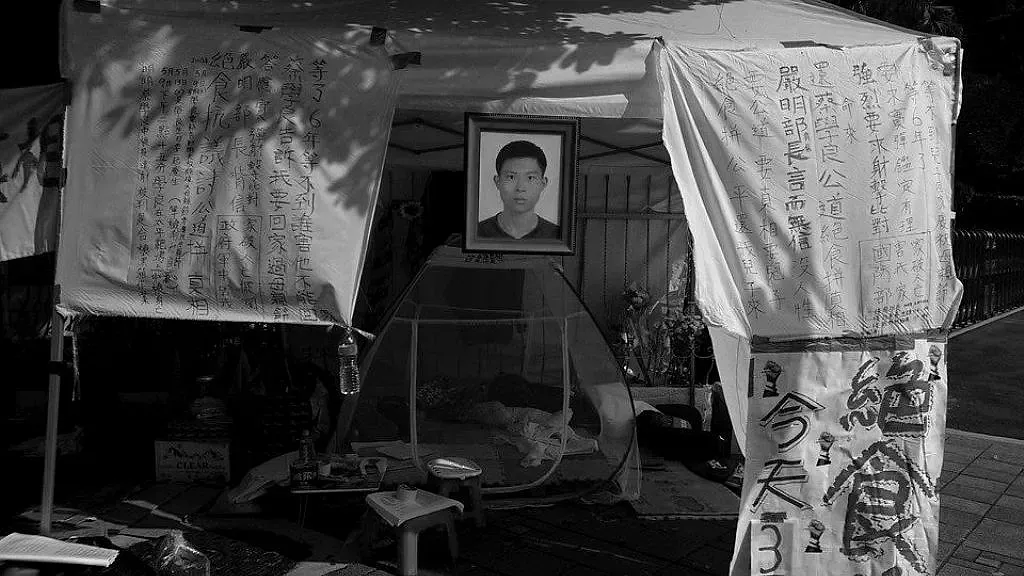
| 2014.5.11 | Ch'en's mother conducts a hunger strike protest in front of the Ministry of National Defense, demanding that the Ministry conduct live-fire testing to investigate the truth behind her son's death. Hu Shih-ho (uncle of Hung Chung-chiu) and Taipei mayoral candidate Ko Wen-je also arrive at the scene to show support. |
| 2014.5.13 | At noon, Ch'en's mother is temporarily hospitalized due to physical malaise. The 1985 Citizens Alliance also holds the "May 13 Hsueh-liang Memorial Vigil" on the evening of the same day, calling on society to care about this case. |
| 2014.6.9 | Forensic pathologist Pan Chih-hsin testifies in court at the Taiwan High Court, pointing out that the gunshot wound in this case should have been caused by a high-velocity firearm. |
| 2014.8.11 | Central Police University Professor Meng Hsien-hui issues an appraisal report stating that the characteristics of the deceased's gunshot wound in this case are not inconsistent with those of a T65K2 rifle, and are distinctly differentiated from handgun gunshot wound characteristics. |
| 2014.10.7 | Professor Li Chun-i of the National Taiwan University Graduate Institute of Forensic Medicine, alongside Ch'en's mother and Legislator Hsu Chih-chieh, holds a press conference pointing out multiple doubts in the previous appraisal reports of this case and proposes a second test-firing method, suggesting that an entry wound flame burn mark test of the T65K2 rifle should be conducted to clarify the truth. |
| 2014.11.25 | The JRF forms a pro bono legal team to accept the commission and assist the family with the litigation. |
| 2015.4.15 | The Taiwan High Court rules that the Ministry of National Defense shall pay NT$1,480,073 to Ch'en Hsueh-liang's family, concluding without any test-firing experiments that Ch'en Hsueh-liang died from an accidental firearm discharge. (Refer to Taiwan High Court Civil Judgment 102-Shang-Kuo-12) |
| 2015.5.7 | The civil state compensation case is appealed to the third instance. |
| 2015.7.9 | The third-instance appeal of the civil state compensation case is dismissed, finalizing the judgment. |
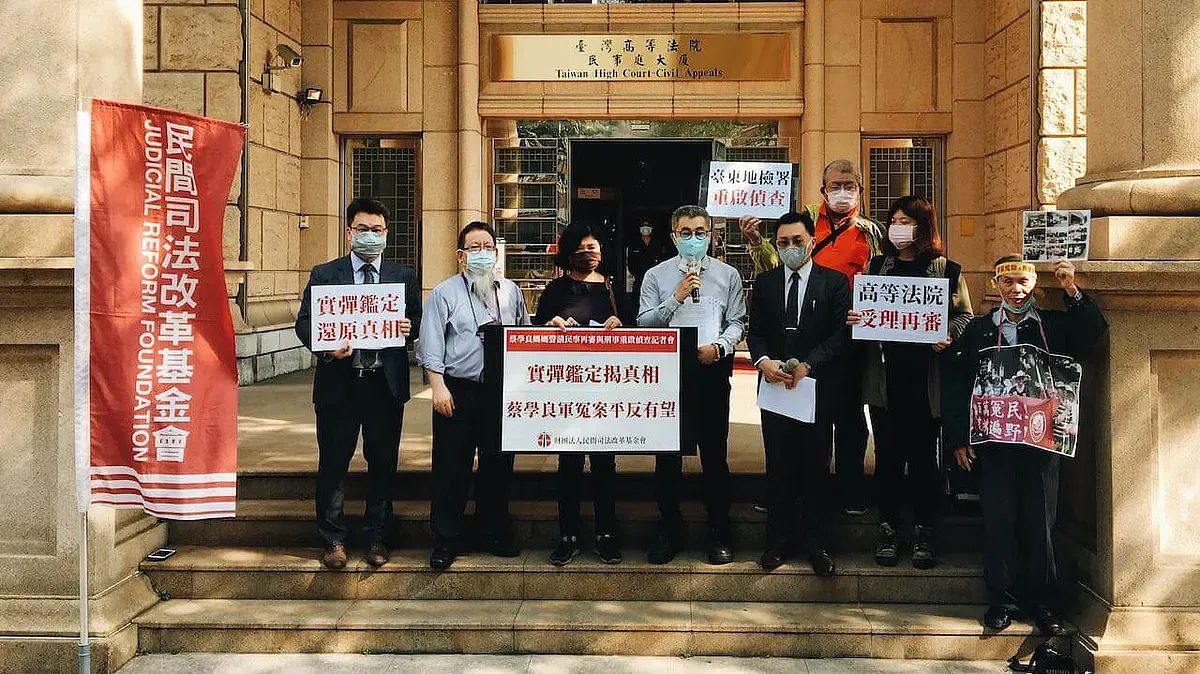
2020
Live-Ammo Ballistic Analysis Reveals the Truth, Bringing Hope for Vindication in the Tsai Hsueh-liang Military Injustice Case: Press Conference on Filing for Civil Retrial and Criminal Reinvestigation
On May 9, 2008, Air Force Sergeant Tsai Hsueh-liang was found shot to death at the Taiping Firing Range in Taitung…
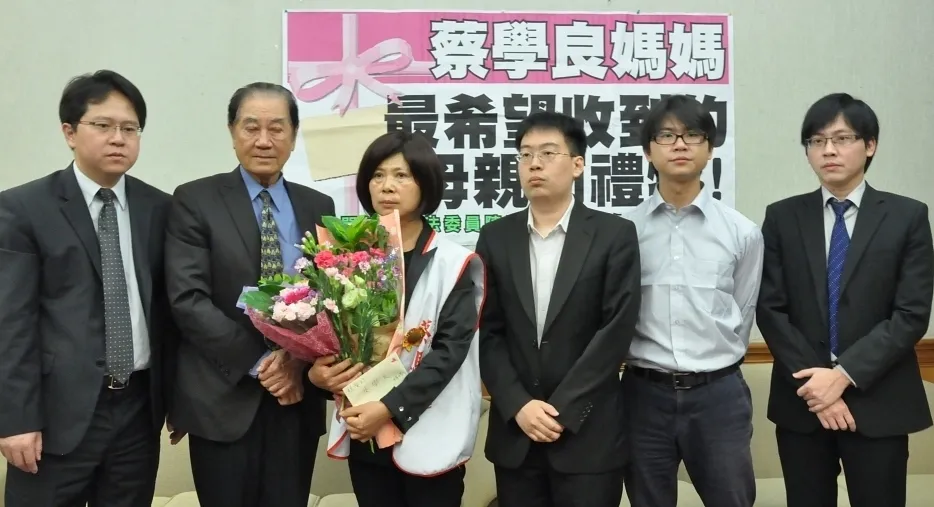
2015
Seeking Truth and Reconciliation: A Mother's Plea for Justice in the Tsai Hsueh-liang State Compensation Appeal — Press Conference on the Third-Instance Appeal
At noon on May 9, 2008, Air Force Sergeant Tsai Hsueh-liang called his mother, promising to return home the day after…
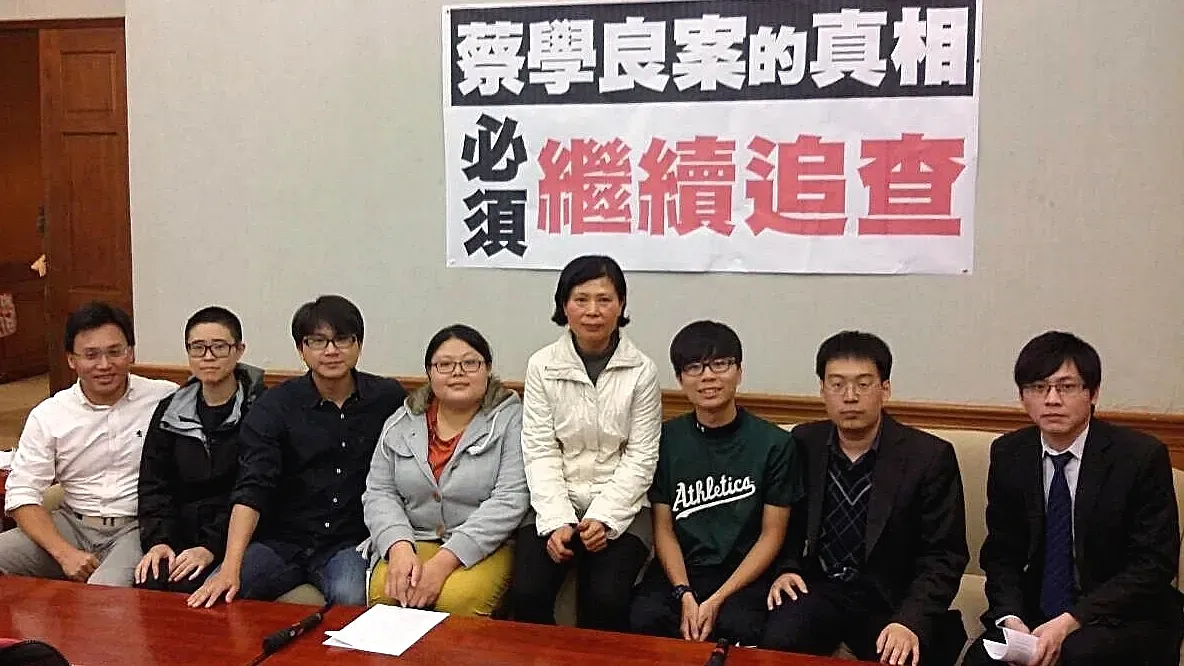
2015
A Place in Our Hearts for Tsai Hsueh-liang
Air Force Sergeant Tsai Hsueh-liang died from a gunshot wound at a shooting range, and his family has been seeking the…
2015
Defending Accountability in Military Fatalities: Pro Bono Legal Defense Team Statement on the Partial Victory in the Tsai Hsueh-liang State Compensation Judgment by the Taiwan High Court
Regarding the Taiwan High Court's Judgment Today (April 15) Ruling in Partial Favor of the State Compensation Claim in…
2015
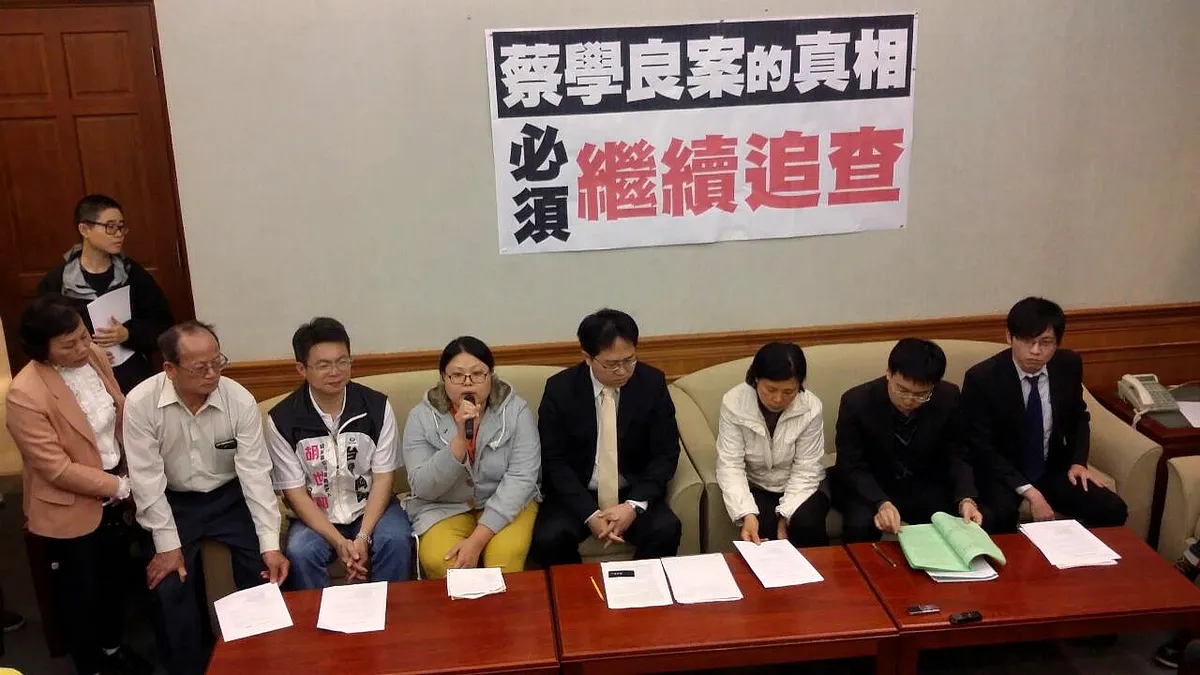
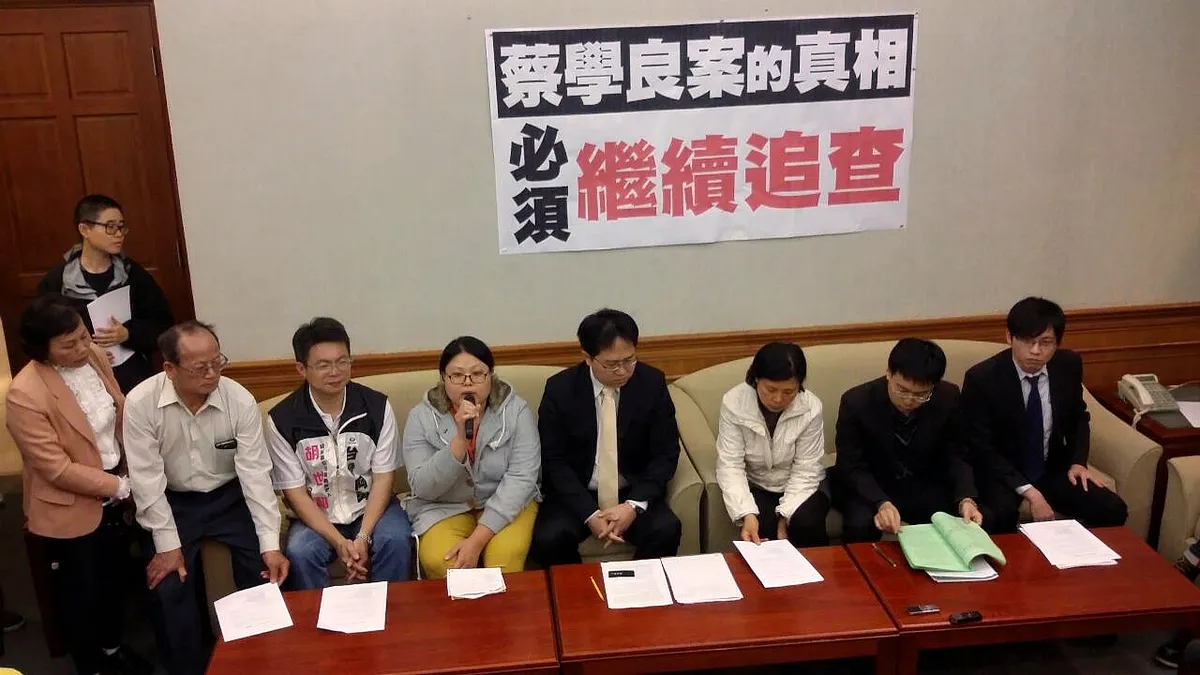
The truth behind the Tsai Hsueh-liang case must continue to be investigated — Press Conference on the Ministry of National Defense ordered to pay NT$1.48 million in compensation in the Tsai Hsueh-liang case.
At 11:00 AM today (April 15), the Taiwan High Court delivered the judgment in the case concerning Air Force Staff…
2015
Court Observation on the Tsai Hsueh-Liang Case: Pistols, Rifles, and Expert Witnesses
At the next hearing, the court will summon Forensic Pathologist Wu Mu-jung holding a Master's degree from the National…
2014
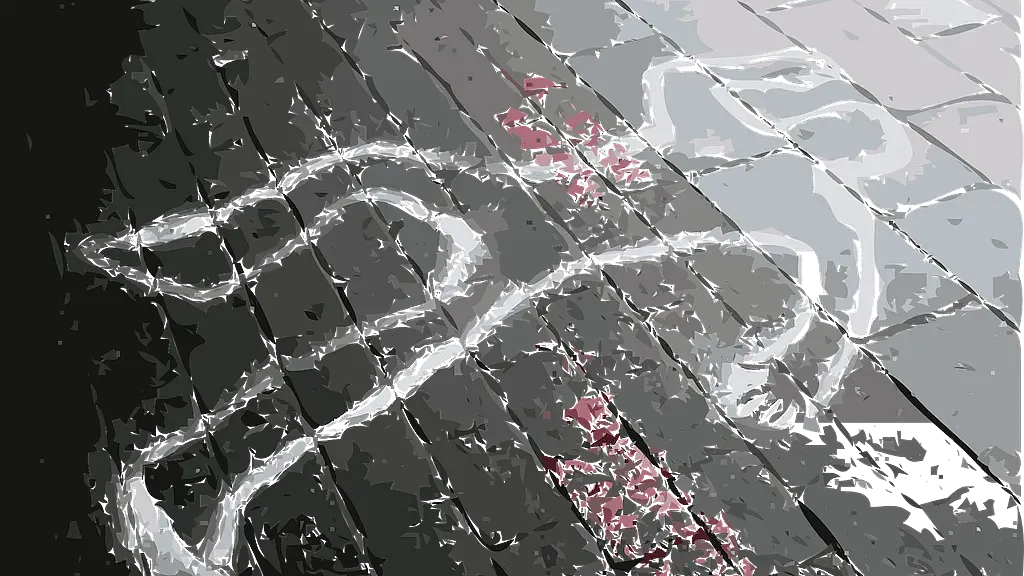
Crime Scene Reconstruction is Mother Ts'ai's Right
This Mother's Day, a mother launched an indefinite hunger strike in front of the Ministry of National Defense. She is…