
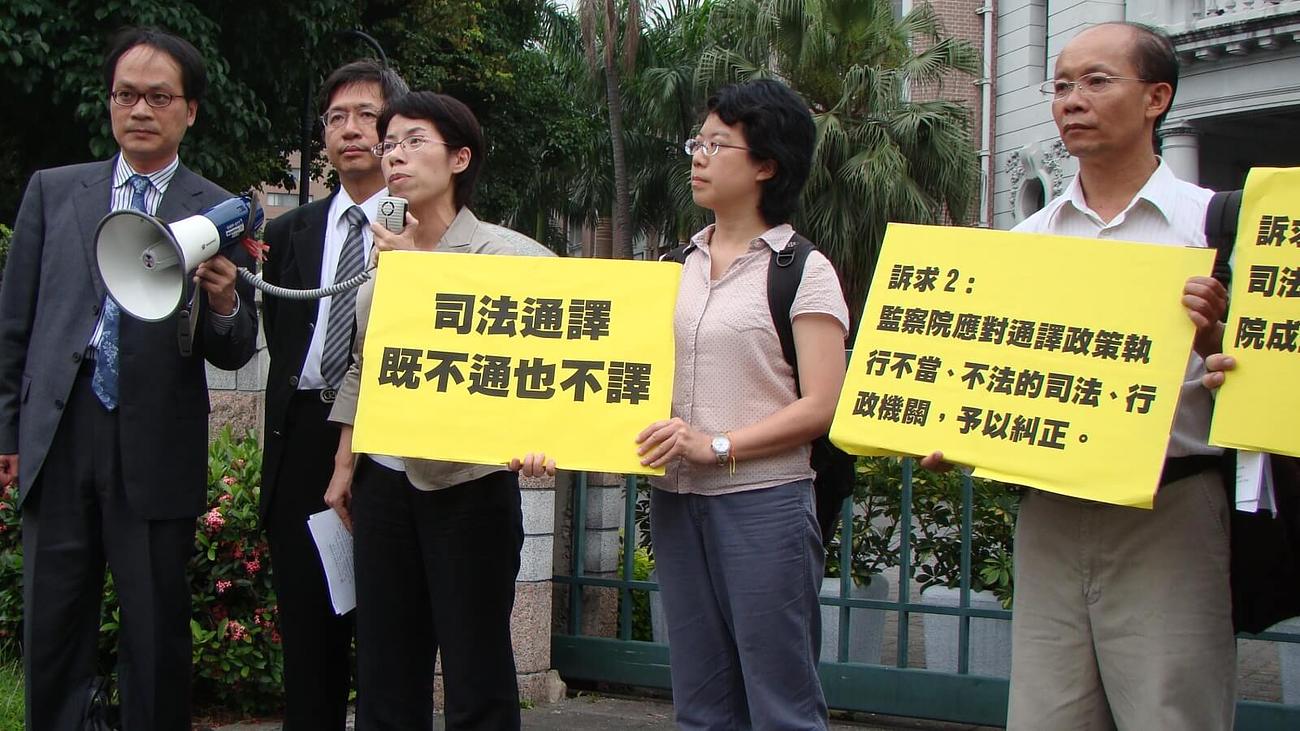
Court Interpreter System Reform
National Human Rights Commission Releases Special Report on Court Interpretation and Appointed Defense
On March 31, 2026, the National Human Rights Commission released its special report, Equal Access to Justice: Taiwan's Court Interpretation and Appointed Defense Systems, a comprehensive review of how these two systems currently operate and the structural problems they face. The report finds that parties who face language barriers or lack resources still commonly encounter real obstacles to accessing justice in criminal proceedings, which impairs their right to defend themselves and may undermine the right to a fair trial. Under Article 14 of the International Covenant on Civil and Political Rights (ICCPR), the State is obliged to ensure that everyone is tried in proceedings they can understand and with effective legal representation.
Accurate and Effective Interpretation Is a Basic Human Right
How can a party who cannot understand what the judge, the prosecutor, the lawyers, or anyone else in the courtroom is saying or asking fully explain themselves and mount a defense?
Should only those who speak the language of this country have the chance to speak up for themselves and for justice?
When a person stands in a courtroom unable to understand a single word being said, are the scales of justice not tilted from the very start? Such a person has no chance to fully express their views, assert their rights, or even understand what is happening in the courtroom.
Article 14, Paragraph 3 of the ICCPR sets out the minimum guarantees to which every person charged with a criminal offence is entitled, including: "(a) To be informed promptly and in detail in a language which he understands of the nature and cause of the charge against him; (b) To have adequate time and facilities for the preparation of his defence and to communicate with counsel of his own choosing; ... (f) To have the free assistance of an interpreter if he cannot understand or speak the language used in court."
Article 98 of Taiwan's Court Organization Act likewise provides: "Where a party to the proceedings, a witness, an expert witness, or any other person concerned does not understand the national language, an interpreter shall interpret."
When a person does not understand the language used in court, the right to accurate and effective interpretation is indispensable to a fair trial. Having an interpreter present is therefore crucial, and so is the ability to request one proactively. This is a basic human right enshrined in the two Covenants (the ICCPR and the ICESCR) and an inherent obligation of the State.
Problems with the Current Interpretation System
JRF's attention to interpretation issues grew out of its long-running court observation program. Court observers found that court interpreters were often able neither to translate nor to communicate. Some could not even make themselves understood in Taiwanese or Hakka, languages commonly used in Taiwanese society. In practice, interpreters in the courtroom did little more than press the record button or hand over exhibits, and some even threw their weight around, acting more imperiously than the judges.
Insufficient Language Coverage
Some languages—including Portuguese, which Article 3 of the Regulations on the Engagement of Contracted Court Interpreters expressly requires courts to recruit for, as well as languages previously covered, such as Hindi and Yunnanese—have not been maintained because there are too few interpreters with legal expertise. As a result, courts must hire ad hoc interpreters.
Statistics on Languages Covered and Number of Contracted Interpreters on the Roster
| 2017 | 2021 | |
| Number of Languages | 20 | 232 |
| Number of Contracted Interpreters on the Roster | 21 | 271 |
Source: Control Yuan, 2021 Final Accounts Report
Feedback and Evaluation Forms on Contracted Interpreter Services Are Not a Reliable Reference
From January to August 2021, courts used interpreters in a total of 5,756 cases. The table below shows how many feedback and evaluation forms were collected and reported. Notably, some courts did not report all of their forms, while others reported more forms than they had collected, so the data are not entirely reliable.
Statistics on Collection and Reporting of Feedback and Evaluation Forms on Contracted Interpreter Services
| Feedback Form | Evaluation Form | |
| Forms Collected | 222 | 1,596 |
| As a Percentage of Interpreted Cases | 3.86% | 27.73% |
| Forms Scanned and Reported or Submitted Online | 135 | 1,300 |
| As a Percentage of Forms Collected | 60.81% | 81.45% |
Source: Control Yuan, 2021 Final Accounts Report
Staff Shortages and Conflicts of Interest
Because court interpreters sometimes cannot do their job, when interpretation is genuinely needed, the foreign affairs police officers who made the arrest end up interpreting for the very defendants they arrested, social workers accompanying parties to court act as ad hoc interpreters, and brokers are even allowed to interpret for migrant workers. This violates the interpreter's duty of impartiality and neutrality, and brokers may have interests that conflict with those of the migrant workers they place. These practices are in urgent need of reform.
Quality of Interpretation
At a forum on the interpretation system that JRF held at the end of 2021, a panelist noted that interpreters sometimes add to or omit parts of the questions based on their own judgment, so that migrant workers may not receive what the judge or prosecutor actually meant. In courts, law enforcement agencies, police stations and substations, or the National Immigration Agency, interpreters may convey their own version of a question to the party and then answer according to their own understanding. Some interpreters, worried that the answer will miss the point or that taking too long will draw criticism, paraphrase questions or answers in their own words. Such practices seriously undermine the quality of interpretation.
Furthermore, most interpreters translate only when the judge or prosecutor is questioning the defendant. Properly speaking, however, the entire court proceeding should be fully interpreted for the defendant. Otherwise, except when it is their turn to speak, defendants are like orphans in the courtroom, with no way of knowing what is going on.
Fragmented Systems and Resources
Taiwan has no established system for training interpreters, and there are no unified standards for training, certification, or evaluation. Within the government alone, there are two separate systems for contracted interpreters—the Ministry of the Interior's interpreter database and the courts' engagement regulations—each with different qualification requirements.
To be listed in the Ministry of the Interior's interpreter database, a person need only complete training and pass an examination offered by a government agency, a university, or a civil society organization and obtain a certificate. The courts' Regulations on the Engagement of Contracted Court Interpreters set stricter requirements and a higher threshold: applicants must pass a document review by the court and attend court-run classes, including an overview of court operations, basic legal knowledge, and trial procedure, as well as courses on professional skills and ethical responsibilities. Courts may also add course hours, and once an interpreter qualifies, the listing in the court database is valid for only two years. However, a person who registers in different regions is treated as a different individual in the database, so that one-third of the names on the roster for a given language are duplicates. This shows that the database does not properly verify the identity of those who register.
What the Government Has Done
During the 2017 National Congress on Judicial Reform, seven resolutions were adopted on court interpretation, including increasing funding for interpreter training, administering language proficiency tests at all levels, and establishing a database of court interpreters, as part of a gradual reform of the interpretation system. However, many problems remain:
- Interpreter rosters are currently scattered across the Judicial Yuan and various ministries, making it hard for parties to find relevant information. Agencies should pool their staff and resources so that the information is available in one place on the website of the Judicial Yuan or the Ministry of Justice, making it easier for the public to look up.
- Comprehensive training and certification standards should be put in place—covering in particular legal terminology, specialized vocabulary, government procedures for handling relevant matters, and cultural differences—with uniform certification standards set by the Judicial Yuan, so that interpretation quality is not uneven and difficult to oversee.
- Given the diversity of Taiwanese society, the Judicial Yuan's official website should be available in multiple languages, and the information provided should be consistent across all language versions.
- Multilingual post-service feedback forms should be developed, so that feedback and evaluation forms in the parties' native languages can be used to understand how interpretation services are actually working for them.
- Laws establishing a comprehensive recusal system and code of ethics for interpreters should be enacted, to prevent unscrupulous brokers from interpreting for foreign nationals to their detriment.
2024
Statement | Civil Society Press Conference Following the ICERD Initial State Report Review
Since 2006, Taiwan has primarily relied on the contracted interpreter system to handle judicial cases involving migrant…

2023
Judicial Interpretation Information and Document Compilation
Since the 2017 National Congress on Judicial Reform reached seven resolutions regarding the judicial interpretation…
2021
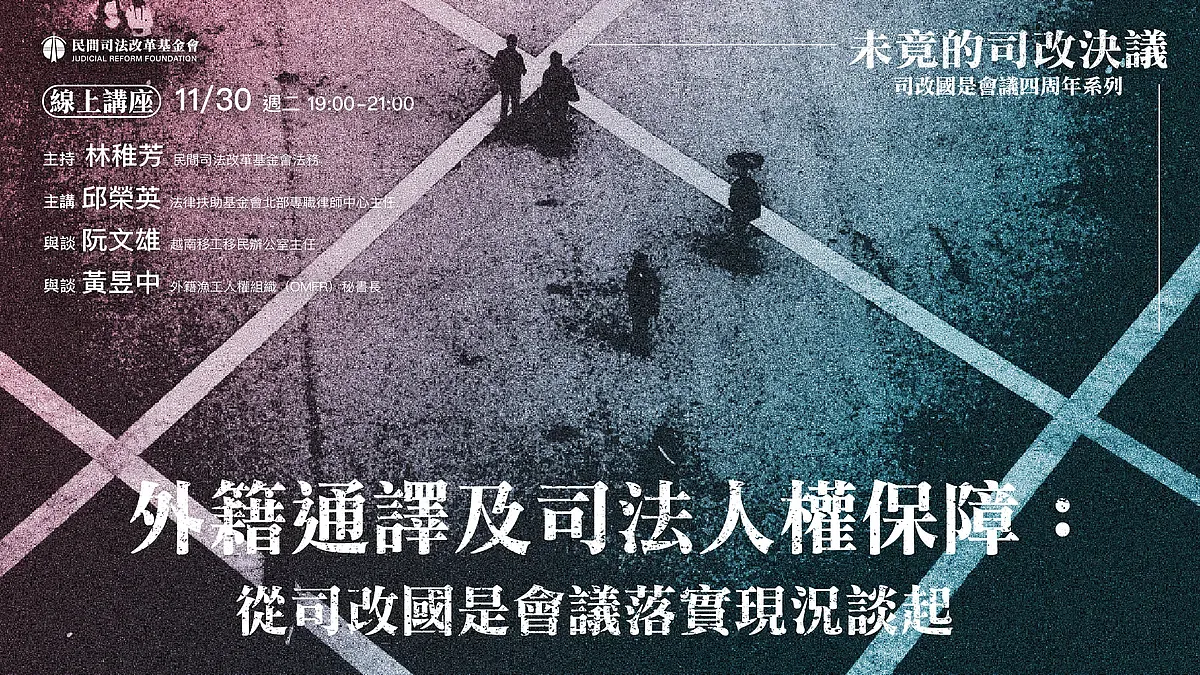
Seminar Transcript | Unfinished Judicial Reform Resolutions: Foreign Interpreters and Judicial Human-Rights Protection
Four years after the National Conference on Judicial Reform, practitioners and advocates review whether Taiwan has…
2010
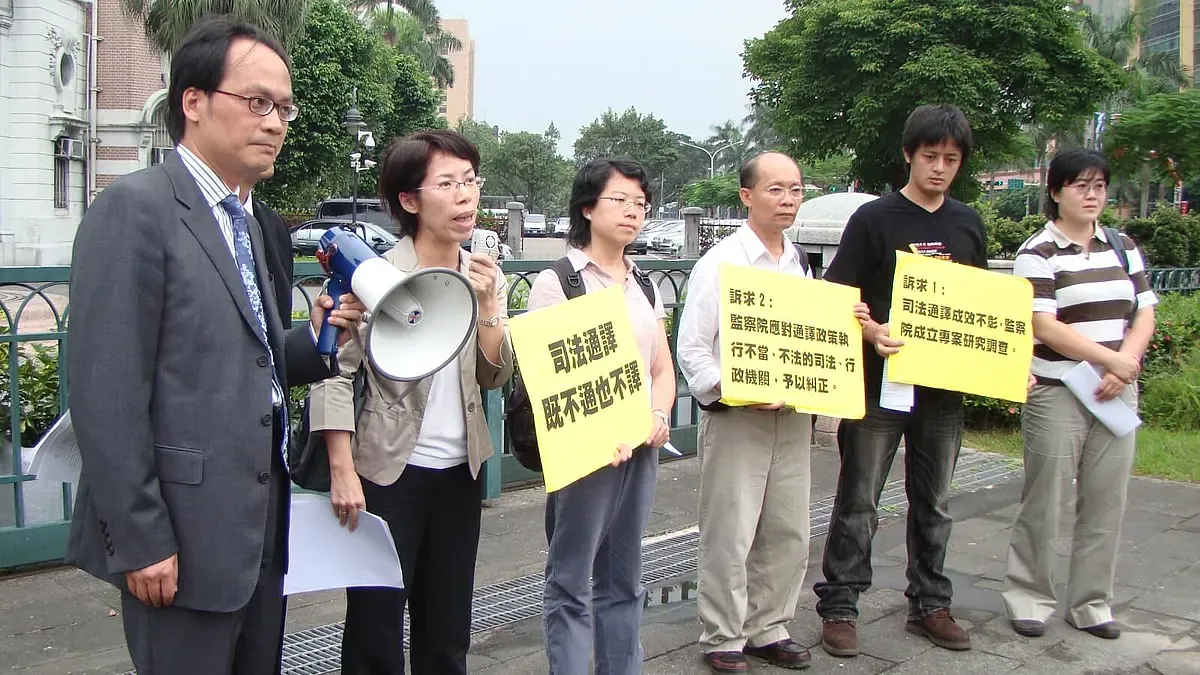
"Judicial Professionalism Promotion Alliance" Promotes Court Interpretation System and Visits Control Yuan
Recently, news regarding the abuse of foreign migrant workers by Taiwanese people—such as the inhumane treatment of…
2008
A Cold-Eyed Perspective on the Courtroom Kaleidoscope: Court Observation Records of the Aimiyar Case
The Aimiyar case may not be a homicide case that garnered exceptional public attention in Taiwan. However, due to…
2007
Recognizing Vulnerable Individuals in Legal Proceedings
According to news reports, Lin, a totally blind student at The Affiliated Senior High School of National Kaohsiung…
2006
Establishing an Independent Interpreters Association
The Judicial Reform Foundation, together with Awakening Foundation, Rerum Novarum Center, Hope Workers' Center, Taiwan…

2006
Chicken Talking to a Duck: Arguing Reason and Might—Where is the Court Interpreter Headed?
Diversity without integration is a major cause of conflict among ethnic groups. So-called "Mainland brides,"…

2006
Court Interpreters: Just for Show?—Imbalanced Justice Under Linguistic Hegemony
Whether teaching "Law and Society," "Gender and Law," or other legal courses, I always arrange a "Court Visit." The…

2006
The Function and Definition of Court Interpreters
From a legal perspective, Taiwan currently lacks a unified certification system for professional court interpreter…

2006
Preparing for a New Immigrant Nation
Taiwan has a history of over a decade of importing large numbers of international laborers to sustain its…

2006
The Ethics of Court Interpreting—The Importance and Responsibilities of Court Interpreters
As stated by the U.S. court in Arizona v. Natividad, "To be violently hurled against an unfeeling object, as it were,…