
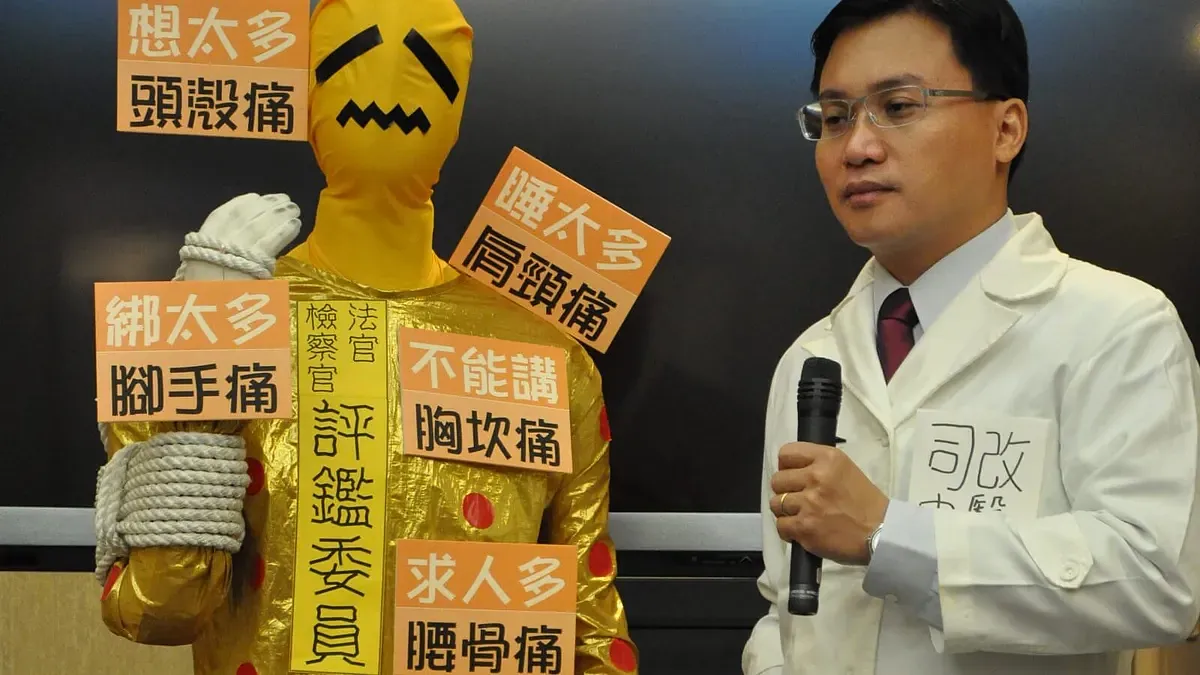
Who Messed Up the Judgment? The Judges Act Combat Manual: Judgment Search Edition
Last edited: 2026-08-25
Poor judgment quality has always been a source of public grievance against the judiciary. On May 30, 2012, the Judicial Yuan for the first time severely penalized a judge by dismissing them from office on the grounds of sloppy copy-pasting in a judgment. The Judicial Yuan's determination to improve judgment quality is commendable and deserves support. This article introduces six essential judgment search techniques. When utilized effectively, they not only safeguard personal rights when errors occur in judgments, but also effectively monitor judgment quality and assist judicial authorities in weeding out incompetent judges.
Copy-Pasting Judgments Online Results in Dismissal of Slacking Judges
Judge A of the Kaohsiung District Court was unable to write a judgment and instead searched online for a judgment involving the same monetary amount, which they then copied and pasted to fake it. After receiving the judgment, the parties involved could not write their grounds for appeal because the contents of the judgment were entirely unrelated to their case, and they indignantly filed a report. In fact, judges randomly copy-pasting judgments is not uncommon. In legal practice, this practice—where a judgment cannot be written in time, so a judgment from another case is copied and pasted online to report the case closed, after which the judge hurriedly writes the actual judgment and has the clerk swap the pages—is known as "supplementing a nutritional sheet." In this case, Judge A did not even swap the pages after copy-pasting and was a repeat offender. To crack down on the bad habit of judges randomly copy-pasting judgments, the Personnel Review Committee of the Judicial Yuan set a precedent by resolving to dismiss Judge A from office, temporarily reassigning them as a judicial affairs officer, and referring the entire case to the Disciplinary Court for further deliberation.
Search Technique (1): Design Keywords and Full-Text Search Terms
For searching judgments, it is recommended to use the "Judgment Search" and "Simple Case Search" features on the Judicial Yuan's Law and Regulations Retrievals System, which are free, convenient, and effective. Among them, the most useful function is the "Full-Text Search Term." By simply entering keywords, you can find judgments containing the same keywords. Taking Judge A's case as an example, the parties only needed to set the content in the judgment unrelated to the case as keywords and enter them into the "Full-Text Search Term" for a query. If they found a judgment with completely identical keywords and confirmed the source of the copy-paste, they could use it to report Judge A for cheating.
The following are a few suggested methods for setting keywords to achieve effective queries:
-
Judgment Case Numbers and Cited Legal Provisions
Relevant judgment case numbers appearing in the judgment, such as the indictment case number, the first-instance judgment case number, the Supreme Court precedent and judgment case numbers, as well as the article numbers of cited legal provisions, can all be used as keywords for searching. -
Crime Scene Address, Time, and Modus Operandi
Addresses, times of the incident, and modi operandi related to the case appearing in the judgment are very suitable for use as search keywords. -
Names of Involved Persons, Companies, and Matters
Names appearing in the judgment, such as plaintiffs, defendants, witnesses, police officers, expert witnesses, company names, and names of organizations and institutions, can all be set as keywords.
Search Technique (2): Identify Erroneous Judgments and Health-Check Judicial Quality
When an error occurs in a judgment, the court remedies it through a "Ruling on Correction" (裁定更正). Therefore, by simply performing a full-text search using "Ruling on Correction" as the keyword, you can view all sorts of bizarre erroneous judgments. For friends using the Judicial Yuan's Law and Regulations Retrievals System for the first time, it is also recommended to practice search skills using this keyword while health-checking judicial quality. The steps are as follows:
- [Court Name] Select "Taiwan High Court" (other courts may be selected arbitrarily)
- [Judgment Category] Select "Criminal" (other categories may be selected arbitrarily)
- [Full-Text Search Term] Enter "Ruling on Correction"
- Click [Search]

At this point, thousands of judgments will be retrieved. Please click on any [Judgment Number]. Judgment errors and correction contents will be recorded in the "Main Text" (主文) of the judgment. Common contents include:
- Errors in recording the names and ages of the parties.
- Errors in citing legal provisions.
- Errors in recording the sentence or monetary amount in the main text.
It is worth noting that there have actually been cases where members of the public received a copy-pasted, erroneous judgment, and subsequently received a correct version of the judgment. However, the judge never issued a ruling on correction; instead, they directly swapped the physical judgment paper inside the case file and directly modified the content of the judgment on the Judicial Yuan's Law and Regulations Retrievals System website (102nd Year Ping-Tzu Resolution No. 2).
Errors in judgments are mostly unintentional, but some judicial personnel commit them repeatedly or privately swap judgments to conceal their mistakes. Members of the public who discover unfit personnel are welcome to file reports.
Search Technique (3): Query Similar Cases Using Judgment Causes
A complainant once called in, very angry, saying they had encountered a dinosaur prosecutor: their house accidentally caught fire while worshipping ancestors, and since they were clearly the victim, how could the prosecutor indict them for the crime of public endangerment. To help the complainant understand the core of the issue, it is recommended to search judgments using the "Judgment Cause" (判決案由). The method is as follows:
- [Court Name] Select "Kaohsiung District Court" (any competent court of jurisdiction may be selected)
- [Judgment Category] Select "Criminal"
- Enter "Public Endangerment" in [Judgment Cause]
- Enter "Worship Ancestors" in [Full-Text Search Term]
- Click [Search]
After reading the judgment, this citizen sheepishly said they had no idea there were so many cases indicted for fires caused by ancestral worship, and now they understood that the crime of public endangerment penalizes such behavior. This example shows that by querying judgment causes, one can find similar cases in legal practice and understand the typical handling by courts in litigation cases involving oneself. The following examples are provided for readers to practice search skills: (Please first select the competent court of jurisdiction for your location)
- [Judgment Category] "Criminal" + [Judgment Cause] "Negligent Injury" + [Full-Text Search Term] "Traffic Accident"
- [Judgment Category] "Civil" + [Judgment Cause] "Debt Restructuring Event" + [Full-Text Search Term] "Mediation Unsuccessful"
- [Judgment Category] "Administrative" + [Judgment Cause] "Business Tax" + [Full-Text Search Term] "Failure to Issue Receipt"
Search Technique (4): Make Good Use of Logical Operators to Unleash Full Search Firepower
Beginners searching for judgments are often troubled by finding too many irrelevant judgments, requiring a lot of time to find truly reference-worthy ones. The solution is actually hidden in the "Help Description" next to the full-text search term field. As it turns out, the Judicial Yuan Judgment Search System supports four sets of logical operators: "+", "-", "&", and "( )" (please go online to click on the official explanation). Making good use of these four sets of logical operators allows you to precisely find reference-worthy judgments.
The following demonstrates the usage techniques of the most commonly used logical operators, "&" (AND) and "-" (NOT):
-
Search for Acquittal Judgments
Judgments obtained from general searches do not distinguish between guilty and not-guilty cases. If you are a defendant and only want to check not-guilty cases to reference successful experiences of others, taking traffic accident cases as an example, you can search like this in the district court: [Judgment Category] "Criminal" + [Judgment Cause] "Negligent Injury" + [Judgment Main Text] "Acquittal" + [Full-Text Search Term] "Traffic Accident"
If it is a case appealed to the high court, searching this way will be more precise:
[Judgment Category] "Criminal" + [Judgment Cause] "Negligent Injury" + [Judgment Main Text] "Acquittal&Original Judgment Quashed" + [Full-Text Search Term] "Traffic Accident"
-
Search for Specific Opposing Parties
Taking debt restructuring for credit card debtors as an example, if you want to understand the litigation strategy of a major creditor bank and find examples of successfully entering debt restructuring procedures, you can search like this: (Please enter the bank name; Citibank is used merely as an example) [Judgment Category] "Civil" + [Judgment Cause] "Debt Restructuring Event" + [Full-Text Search Term] "Mediation Unsuccessful&Citibank-Application Dismissed"
-
Search for Specific Legal Application Circumstances
The Grand Justices of the Judicial Yuan rendered Interpretation No. 685, declaring Article 44 of the Tax Collection Act unconstitutional. For companies and businesses wanting to understand how this interpretation is applied in courts, they can search like this: (Please select an administrative court with jurisdiction over your location) [Judgment Category] "Administrative" + [Judgment Cause] "Business Tax" + [Full-Text Search Term] "Failure to Issue Receipt&Interpretation No. 685"
If you still cannot find the judgment you are looking for no matter what, it is recommended to write to the Judicial Yuan Mailbox to inquire, and you will usually receive a reply very quickly. If there is an omission in publication, the Judicial Yuan will promptly supplement it.
Search Technique (5): Compare Judgment Text to Identify Where the Error Lies
Judge A's case drew public attention to the fact that judges also copy and paste from the internet when drafting judgments. In other words, most of the content in the judgments we receive is not original text, but rather a compilation of the prosecutor's indictment, the briefs of both lawyers, and the judge's mental reasoning. The general division of labor is as follows:
| Judgment Section | Responsible Party |
| Case number, names of parties, address... etc. | Judge |
| Main Text | Judge |
| Summary of Prosecution | Prosecutor, Plaintiff (Lawyer) |
| Summary of Defense | Defendant (Lawyer) |
| Facts and Reasons for Judgment | Judge |
| Instructional Recording at the End of Text, Appendices, and Attachments | Court Clerk |
If an error occurs in a judgment, by simply identifying which section the error occurred in, one can determine who messed up the judgment. Taking Judge A's case as an example, the error was in the reasons for the judgment, which is the judge's responsibility; therefore, it was the judge's fault. Another example is given below where the error was in the instructional notes at the end of the text, which is the responsibility of the court clerk; therefore, it was the court clerk's fault. By extension, one can know whom to hold accountable. When a judgment error occurs, if the problem lies with the judge, a "ruling" is used for correction; if it lies with the court clerk, a "disposition" is used for correction. The public can also distinguish whether the error belongs to the judge or the court clerk by whether they receive a ruling or a disposition.
Delayed Issuance of Finality Certificate Turns Guardian into Heir
Brother Ta-Ming applied to be reassigned as his father's guardian. This was approved and designated by the first-instance court, and the entire case became final on January 20, 2011, after the court dismissed the opposing party's re-appeal. However, the judgment received by both parties in this case stated at the end: "Except on the grounds that the application of laws and regulations is manifestly erroneous and with the permission of this court, this ruling may not be re-appealed. If a re-appeal is filed, it shall be submitted to this court within 10 days after receipt of service."
Upon receiving the judgment, Brother Ta-Ming immediately applied for the issuance of a certificate of finality, hoping to quickly bring his father home from the nursing home for care. To his surprise, the court delayed issuance, dragging it out until May 20 when he finally received the certificate of finality. By this time, his father had already passed away in the nursing home, leaving him heartbroken that his parent died before he could fulfill his duty of filial care.
Tracing the cause, Brother Ta-Ming discovered that the court clerk had mistakenly pasted a boilerplate template at the end of the judgment text; the correct template should have been "This case may not be re-appealed." The result of the clerk pasting the wrong template led the opposing party to mistakenly believe they could file a re-appeal. After receiving this illegal re-appeal, the court corrected it in accordance with the law via a court clerk's disposition document; the opposing party then filed a statement of objection in accordance with the law, and the court dismissed the objection in accordance with the law. Such back-and-forth resulted in Brother Ta-Ming being delayed for four months without reason before receiving the finality certificate, and his status changed from guardian to heir. For this reason, the court specifically apologized to Brother Ta-Ming and initiated state compensation proceedings.
As for how the public can confirm whether the judgment they received contains a wrongly pasted template, they can also use the judgment search system to inspect it. Taking Brother Ta-Ming's case as an example, by searching for judgments that similarly dismissed re-appeals against changing guardianship and comparing the instructional notes at the end of the text, if the judgment received has identical notes to other judgments, it is correct; if there are differences, the wrong template may have been pasted. It is recommended to promptly seek assistance from legal professionals to resolve the sequelae caused by the judgment error.
Search Technique (6): Query Historical Judgments of Judges, Prosecutors, and Counsel for Both Sides
Members of the public frequently call to inquire: Is a certain judge fair in trying cases? Is a certain prosecutor serious during trial? Is a certain lawyer professional? These are questions without standard answers and cannot be answered concretely. However, we are very willing to introduce a method for researching issues: utilizing the judgment search system to query the historical judgments of judges, prosecutors, and counsel for both sides.
Querying historical judgments is just like professional baseball or basketball games: although the game's outcome cannot be predicted, one can make a reasonable assessment of the strengths of both sides based on the past performance of players on the field, such as batting average, shooting percentage, defense rate, assist rate, etc. This method holds significant reference value; while it may not necessarily be accurate, it is absolutely authentic. The legal requirement that judgments must be transparent and public is precisely to demand that judicial personnel accept public supervision to ensure fairness and impartiality. Therefore, it is recommended that before and during litigation, members of the public input the names of the presiding judge, prosecutor, and lawyers for both sides into the judgment search system respectively, observing their actual performance of duties from the judgments of cases they participated in the past. The recommended key areas of observation are listed below:
-
Judges
From historical judgments with similar facts, observe what kind of judgment results the judge typically renders, the severity of sentencing, or the height of monetary amounts; one can also observe under what circumstances the judge will agree to applications to summon witnesses, commission expert evaluations, or conduct on-site inspections. In cases with similar legal disputes, the legal provisions, precedents, judgments, or academic opinions that the judge habitually cites are all worth observing. -
Prosecutors
From historical judgments with similar facts, observe the types of evidence presented by the prosecutor, evidence-gathering methods, and the presentation model of criminal facts. In cases with similar legal disputes, observe the legal basis the prosecutor habitually cites, as well as legal opinions on the evidentiary capability of witness testimony, physical evidence, expert evaluation, and other forms of evidence. It should be incidentally explained that in practice, prosecutors are divided into investigative prosecutors (responsible for investigating crimes) and public prosecution prosecutors (responsible for presenting arguments at trial). However, because indictments are currently not published online, it is not easy to identify in judgments which part of the legal opinions belongs specifically to the investigative prosecutor and which part belongs specifically to the public prosecution prosecutor. Therefore, at most, one can currently roughly summarize the characteristics of a certain prosecutor's office. -
Counsel for Both Sides
From the historical judgments handled by lawyers, observe their areas of expertise in practice, legal argumentation skills, winning or defense rates in handled cases, and whether they have handled cases or clients with conflicts of interest with your own.
Conclusion: Make Good Use of Judgment Searches to Lift the Veil of Judicial Mystery
Complex litigation procedures and abstruse legal terminology give the public an impression of the judiciary as both professional and mysterious. In fact, in an internet-developed Taiwan, through free public judgment search websites, one can have a firsthand look at the work of judges, prosecutors, and lawyers, lifting the veil of judicial mystery and leaving incompetent personnel with nowhere to hide.
Finally, readers are reminded: never assume that knowing how to query judgments means you can handle a lawsuit by yourself. When going to court, please be sure to seek professional legal assistance to effectively safeguard your rights and interests.
This article is an AI-generated translation of the original Chinese text. In the event of any discrepancy, the Chinese version shall prevail.