
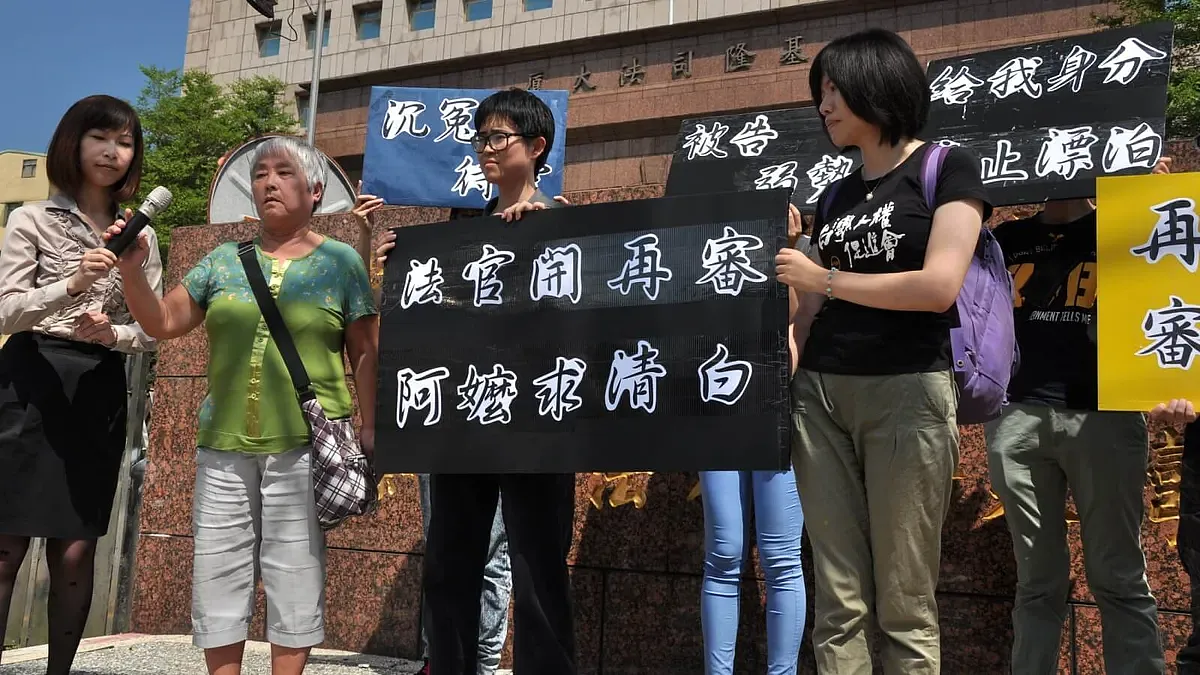
Disciplining Judges and Prosecutors, and Redressing Wrongful Convictions! The Judges Act Manual: Retrial
Last edited: 2026-08-25
The Judges Act provides the legal basis for disciplining judges and prosecutors. If the grounds for discipline are sufficient to impact the outcome of a specific case—such as corruption, bribery, lobbying/influence-peddling, or the abuse of discretionary power—victims of wrongful convictions or erroneous judgments may apply for a retrial in accordance with the law to clear their names. The relevant legal bases are summarized in the table below:
| Name of Law | Provisions | Time Limits | Application Restrictions |
| Article 420, Paragraph 1, Subparagraph 5 of the Code of Criminal Procedure (Applying for a retrial in the interest of the convicted person) | After a judgment of conviction has become final, if any of the following circumstances exists, a retrial may be applied for in the interest of the convicted person: (5) A judge who participated in the original judgment, the prior instance judgment, or the investigations conducted prior to the judgment, a prosecutor who participated in the investigation or prosecution, or a prosecutor's investigator, judicial police officer, or judicial police who participated in the criminal investigation, has been proven to have committed an official crime in connection with the case, or has received a disciplinary sanction for illegal and derelict conduct in connection with the case, which is sufficient to affect the original judgment. | None | Limited to cases where a final judgment has been rendered, or where criminal proceedings cannot be initiated or continued for reasons other than insufficient evidence. |
| Article 422, Paragraph 1, Subparagraph 1 of the Code of Criminal Procedure (Applying for a retrial to the detriment of the convicted person) | After a judgment of conviction, acquittal, dismissal of prosecution, or non-acceptance has become final, if any of the following circumstances exists, a retrial may be applied for to the detriment of the convicted person: (1) Any of the circumstances set forth in Subparagraphs 1, 2, 4, or 5 of Article 420. | Such an application shall not be made after half of the period prescribed in Article 80, Paragraph 1 of the Criminal Code has elapsed following the finality of the judgment. | To be initiated by the prosecutor of the competent court and the private prosecutor. |
| Article 496, Paragraph 1, Subparagraph 7 of the Code of Civil Procedure | A final and binding judgment may be challenged by filing an action for a retrial if any of the following circumstances exists; provided, however, that this shall not apply if a party has already asserted the ground through an appeal or knew of the ground yet failed to assert it: (7) The judge who participated in the adjudication committed a criminal offense regarding official duties in that litigation, or received a disciplinary sanction for breaching official duties in that litigation, which is sufficient to affect the original judgment. | To be filed within a non-extendable period of 30 days starting from the time of awareness; provided, however, that no such action may be filed if 5 years have elapsed since the finality of the judgment. | Limited to cases where a judgment of conviction or a ruling imposing a fine has become final, or where a final judgment of conviction or final ruling of a fine cannot be rendered for reasons other than insufficient evidence. |
| Article 273, Paragraph 1, Subparagraph 7 of the Administrative Litigation Act | The judge participating in the adjudication committed a criminal offense in violation of official duties regarding the litigation. | To be filed within a non-extendable period of 30 days starting from the time of awareness; provided, however, that no such action may be filed if 5 years have elapsed since the finality of the judgment. | A retrial is permissible only when the judge has been convicted by a final judgment for violating official duties regarding the litigation; a retrial may not be initiated based solely on a disciplinary sanction. |
For Criminal Proceedings, Retrials Should Be Applied for First, Not Extraordinary Appeals
In 2010, the "Judge lobbying for son, changing guilty to innocent" case broke out. Supreme Court Judge Hsiao Yang-kuei (蕭仰歸), who engaged in lobbying, and Taiwan High Court Judge Kao Ming-che (高明哲), who was lobbied, were given disciplinary sanctions of suspension from office and demotion, respectively, by the Disciplinary Committee for Public Functionaries on January 28, 2011. As for the defendant who was acquitted due to the illegal favoritism of his elders, the Prosecutor-General filed an extraordinary appeal to overturn the acquittal, uphold judicial justice, and redress the victim.
However, the Supreme Court dismissed the extraordinary appeal on June 30, 2011, in Ruling 100-Tai-Fei-Zi-No. 179. The reasoning stated: "The core purpose of the extraordinary appeal system is to make a fair and reasonable consideration, weighing human rights protection, circumstances of illegal judgments, and the functions of the litigation system. Except where it relates to the uniform interpretation of laws, or where the judgment is unfavorable to the defendant and failure to provide relief would be insufficient to safeguard human rights—if the original judgment is not unfavorable to the defendant and does not involve the uniform interpretation of laws, or even if it is unfavorable to the defendant, but there are other avenues of relief available without prejudice to the defendant's interests—there is no necessity to file an extraordinary appeal." It emphasized that extraordinary appeals cannot be brought to the detriment of the defendant; that is, extraordinary appeals cannot be used to change an acquittal into a conviction. Furthermore, if other avenues of relief exist, an extraordinary appeal may not be filed.
Therefore, when encountering wrongful convictions or erroneous judgments caused by unscrupulous judicial officers, an application for a retrial should be prioritized in criminal proceedings rather than an extraordinary appeal. Taking the Hsiao case as an example, the prosecutor should have applied for a retrial with the Taiwan High Court to be legally proper. Because this unique view held by the Supreme Court can confuse even the Prosecutor-General, it is necessary to spell this out specifically so that the public does not repeat past mistakes and waste litigation procedures.
Summary of the Disciplinary Committee for Public Functionaries Resolution (100-Chien-Zi-No. 11895)
Main Text: Hsiao Yang-kuei is suspended from office for a period of six months. Kao Ming-che is demoted by two grades and re-ranked.
II. The act of subject of disciplinary action Kao Ming-che in being lobbied and lobbying on behalf of others:
The subject of disciplinary action Kao Ming-che was a judge of the Taiwan High Court. During his trial of Hsiao Hsien-lun's hit-and-run case (from November 24, 2009, to January 19, 2010), on a certain day before the end of 2009 at an unknown location, he was lobbied by fellow subject of disciplinary action Hsiao Yang-kuei, who requested that the first-instance guilty verdict and its accompanying probation ruling be revoked and changed to an acquittal. Consequently, on January 5, 2010, Kao Ming-che accompanied assigned judge Kao Yu-shun to open a trial session. While walking through the court's secret corridor (exclusively used by judges attending court sessions), Kao Ming-che told Kao Yu-shun that the defendant in the case was the son of fellow subject of disciplinary action Hsiao Yang-kuei and expressed his hope that an acquittal could be rendered. On the same day, subject of disciplinary action Kao Ming-che, Lin Chou-fu, and Kao Yu-shun deliberated in the Taiwan High Court judges' office. Kao Yu-shun expressed his opinion first, holding that the evidence in the case was clear and definite, and the first-instance guilty verdict should be upheld. However, subject of disciplinary action Kao Ming-che stated that the defendant was the son of fellow subject of disciplinary action Hsiao Yang-kuei, and that Hsiao Yang-kuei had approached him. Kao Yu-shun initially stated that the donation portion attached to the probation declaration in the first-instance judgment could be revoked. Subject of disciplinary action Kao Ming-che unexpectedly stated, "He (referring to Hsiao Yang-kuei) does not want this! He wants an acquittal." As the two held their ground, Kao Yu-shun drafted a guilty judgment dismissing the appeal according to his own views. Subject of disciplinary action Kao Ming-che separately drafted a judgment revoking the original judgment and changing it to an acquittal. Subsequently, accompanying judge Lin Chou-fu signed the judgment changing it to an acquittal, finalizing it by a two-to-one deliberation vote to revoke the original judgment and grant an acquittal. After service upon the parties, the prosecutor of the Taiwan High Court Prosecutor's Office did not appeal, and the case became final. With the consent of subject of disciplinary action Kao Ming-che, Kao Yu-shun bound the originally drafted judgment dismissing the appeal into the deliberation record as a dissenting opinion.
For Civil Proceedings, Pay Attention to the 30-Day Non-Extendable Period
In 1988, a serious judicial misjudgment occurred in the civil division of the Taipei District Court. The origin was a land ownership registration case in which the presiding judge, Tseng Te-shui (曾德水), ruled upon the plaintiff's application that the defendant should transfer the plot of land to the plaintiff. The problem was that the presiding judge was remiss in failing to require the parties to submit a land registration transcript for verification, because the defendant in this case was not the actual owner of the land at all—someone else was. When encountering such a situation, the judge should have dismissed the plaintiff's action as "groundless"; however, Judge Tseng Te-shui failed to discover this, continued the proceedings, and ruled in favor of the plaintiff, resulting in an erroneous judgment.
Following an investigation and impeachment by the Control Yuan, the Disciplinary Committee for Public Functionaries imposed a disciplinary sanction of demerit on July 3, 1995. The wrongly judged parties (including the true owner whose land was unlawfully transferred) could rely on this disciplinary sanction to apply for a retrial. However, Article 500 of the Code of Civil Procedure stipulates: "An action for a retrial shall be filed within a non-extendable period of thirty days. The period mentioned in the preceding paragraph shall start from the time the judgment becomes final; if the judgment becomes final before service, it shall start from the time of service; where the grounds for retrial arise or are known later, they shall start from the time of awareness. However, no such action may be filed if five years have elapsed since the finality of the judgment." The application must be made within the 30-day non-extendable period; otherwise, the court will refuse to entertain it.
Under current regulations, judgments of the Judicial Tribunal are only served upon the parties specified in Article 56 of the Judges Act—namely, the Control Yuan, the Judicial Yuan, the respective courts or branch courts, and the disciplined judge—and are not served upon the parties to the underlying case. Therefore, parties entitled to file for a retrial have difficulty learning the disciplinary outcome, and a moment of carelessness will cause them to miss the 30-day non-extendable period for filing a civil retrial. Therefore, the public is specially reminded that if the judge or prosecutor they reported is currently being tried by the Judicial Tribunal, in addition to paying close attention to media reports, they may also issue a formal inquiry to the Control Yuan, the Judges' Review Committee, or the Prosecutors' Review Committee, requesting the institution to notify them of the disciplinary result and provide supporting documents to safeguard their right to apply for a retrial.
Summary of the Disciplinary Committee for Public Functionaries Resolution (84-Chien-Zi-No. 7673)
Main Text: Tseng Te-shui is given two demerits.
1. Regarding the error in ordering the defendant to transfer registration concerning the land located at Lot No. XXX, Section XXX, XXX District, regarding which the registered owner is a third party:
The land located at Lot No. XXX, Section XXX, XXX District was partitioned from Lot No. 352 of the same section in 1978. Before the re-survey in 1979, it was designated as Lot No. XXXXX, Section XXX, XXX District, and its ownership remained registered under the third party Ping-Ch'o (丙○○). It was never registered under the name of the Yang ○-ch'ang (楊○昌公) Ancestral Shrine's Wanchu branch. The complaint and the evidentiary attachments in the first and second preparatory briefs filed by the plaintiff did not submit a land registration transcript for this land, nor did the presiding judge order them to be supplemented—both facts are undisputed by the subject of disciplinary action Tseng Te-shui. Moreover, the complaint filed by plaintiff Yi-Ch'o (乙○○) listed this land within the scope of claims, ordering the defendant to transfer registration, which was evidently lacking the requisite essentials for protection of rights. According to law, this part of the plaintiff's action should have been dismissed as groundless. Unexpectedly, subject of disciplinary action Tseng Te-shui failed to examine it in detail and instead ruled in accordance with the plaintiff's request that the defendant transfer this land. There was a clear negligence in the performance of his duties. The subject of disciplinary action's statement of defense roughly stated: "Changes to the statement of claims do not fall within the scope of the court's power of clarification, as demonstrated by Supreme Court Precedent 64-Tai-Zai-No. 156. Furthermore, this land has already been adjudicated by a final court judgment requiring third party Ping-Ch'o to cancel the registration and restore it to the ancestral shrine, and as there is a mandate relationship between the parties, the subject of disciplinary action naturally did not need to order the plaintiff to supplement the land registration transcript, and the plaintiff also had the necessity for protection of rights," etc. This Committee holds: The intent of Supreme Court Precedent 64-Tai-Zai-No. 156 refers to: "During the course of litigation, in the event of a change in circumstances, whether to substitute other statements for the initial statement shall be decided by the plaintiff at their free will; the court has no obligation to clarify this." This is fundamentally different from the scenario in this case where the plaintiff filed a lawsuit requesting the defendant to process the transfer of ownership of land registered in the name of a third party. The subject of disciplinary action cited this irrelevant precedent to shirk responsibility, which is untenable. Furthermore, the defense that because a mandate relationship existed between the parties, the plaintiff's rights had a necessity for protection and thus there was no need to order the plaintiff to supplement the land registration transcript is a particularly clever evasion of responsibility. This dereliction of duty is indefensible.
Administrative Litigation Requires a Criminal Judgment as a Prerequisite
The retrial provisions under Article 273, Paragraph 1, Subparagraph 7 of the Administrative Litigation Act differ from criminal and civil proceedings, requiring solely this constitutive element: "The judge participating in the adjudication committed a criminal offense in violation of official duties regarding the litigation." If the judge has not received a criminal punishment through a final judgment and has only been subjected to a disciplinary sanction, an administrative litigation retrial still cannot be filed. Therefore, administrative litigation misjudgments caused by the crimes of the presiding judge cannot merely be reported under the Judges Act; one must also file a criminal accusation or complaint against the presiding judge, and only after the criminal judgment becomes final can it serve as the basis for applying for a retrial.
Conclusion: Ousting Unfit Judges and Prosecutors, and Comprehensively Investigating Wrongful Convictions and Erroneous Judgments
This article introduces the legal avenues through which parties may apply for a retrial after judges and prosecutors are disciplined, hoping to assist the public in redressing wrongful grievances. However, it must still be clarified here that this is limited to cases where the grounds for discipline are sufficient to impact the outcome of the individual case. In the vast majority of judge and prosecutor reporting cases, even if the judge or prosecutor ultimately receives disciplinary punishment, it still cannot be used to apply for a retrial.
Nevertheless, it is undeniable that in recent cases of judicial corruption, those involved have served in the legal profession for many years and handled countless cases, among which there may be many miscarriages of justice. However, because the information accessible to the public is limited, the dark figure of unreported crimes is bound to remain high.
The solution lies in establishing a comprehensive investigation mechanism. By empowering the Judges' Review Committee and Prosecutors' Review Committee with the authority of active investigation and providing them with greater personnel and budgetary resources, whenever unfit cases are encountered, victims can be publicly solicited, criminal methods can be thoroughly studied, and similar suspicious cases can be comprehensively investigated, so as to thoroughly eradicate wrongdoing and ensure thorough redress of grievances.
This article is an AI-generated translation of the original Chinese text. In the event of any discrepancy, the Chinese version shall prevail.