
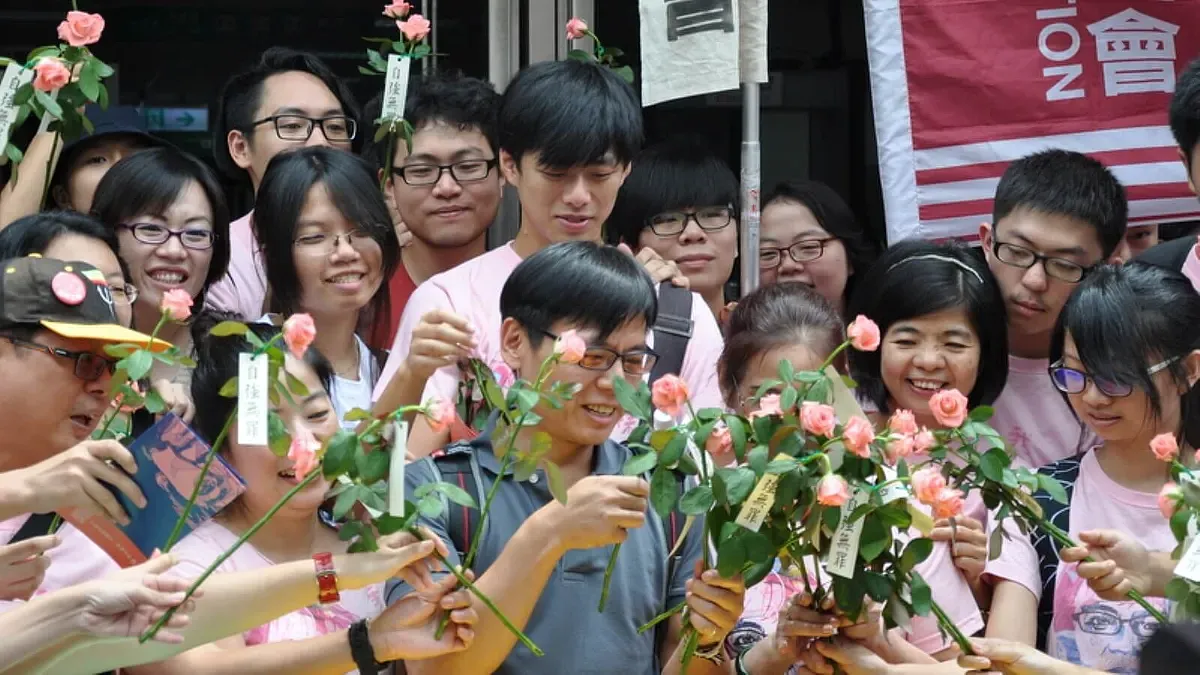
Innocence Without Fear, Justice Arrives Late: Celebrating Twenty Years of Judicial Reform – Statement on the Not-Guilty Verdict of Hsu Tzu-chiang's 9th Remand Trial
Last edited: 2026-08-25
At 11:00 AM this morning, judges Hsieh Ching-huan, Lin I-hsiu, and Wu Tso-cheng of the Taiwan High Court panel sentenced defendant Hsu Tzu-chiang to not guilty. Choosing the 20th anniversary of Hsu's wrongful accusation to vindicate him carries profound significance. The courage of the three judges in rendering an independent judgment based on their conscience is deeply admirable. The defense team for the Hsu Tzu-chiang case—composed of lawyers Lin Yung-sung, Yu Po-hsiang, Chen Chien-hung, Yen Hsin-yin, and all participating defense attorneys—has finally secured a reversed verdict and rescued a death-row inmate from wrongful imprisonment, clearing the defendant's name through their unwavering persistence in the pursuit of judicial justice. Regarding today's not-guilty verdict in the Hsu Tzu-chiang case, supporting groups issue the following statement:
-
Twenty Years of the Hsu Tzu-chiang Case: Witnessing the Fruits of Judicial Reform
In 1995, the Judicial Reform Foundation began preparations for its establishment, and that same year Hsu Tzu-chiang was wrongfully accused. Twenty years ago, court clerks recorded proceedings with pen and paper, illegible and difficult to distinguish; twenty years later, court recordings are outsourced for transcription, accurate to the very last word. The panel for the 9th remand trial even introduced the latest digital courtroom equipment, presenting case files and evidence one by one, allowing both the prosecution and the defense to thoroughly debate the admissibility and probative value of various pieces of evidence, meticulously fulfilling the procedures of the Code of Criminal Procedure. Over the past twenty years, the achievements of judicial reform have been implemented step by step in the case of Hsu Tzu-chiang. Winning a not-guilty verdict is the natural result of these efforts and marks an elevation of Taiwan's legal civilization. -
Respecting the Prosecutor-General's Five Extraordinary Appeals and Fulfilling the Objective Obligation: Urging the Taiwan High Prosecutors Office to Forego an Appeal
Between 2002 and 2005, Prosecutors-General Lu Jen-fa and Wu Ying-chao successively filed five extraordinary appeals on behalf of Hsu Tzu-chiang, which remains the highest record in judicial history. The Prosecutors-General's efforts to vindicate the miscarriage of justice led to the suspension of Hsu Tzu-chiang's death sentence, thus granting him the opportunity for a retrial. Based on the principle of the unity of the prosecution, and given that the five extraordinary appeals pointed out numerous doubts, prosecutors should no longer stubbornly speculate on Hsu Tzu-chiang's guilt. Article 2 of the Code of Criminal Procedure stipulates: "Public officials implementing criminal litigation procedures shall pay equal attention to circumstances advantageous and disadvantageous to the defendant in matters under their jurisdiction." Prosecutors bear an objective obligation; their duty is not to endlessly pursue convictions by any means necessary, but also to prevent miscarriages of justice and pay attention to circumstances favorable to the defendant. With the precedents set by Prosecutors-General Lu and Wu before them, we urge the Taiwan High Prosecutors Office to forego an appeal and bring an end to Hsu Tzu-chiang's twenty-year judicial nightmare. -
"How Many Twenty Years Does a Life Have?" Urging the Supreme Court to Uphold the Not-Guilty Verdict
The Hsu Tzu-chiang case began on September 1, 1995, followed by the Ministry of Justice's five-year suspension of the execution of the death sentence, five extraordinary appeals by the Prosecutor-General, Interpretation No. 582 by the Grand Justices, and nine remands for retrial by the Supreme Court. Twenty years of protracted litigation have destroyed the life Hsu Tzu-chiang once had. Delaying justice is denying justice; we urge the Supreme Court not to remand the case for retrial, allowing Hsu Tzu-chiang to gradually reclaim his life after twenty years of torment.
Press Contact
Judicial Reform Foundation Executive Officer, Attorney Kao Jung-chih 02-25231178
〈Taiwan High Court Press Release〉
Press Release on Taiwan High Court 102年度上重更(九)字第5號 Case The defendant Hsu Tzu-chiang's abduction and extortion remand case, 102年度上重更(九)字第5號, pronounced its adjudication main text today (01st), detailed as follows:
I. Main Text
"The original judgment is revoked, and Hsu Tzu-chiang is found not guilty."
II. Background of the Case
The defendant in this case, Hsu Tzu-chiang, was accused along with accomplices Huang Chun-chi, Chen I-lung, and Huang Ming-ch'üan (who has died in Thailand) of jointly kidnapping the victim Huang Chun-shu on September 1, 1995, killing him on the same day, and subsequently attempting to extort ransom from Huang Chun-shu's family to no avail. Defendant Hsu Tzu-chiang as well as Huang Chun-ch'i and Chen I-lung were all originally sentenced by this court on November 16, 1999, under judgment 88年度重上更(五)字第145號 for the joint commission of kidnapping for ransom resulting in death, sentenced to death, deprivation of civil rights for life, and the appeal was dismissed and finalized by the Supreme Court on April 27, 2000, under judgment 89年度台上字第2196號. Defendant Hsu Tzu-chiang considered that the Supreme Court precedents 31年上字第2423號 and 46年台上字第419號 upon which the finalized judgment was based were unconstitutional, and applied for an interpretation by the Judicial Yuan Grand Justices. On July 23, 2004, the Judicial Yuan Grand Justices rendered Interpretation No. 582, holding that these two precedents improperly deprived co-defendants of the right to cross-examine co-defendants who genuinely possessed the qualifications of witnesses, which was inconsistent with the intent of the Constitution and declaring that these two precedents shall no longer be applied. Because defendant Hsu Tzu-chiang was the applicant for Interpretation No. 582, the Prosecutor-General of the Supreme Prosecutors Office accordingly filed an extraordinary appeal regarding the portion concerning Hsu Tzu-chiang in the original finalized judgment. On May 26, 2005, the Supreme Court rendered judgment 94年度台非字第124號, revoking the portion concerning Hsu Tzu-chiang in its judgment 89年度台上字第2196號 and this court's judgment 88年度重上更(五)字第145號, and remanded the case to this court for trial on June 2, 2005. Subsequently, after successive judgments by this court from the 6th to the 8th remand trials, all of which were revoked by the Supreme Court and remanded to this court for retrial, this case is the adjudication of the 9th remand trial.
III. Trial Process
This case underwent intensive trials by the panel. In addition to summoning relevant witnesses, submitting the seized mobile phones for appraisal, and for the first time trialing the digitization of all case transcripts and documentary evidence, video technology equipment was utilized during the trial process for public presentation. This not only enabled the parties and defense counsel to easily express specific opinions on various evidence and debate them one by one, but also allowed members of the public attending the audience to witness and hear the evidentiary materials together, thereby implementing open courtroom proceedings. Argumentation in this case was concluded on August 6, 2015.
IV. Reasons for Acquitting Defendant Hsu Tzu-chiang
1. The panel of this court points out in the judgment that the defendant is subject to the principle of presumption of innocence, and the prosecutor bears the burden of proof. If the prosecutor cannot prove the defendant's crime, a not-guilty verdict shall be pronounced. In this case, the prosecutor primarily relied on the statements made by co-defendants in the previous instance, Huang Chun-ch'i and Chen I-lung, during judicial police questioning, prosecutor interrogation, and court proceedings to establish that defendant Hsu Tzu-chiang jointly committed the crime. However, although Huang Chun-ch'i had previously pointed out defendant Hsu Tzu-chiang as an accomplice in his capacity as a defendant, throughout successive court trials, he repeatedly refused to testify without justifiable reason, improperly depriving defendant Hsu Tzu-chiang of the right to confront and cross-examine a witness adverse to him. Consulting the intent of Judicial Yuan Interpretation No. 582 and adopting a constitutional interpretation of Article 159-3 of the Code of Criminal Procedure, this court holds that Huang Chun-ch'i's statements made in the capacity of a defendant without taking an oath, which were adverse to defendant Hsu Tzu-chiang, lacked "special circumstances of reliability" and thus possessed no admissibility as evidence. Furthermore, although co-defendant Chen I-lung had previously testified as a witness in the 8th remand trial of this court, his prior statements made in the capacity of a defendant during judicial police questioning and prosecutor interrogation, being statements made by a witness outside of trial and lacking "special circumstances of greater reliability," also possessed no admissibility as evidence. Meanwhile, while Chen I-lung's statements made to the court possessed admissibility as evidence, they contained major flaws where crucial contents were inconsistent or contrary to common sense, and constituted merely his unilateral statement without corroborating evidence, thus lacking probative value. As for the other evidence presented by the prosecutor in this case, it was insufficient to prove that defendant Hsu Tzu-chiang was an accomplice. Because the prosecutor's presentation of evidence failed to enable the panel to form a conviction of guilt beyond a reasonable doubt in this case, based on the principle of presumption of innocence, the panel revoked the guilty verdict of the first instance and instead pronounced defendant Hsu Tzu-chiang not guilty.
2. Following the judgment in this case, if the prosecutor is dissatisfied, an appeal may still be filed with the Supreme Court within the statutory period. The panel also calls upon the public to trust the court, respect the trial, and continue to provide judges with a pure and quiet trial space.
V. Members of the Trial Panel: Presiding Judge Hsieh Ching-huan, Accompanying Judge Lin I-hsiu, Judge-in-Charge Wu Tso-cheng
This article is an AI-generated translation of the original Chinese text. In the event of any discrepancy, the Chinese version shall prevail.