
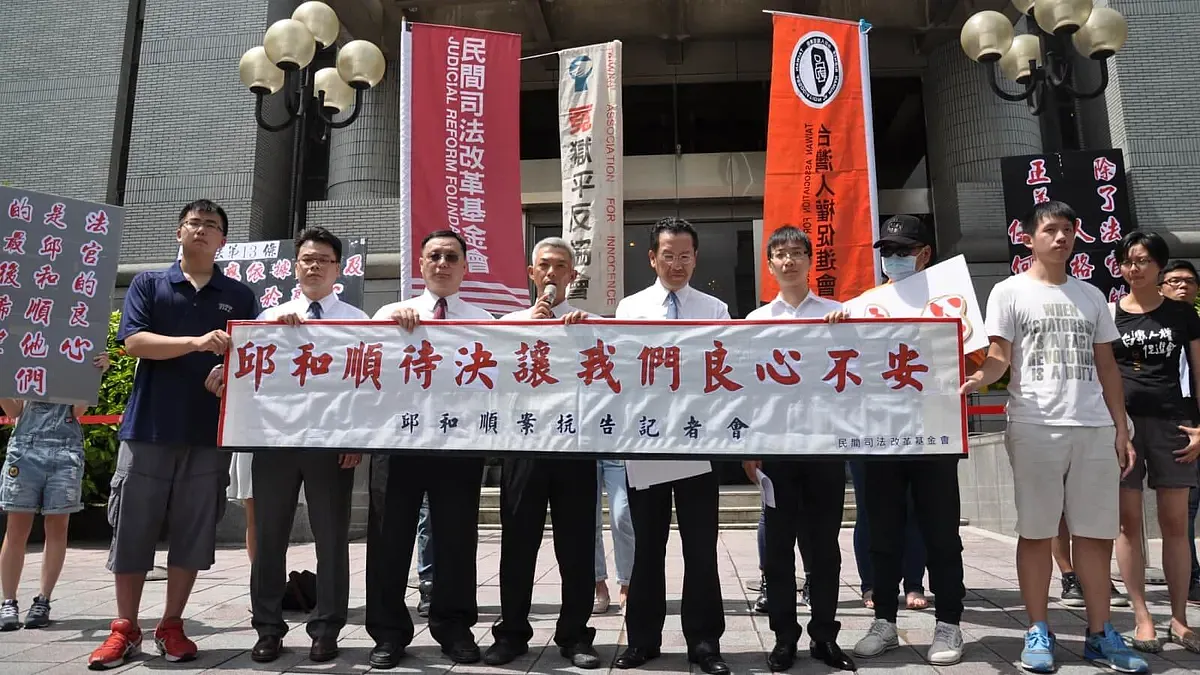
Calling Upon the Conscience of Judges: Press Conference on the Retrial Interlocutory Appeal in the Chiou Ho-shun Case
Last edited: 2026-08-25
On June 9, 2015, Police Officer B came forward to state that he had personally witnessed Chiou Ho-shun and other defendants being beaten by handling police officers, who threatened them with torture if they did not confess. The defendants were taken to an isolated room, after which Officer B heard them wailing and pleading for mercy as they agreed to comply with making a confession record. Officer B also stated that he had participated in the verification of the confession record, which ultimately proved that its contents did not match the facts of the case, exposing the defendants' ignorance of the case facts and indicating that they were not the perpetrators, and that the true culprits were elsewhere. The JRF filed a motion for a retrial for Chiou Ho-shun and his co-defendants based on the testimonies of Police Officer B and another officer, Officer A. Unexpectedly, on June 22, the Taiwan High Court dismissed the retrial motion via Ruling 104-Sound-Re-258.
The most absurd aspect of this retrial petition is that Article 420 of the Code of Criminal Procedure was amended and took effect on February 4 of this year, relaxing the statutory conditions for retrials. Chiou Ho-shun's retrial motion fully complies with the provisions of the new law, as detailed below:
-
Article 420, Paragraph 1, Subparagraph 5 of the Code of Criminal Procedure:
(The police officers handling the Chiou Ho-shun case were convicted of torture committed in this case.)
Where a judge who participated in the original judgment or the judgment of a prior instance, or in the investigation conducted prior to such judgment, or a prosecutor who participated in the investigation or prosecution, or a prosecutorial investigator, judicial police officer, or judicial police who participated in the investigation of the crime, has been proven to have committed an offense related to their official duties in connection with the case, or has been subjected to a disciplinary sanction for illegal conduct or dereliction of duty in connection with the case, which is sufficient to affect the original judgment.
-
Article 420, Paragraph 1, Subparagraph 6 of the Code of Criminal Procedure:
(Police Officers A and B came forward to prove that Chiou Ho-shun is not the true perpetrator.) Where new facts or new evidence are discovered which, considered alone or in conjunction with previous evidence, are sufficient to establish that the person convicted should be acquitted, exempted from prosecution, exempted from punishment, or given a lighter sentence than that recognized in the original judgment.
-
Article 420, Paragraph 2 of the Code of Criminal Procedure:
(Police Officers A and B had never come forward during the original trial proceedings.)
The new facts or new evidence referred to in Paragraph 1, Subparagraph 6 shall include facts and evidence that existed or were established prior to the finalization of the judgment but were not investigated or considered in time, as well as facts and evidence that came into existence or were established after the finalization of the judgment.
In this case, judges Chiu Yin-tung, Chen Shih-tsung, and Chou Ming-hung dismissed the retrial motion on the grounds that the "original judgment" had already "detailed and refuted" the various claims regarding the police officers' testimonies, clearly presupposing that the original judgment was correct and flawless, and thereby using it as the basis for discounting the police testimonies. This method of reasoning commits the logical fallacy of "question-begging" (or unwarranted presupposition). Furthermore, coupled with the refusal to review the case files, the failure to hold a court hearing, and the hasty conclusion of the case in a mere 13 days, it is evident that the problem lies in the fact that the three judges were unwilling from the bottom of their hearts to redress this miscarriage of justice. Article 420 of the Code of Criminal Procedure, which relaxed the retrial requirements, has thus been rendered a dead letter under such an institutional mindset. Not only has the anticipated surge in retrials failed to materialize, but landmark miscarriage of justice cases that have garnered widespread public concern—such as those of Chiou Ho-shun, Cheng Hsing-tse, Hsieh Chih-hung, Lü Chin-kai, and Wang Chi-cheng—still find themselves with no doors open to a retrial and no foreseeable end to their wrongful convictions.
"Conscience" is the core of adjudication and the fundamental element that allows all legal provisions to function. Article 13 of the Judges Act explicitly stipulates: "Judges shall, in accordance with the Constitution and the law, and based upon their conscience, render judgments transcendentally, independently, and impartially, free from any interference." As the Austrian legal sociologist Eugen Ehrlich stated: "In the long run, there is no guarantee of justice except the personality of the judge." A retired police officer insisted that a person must keep their conscience clear by speaking out about the truth of the Chiou Ho-shun case, revealing the bright side of human nature. Yet, throughout Chiou Ho-shun's retrial proceedings, only the darkest facets of the judiciary were laid fully bare.
r
Miscarriages of justice stem from judicial errors. While judicial errors are terrifying, refusing to acknowledge judicial errors against one's conscience is even more terrifying. Today, we step forward to express our solidarity with Chiou Ho-shun and numerous other victims of wrongful convictions with the aim of invoking the conscience of adjudicators. Only when adjudicators confront their mistakes with a clear conscience can the judiciary truly win the trust of the people.
Time
July 7, 2015 (Tuesday) 10:00–10:30
Location
Main Entrance of the Supreme Court (No. 6, Sec. 1, Changsha St., Jhongzheng Dist., Taipei City)
Attendees
Retired Police Officer / Mr. B
Chiou Ho-shun Case Defense Team / You Po-hsiang, Esq., Ku Li-hsiung, Esq., Lin Hung-wen, Esq., Wei Chao-tsung, Esq.
Representatives of Rescue Organizations / Taiwan Association for Human Rights, Taiwan Innocence Project, Judicial Reform Foundation
Media Contacts
Chiou Ho-shun Case Defense Team / You Po-hsiang, Esq.
Judicial Reform Foundation Executive Secretary / Huang Wei-ting
This article is an AI-generated translation of the original Chinese text. In the event of any discrepancy, the Chinese version shall prevail.