
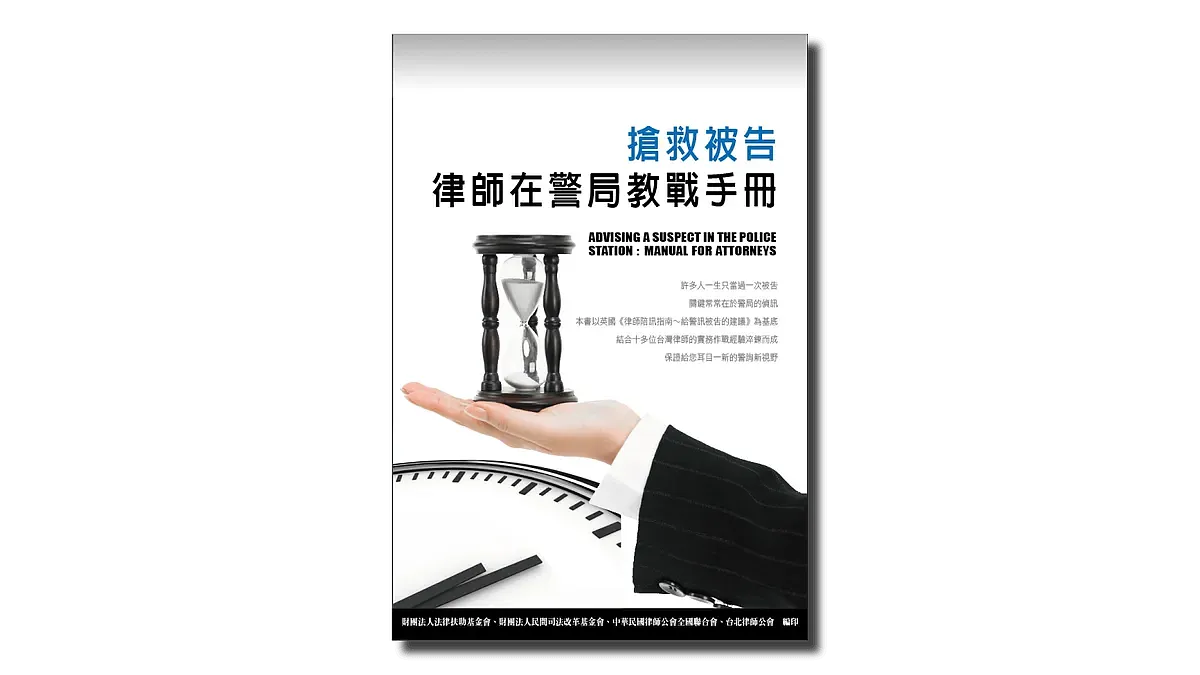
Rescuing the Accused: A Manual for Attorneys at Police Stations
Last edited: 2026-08-25
Many people find themselves in the position of a criminal defendant only once in their lives, and the turning point often lies during police interrogation. Based on the British publication 'Advice on Police Station Interrogations' and combined with the practical litigation experience of more than a dozen Taiwanese attorneys, this book guarantees a fresh perspective on police questioning.
Features of This Book
The Taiwanese-style Miranda warning, the helplessness of defendants facing police questioning, professional ethics for attorneys, and realistic considerations for protecting the defendant's interests—the intertwining legal contexts and practical operational environments behind these elements are hard to fathom without personal experience. Driven by the initial aspiration to realize judicial justice and uphold the human rights and dignity of defendants, while blending potential encounters and related psychological factors during police questioning with attorney ethics codes, the Legal Aid Foundation, the Judicial Reform Foundation, the Taiwan Bar Association, and the Taipei Bar Association collaborated to draft this book. Bringing together the efforts of dozens of attorneys and scholars through their own experiences and dozens of meetings, they distilled this concise practical manual. It shapes and constructs a spotlighted judicial experience platform and a bastion for the protection of defendants' human rights for the police interrogation process, which has traditionally been 'closed, gloomy, and where defendants are often subjected to moral judgment and trial by media.'
Table of Contents
- Chapter 1
- The Role of the Attorney: Purpose and Importance of Providing Legal Advice and Assistance
- Chapter 2
- Accepting Retainers
- Chapter 3
- Arriving at the Police Station
- Chapter 4
- Functions of Attorneys at Police Stations
- Chapter 5
- Legal Consultation Prior to Police Interrogation
- Chapter 6
- Assistance During Questioning
- Chapter 7
- Expressing Opinions on Evidence Collection
- Chapter 8
- Identification Procedures
- Chapter 9
- Juveniles and Persons with Physical, Mental, or Communication Disabilities
- Chapter 10
- Social Movements
Co-authors of the Text
- Attorney Yu Po-hsiang
- Attorney Wang Shih-ping
- Attorney Wang Chan-hsing
- Attorney Wu Meng-hsun
- Attorney Chou Hsin-hung
- Attorney Chou Wei-liang
- Attorney Lin Chun-hung
- Attorney Lin Feng-cheng
- Attorney Lin Hung-wen
- Attorney Chuang Chiao-ju
- Attorney Kuo I-ching
- Attorney Chen Yü-fan
- Attorney Chen Yen-chün
- Attorney Chen Po-chün
- Attorney Tseng Wen-chi
- Attorney Tseng Chao-mou
- Attorney Yang Shu-ling
- Attorney Cheng Kai-hung
- Attorney Hsieh Ping-chi
- Attorney Lo Wan-ting
- Associate Professor Chang Ming-wei
- Shih Chih-hung
- Hu Chiao-hsin
- Liao Cheng-cheng
Full Text Reading
This article is an AI-generated translation of the original Chinese text. In the event of any discrepancy, the Chinese version shall prevail.