
How to Organize Case Files, Evidence, and Facts in Wrongful Convictions? Organizing Cases from the Wrongful Conviction Relief Manual
Last edited: 2026-08-26
To overturn a wrongful conviction, one must first grasp the case details to identify the causes of the miscarriage of justice and subsequently plan an exoneration strategy. This article introduces concrete methods for organizing case files, evidence, and factual timelines, serving as a reference for those seeking to overturn wrongful convictions. Not only does this empower individuals to help themselves and others, but it also assists case rescuers in analyzing the case and accelerating rescue progress.
Method 1: Organizing Case Chronologies and Timelines
Arranging and tabulating events in chronological order is a fundamental task in mastering case information. It is recommended to begin by organizing a "chronology" to grasp the overall structure of the case. An example is as follows:
Example Table: Chronology
| Date and Time | Event | Remarks |
| Month/Day/Year, **:** | A neighbor found the victim dead in their living room. | ** Precinct Case Report |
| Month/Day/Year, **:** | The defendant was arrested by police at their workplace and detained for questioning at the ** Criminal Investigation Division. | ** Police Bureau Interrogation Record |
| Month/Day/Year, **:** | Following prosecutor interrogation, a motion for detention was approved, and the defendant was detained at the Taipei Detention Center. | ** Prosecutor Interrogation Record |
| Month/Day/Year | The prosecutor indicted the defendant on charges of robbery and homicide. | Case Number: ** Year, Chen Tzu No. ** |
| Month/Day/Year | The court of first instance acquitted the defendant, who was released in the courtroom. | Case Number: ** Year, Su Tzu No. ** |
| Month/Day/Year | The court of second instance sentenced the defendant to life imprisonment. | Case Number: ** Year, Shang-Su Tzu No. ** |
| Month/Day/Year | The court of third instance dismissed the defendant's appeal. | Case Number: ** Year, T'ai-Shang Tzu No. ** |
| Month/Day/Year | The defendant reported for imprisonment and served their sentence at the Taipei Prison. | Execution Notice |
Once completed, analyze the chronology to identify the critical turning points affecting the case, and compile a detailed timeline for them. Taking the previous table as an example, the critical turning point lies in the investigations conducted by the police after the crime that led to targeting the defendant as a suspect. Accordingly, it is recommended to compile a "Police Investigation Timeline," as exemplified below.
Example Table: Police Investigation Timeline
| Date and Time | Police Investigative Action | Unit and Officers | Remarks |
| Month/Day/Year, **:** | A neighbor found the victim dead in their living room. | ** Precinct ** Police Station Officer A |
** Precinct Case Report |
| Month/Day/Year, **:** | Police questioned reporting neighbor A and victim's relatives. | ** Police Bureau Criminal Investigation Division Officers B and C |
** Police Bureau Interrogation Record |
| Month/Day/Year, **:** | Police questioned nearby residents and produced 10 neighborhood inquiry records. | ** Police Bureau Criminal Investigation Division Officers B, C, and D |
** Police Bureau Inquiry Record |
| Month/Day/Year, **:** | Police reviewed nearby merchants' surveillance footage to search for suspicious persons. | ** Police Bureau Criminal Investigation Division Officers C and D |
** Police Bureau Inquiry Record |
| Month/Day/Year, **:** | Forensic pathologist performed an autopsy, determining the death was a homicide caused by a blunt instrument approximately three days prior. | ** Forensic Science Institute Forensic Pathologist E |
** Forensic Science Institute Appraisal Report |
| Month/Day/Year, **:** | Criminal forensics discovered one suspicious fingerprint and one set of skin scrapings DNA from the victim's fingernails. | ** Criminal Forensic Center Officer F |
** Criminal Forensic Center Appraisal Report |
| Month/Day/Year, **:** | A confidential witness stated that the defendant owed a debt to the victim and committed the murder out of frustration from being pressed for repayment. | ** Police Bureau Criminal Investigation Division Officer G |
** Police Bureau Interrogation Record |
| Month/Day/Year, **:** | The defendant was arrested by police at their workplace and detained for questioning at the ** Criminal Investigation Corps. | ** Police Bureau Criminal Investigation Division Officer G |
** Police Bureau Interrogation Record |
After organizing the police investigation timeline in the above example, it can be seen that although the police conducted inquiries, reviewed footage, and performed forensic appraisals, none of these targeted the defendant. Ultimately, they relied on the testimony of a confidential witness to lock onto the defendant. Therefore, the focal point for exoneration in this case example will center on whether the confidential witness is credible and whether the identification contents can withstand scientific evidence scrutiny.
In practical application, timelines should be organized into multiple tables based on the distinct needs of each individual case. Commonly used ones, aside from the chronology and police investigation timeline, include (1) criminal process, (2) confessions and testimonies, and (3) alibi timelines. The underlying principle is to use time as the axis, connecting different individuals at different locations and involving various events to reconstruct the case profile and unearth the concealed truth.
Method 2: Organizing Fact Comparison Tables
The fundamental issue in wrongful convictions lies in the facts determined by the court differing from the facts that actually occurred. Therefore, creating a comparison table of differing facts is a useful tool for illustrating the causes of a wrongful conviction. An example is as follows:
Example Table: Fact Comparison Table
| Date and Time | Guilty Facts Determined by the Court | Innocent Facts That Actually Occurred |
| Month/Day/Year | Chia made a phone call to his cousin Yi, inquiring about channels to acquire a modified handgun and bullets. Yi immediately contacted Ping, reaching a consensus on the transaction of 1 modified handgun and 6 bullets for a price of 40,000 NTD, and agreed to trade at 7:00 PM that same day at the villa located at No. *, Hsien-lu Road, Hemei Township, Changhua. Chia arrived as agreed, paid and took the firearm, and departed immediately. | Chia was on leave at home that day and did not make a phone call to his cousin Yi. In the afternoon, he watched a movie at the ** Theater in Taoyuan City, played online games at an internet café in the evening, and returned home to rest at around 10:00 PM. |
| Month/Day/Year | Because he was short of money, Chia proposed to his cousin Yi to rob a bank. At 3:00 PM, the two jointly rode a motorcycle owned by Yi's girlfriend (license plate number **), carrying 1 handgun, 1 stun gun, and 3 masks (used to cover the license plate), wearing safety helmets, and entered the bank. Chia brandished the gun and ordered the guard to lie down, while Yi demanded the counter teller hand over valuables. The two fled immediately after obtaining the goods, and split the proceeds for personal use. Afterward, the police reviewed surveillance footage to trace the motorcycle license plate and apprehended Chia and Yi along the trail. | Chia had caught a cold and was on sick leave from work for the day. After visiting the ** Clinic for consultation and medicine at 10:00 AM, he returned home to rest and sleep, and did not go out again until the next morning before work. |
Real-life cases are usually complex—such as involving many participants, multiple instances, numerous crime scenes, etc. Please be patient and meticulous in organizing item by item, comparing and tabulating different facts one by one. If the police, prosecutors, court of first instance, court of second instance, or different trial levels have respectively determined different facts, it is recommended to organize the discrepancies in facts determined across successive trials. The principle behind organizing a fact comparison table is to present "multiple different facts and highlight their discrepancies." Where the factual discrepancies lie is where the wrongful conviction exoneration lies, because there is only one truth. An example is as follows.
Example Table: Successive Trials Fact Comparison Table
| Fact | Police Referral Document | Prosecutor Indictment | First Instance Judgment | Second Instance Judgment | Remanded Retrial Judgment |
| Whether Chia purchased a gun from Ping | Yes | Yes | No | Yes | No |
| Whether Chia carried a gun or a stun gun during the robbery | Carried a gun | Carried a gun | Did not participate in the crime | Carried a gun | Carried a stun gun |
Method 3: Organizing Evidence Inventories
Article 154, Paragraph 2 of the Code of Criminal Procedure stipulates: "Facts of a crime shall be established by evidence; no evidence may be established without evidence." That is to say, judges can only convict a person when there is evidence. Therefore, sorting out precisely what evidence the court relied upon to render a guilty verdict is a fundamental task in exonerating a wrongful conviction. Particularly in successfully overturned wrongful convictions, it is often the discovery of evidence previously overlooked by the court, or even evidence concealed by police, prosecutors, and investigative personnel. Thus, organizing the evidence inventory requires thoroughness and completeness, ensuring absolute zero omissions.
The concrete method of organization is to flip through the case files from beginning to end, page by page. Whenever evidence is seen, list it in the inventory, noting the time of appearance and location of the evidence. Then, cross-reference this with the evidence recorded in investigation and trial documents, comparing them item by item to include them in the inventory. Finally, inspect items such as the itemized list of articles in the "stolen property and evidence duplicate form" stored and properly registered in the court's general affairs department, wiretap transcripts, audio and video recordings of interrogations and trials, and externally stored evidence such as surveillance tapes. An example is as follows:
Example Table: Evidence Inventory
| Time of Appearance | Evidence | Location | Police Referral Document | Prosecutor Indictment | First Instance Judgment | Second Instance Judgment |
| Month/Day/Year | 3 grams of heroin and appraisal report | ** Police Bureau | Recorded | Recorded | Inadmissible | Admissible |
| Month/Day/Year | 1 set of ingestion paraphernalia | Court Property Warehouse | Recorded | Recorded | Inadmissible | Admissible |
| Month/Day/Year | 1 scale | Court Property Warehouse | Recorded | Recorded | Inadmissible | Admissible |
| Month/Day/Year | 5 packaging bags | Court Property Warehouse | Recorded | Recorded | Inadmissible | Admissible |
| Month/Day/Year | Wiretap transcript | Stored separately with the file | Not recorded | Recorded | Admissible | Admissible |
| Month/Day/Year | Wiretap audio cassette | Court Property Warehouse | Not recorded | Recorded | Admissible | Admissible |
| Month/Day/Year | Notebook | Court Property Warehouse | Not recorded | Not recorded | Not recorded | Admissible |
| Month/Day/Year | Police interrogation confession | Attached to file | Recorded | Recorded | Inadmissible | Inadmissible |
| Month/Day/Year | Prosecutorial interrogation confession and recording disc | Attached to file | Not recorded | Recorded | Admissible | Admissible |
Taking the above table as an example, one can find that "1 set of ingestion paraphernalia, 1 scale, and 5 packaging bags" were all determined to be inadmissible as evidence in the first instance, but were subsequently determined to be admissible in the second instance. A closer examination of the judgment's contents reveals that this involves the issue of whether the police conducted an illegal search, which may be a focal point for further investigation and confirmation in the wrongful conviction case. Meanwhile, the "notebook" is evidence that only surfaced during the second instance—why it was never mentioned before and how it came to light also warrants further investigation.
Method 4: Organizing Interpersonal Relationship Charts
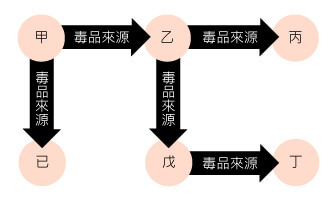
Causes of wrongful convictions frequently stem from issues involving "people," such as: accomplices shifting blame, witnesses telling falsehoods, and police or investigative personnel engaging in illegal malfeasance, etc. Analyzing relationships between people makes charts and diagrams highly efficient tools. Taking the most commonly used identification sequence chart as an example, it maps out the sequence of targets identified by witnesses using "arrows" in a graphical format. An example is as follows:
Example Chart: Identification Sequence Chart
Example Table: Accomplice Charges Table
| Name | Chia | Yi | Ping | Ting | Wu | Chi |
| Charge | Ingesting drugs | Ingesting drugs | Trafficking drugs | Trafficking drugs | Ingesting drugs | Trafficking drugs |
Observing the "Accomplice Charges Table" in isolation does not reveal the reasons for the discrepancies in charges among the six accomplices. However, when combined with the "Accomplice Identification Sequence Chart," it becomes apparent that the police referred those who identified their drug sources (Chia, Yi, Wu) solely on charges of ingesting drugs (a minor offense), while those who did not identify their drug sources were referred on charges of trafficking drugs (a serious offense). Therefore, reviewing the audio recordings of the police questioning the accomplices becomes crucial; one should carefully listen to the identification process to determine whether there were instances of coercion or inducement prompting the defendants to falsely implicate others.
Taking the following table as another example, while four individual witnesses' respective identifications showed inconsistencies between earlier and later statements, organizing a witness identification relationship table for comprehensive comparison reveals a common intersection among the witnesses (B driving), which is extremely helpful for researching the case.
Example Table: Witness Identification Relationship Table
| Testimony Content | Chia | Yi | Ping | Ting |
| Month/Day/Year | A driving | A driving | Uncertain | A driving |
| Month/Day/Year | B driving | B driving | B driving | A driving |
| Month/Day/Year | B driving | Uncertain | B driving | Uncertain |
Method 5: Organizing Media Reports
Criminal cases have historically been the focus of news media, and the primary sources of news reports are usually police officers or prosecutors. Therefore, the content of news reports often reflects the investigative personnel's assessment of the case at that time, as well as their investigative methods and directions.
In addition, journalists will proactively interview witnesses and nearby residents, all of which serve as important clues in pursuing the truth. Consequently, organizing media reports is also an important investigative method for overturning wrongful convictions.
Example Table: Ch'i Ho-shun Case News Chronology
| Date | Newspaper Section | News Headline |
| 1988.03.11 | China Times, Page 5 | Please Kind-Heartedly Let Lu Cheng Go Home: Police Have Extracted Seven Fingerprints from the Envelope; Even with Ransom Paid, Kidnappers Will Not Escape the Net of Justice |
| 1988.03.22 | China Times, Page 5 | Hope Appears in Lu Cheng Kidnapping Case: Taichung Police Deeply Deploy Informants, Track Suspects and Exercise Caution in Verification, Conduct Voice Recording and Active Evidence Collection While Awaiting the Right Moment to Capture Culprits in One Fell Swoop |
| 1988.04.13 | Central Daily News, Page 10 | Falsely Claiming to Have Kidnapped Lu Cheng in Attempted Extortion: Dai Li-sen Arrested Yesterday |
| 1988.04.13 | China Times, Page 10 | Taking Advantage of Misfortune, Impersonating Culprits to Extort Lu Cheng's Family: Woman Caught Red-Handed While Collecting Ransom, Unable to Escape the Net of Justice |
| 1988.05.19 | Central Daily News, Page 10 | Breakthrough in Lu Cheng Kidnapping Case: Police Monitor a Target |
| 1988.06.11 | China Times, Page 5 | Ancient Well Causes Ripples in Lu Cheng Case; Strange Phone Call Rings Again: Uncertain Whether It Is the Original Kidnapper |
| 1988.06.13 | China Times, Page 5 | Glimmer of Life for Lu Cheng? Elusive and Mysterious: Man Calls to Notify, Claiming to Know the Detention Site and Stating No Reward Will Be Taken; Appointment to Pick Up Victim Turns Out to Be a Ruse |
| 1988.06.18 | Central Daily News, Page 10 | Wu Po-hsiung Went to Hsinchu Yesterday to Visit Lu Cheng's Parents; Chuang Heng-tai States Police Will Spare No Expense to Investigate This Case |
| 1988.06.18 | Central Daily News, Page 10 | Chuang Heng-tai Tells Lu Chin-te Couple That Police Will Spare No Expense to Investigate This Case |
| 1988.08.22 | China Times, Page 5 | Kidnapping Nephew? Pure Fabrication: Lu Cheng's Maternal Uncle Suddenly Surrenders, Hsinchu Police Urgently Verify; Inconsistent Statements with Numerous Loopholes Lead to Relief Upon Eliminating Suspicion |
| 1988.08.31 | Central Daily News, Page 10 | Listen to the Voice! Save Lu Cheng! Lu Chin-te Cleverly Designs Promotional Vehicle, Praying for Public Assistance in Finding His Beloved Son |
| 1988.10.01 | Central Daily News, Page 8 | Major Breakthrough in Ke Hung Yu-lan Dismemberment Case: Man Surnamed Ch'iu and Three Juveniles Motivated by Greed Commit Murder; Police Suspect They Also Kidnapped Lu Cheng and That He Has Already Been Murdered |
| 1988.10.01 | Liberty Evening News, Page 5 | Confessing Then Retracting: Three Defendants Claim They Were Subjected to Coerced Confessions |
From the news chronology of the Ch'i Ho-shun case, it can be learned that the police previously extracted 7 suspect fingerprints from the envelope. It is now confirmed that not a single fingerprint belongs to Ch'i Ho-shun. After April 7, 1988, Ch'i Ho-shun was detained in the Hsinchu Detention Center, yet in June, family members still received calls from the kidnappers. News reports show that before arresting Ch'i Ho-shun, the police had captured at least 5 groups of suspects claiming to be the kidnappers, including Lu Cheng's maternal uncle. Furthermore, the 3 juveniles who identified Ch'i Ho-shun immediately confessed after identification that it was a result of police torture and coerced confessions. These pieces of information are all investigative directions for exonerating wrongful convictions and can supplement the deficiencies in judicial case files.
The American Experience in Wrongful Conviction Exonerations
In the 1990s, due to the widespread application of DNA technology in criminal cases, Americans began to realize the existence of wrongful incarcerations, subsequently questioning the soundness of the judicial system and gradually establishing wrongful conviction rescue organizations across the United States. In 2005, over 340 innocent inmates were released. Among these rescue organizations, the experience of the Innocence Commission for Virginia is particularly worthy of reference. This commission investigates wrongful convictions, analyzes their causes, and proposes reform measures. Detailed reports can be accessed via this website.
Issue 94 of the Taiwan Judicial Reform Journal translates and introduces "Guidelines for Volunteer Investigators of the Innocence Commission for Virginia," which serves as an exceptionally useful reference material for those intending to overturn wrongful convictions and is highly recommended reading.
Conclusion: Identifying Issues, Pursuing Evidence
This article introduces five methods for organizing cases. Carrying them out concretely helps pinpoint the problems leading to wrongful convictions. After discovering the issues, the next task is how to pursue evidence and witnesses, unearth the truth of the case, and exonerate the miscarriage of justice. Concrete methods for pursuing evidence will be introduced in the next special article; readers are welcome to continue reading.
This article is an AI-generated translation of the original Chinese text. In the event of any discrepancy, the Chinese version shall prevail.