
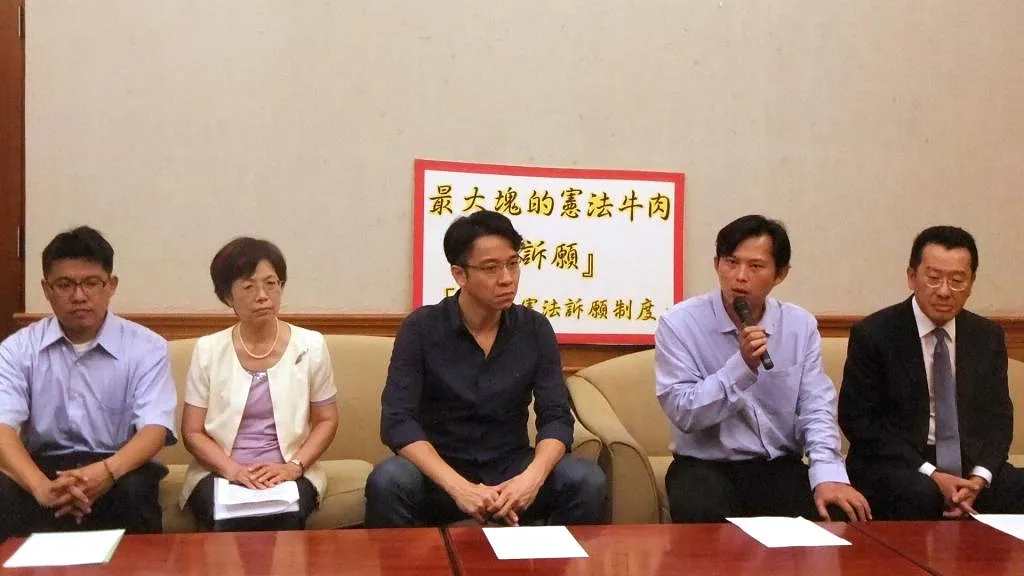
The Core Pillar of Constitutional Protection: "Constitutional Complaint" – Press Conference on the Public Demand for a Constitutional Complaint Mechanism
Last edited: 2026-08-26
On the final day of the Legislative Yuan session, just as the public strongly called for the state to amend the outdated Constitution, the Judicial Yuan intended to sneakily smuggle through the amendment of the Act Governing the Adjudication of Constitutional Cases amid the chaos. The Legislative Yuan even postponed the negotiation schedule for constitutional amendments just to negotiate this bill.
The reason why the Judicial Yuan feared complications and wanted to smuggle it through is precisely because it dreads that the "constitutional complaint" system demanded by many scholars and civil society groups would be accepted by legislators after thorough debate and discussion, thereby forcing the Judicial Yuan to cooperate with legislation.
According to the analysis of former Grand Justice Hsü Tzung-li, the Judicial Yuan's current amendments to the Act Governing the Adjudication of Constitutional Cases focus on several key points:
- Judicialization of adjudication procedures: That is, turning the Council of Grand Justices meeting into a "courtroom." "Grand Justices' Interpretations" will no longer be made through "meetings," but rather through "court sessions" to render "constitutional judgments." It is worth mentioning that if oral arguments are adopted in court sessions, the activities of our country's Constitutional Court will become more lively and dynamic, and it will also shorten the distance between the court and the people.
- Presenting the results of Grand Justices' constitutional interpretation in the style of judicial judgments: Grand Justices will finally no longer need to "monologue" or write interpretations that people cannot understand while talking to themselves. By using the format of judicial judgments, Grand Justices can engage in more effective dialogue with the public.
- Introduction of "amicus curiae": Allowing the public to provide professional opinions or materials to the Grand Justices as references when rendering judgments.
- Attribution of opinions to the authoring Grand Justice: Ensuring that Grand Justices have their own voices and opinions, and can no longer "hide behind the umbrella of majority rule."
All of the above key points are positive changes, and civil society organizations are optimistic about them. However, the true "lifeline" for the success of constitutional interpretation lies in the "reduction of the decision threshold" and the "broadening of the scope of constitutional interpretation" (namely, the "constitutional complaint"). Regarding this, the Judicial Yuan is stubbornly refusing to let go!
First, under the current system, whether unconstitutional or constitutional, a two-thirds majority consent is required, which is extremely unreasonable. An excessively high threshold poses a formidable challenge, making laws difficult to change. Imagine if more than half of the Grand Justices consider a certain law unconstitutional, it means the law is already very problematic. However, because it fails to reach the high threshold of two-thirds, the law cannot be changed, masquerading as a constitutional law—this is highly unreasonable.
Therefore, we advocate following other countries by lowering the thresholds for both constitutionality and unconstitutionality uniformly to 1/2. Over half means unconstitutional, and failing to reach a majority means constitutional—simple, clear, and unambiguous. It can also resolve the unreasonable current situation where the opinions of the majority of Grand Justices are overridden by a minority.
Second, the Judicial Yuan insists on not introducing the "constitutional complaint system," preventing Grand Justices from reviewing specific concrete cases. The Judicial Yuan seems to believe that the constitutional awareness and capacity of Supreme Court judges are already sufficient to handle constitutional controversies that may arise in individual cases involving the public.
However, the reality is precisely the opposite. Our court of final appeal always, intentionally or unintentionally, keeps its distance from the Constitution. Judgments lacking constitutional awareness and failing to stand firm on constitutional principles are ubiquitous. Even the constitutional standards of judgments from district courts often surpass those of most courts of final appeal.
Therefore, while the judiciary of other countries might perhaps be qualified to claim that they do not need a constitutional complaint system because every judge on their court of final appeal is an expert embracing the Constitution, Taiwan's current judicial reality certainly does not qualify it to say so!
Furthermore, mere laws cannot enforce themselves. In Taiwan's judiciary, the problem is often not the law itself, but the people interpreting the law; what should be declared unconstitutional is frequently not the law, but the distortion of the law.
Only with the "constitutional complaint" system can we truly weed out, from a constitutional perspective, all possible "unconstitutional acts" committed by judges in individual judgments, and establish the final line of defense to safeguard the people's constitutional rights.
This is the right that the Judicial Yuan has consistently been unwilling, too afraid, and reluctant to open up to the public, and it is the biggest constitutional prize!
Attendees
Legislator / Yu Mei-chu
Director of the Judicial Reform Foundation / Attorney Ku Li-hsiung
Executive Director of the Judicial Reform Foundation / Professor Huang Kuo-chang
Hsueh-Ku Nan-Jung Law Firm / Attorney Chiu Hsien-chih
Press Contact
CEO of the Judicial Reform Foundation / Attorney Kao Jung-chih
This article is an AI-generated translation of the original Chinese text. In the event of any discrepancy, the Chinese version shall prevail.