
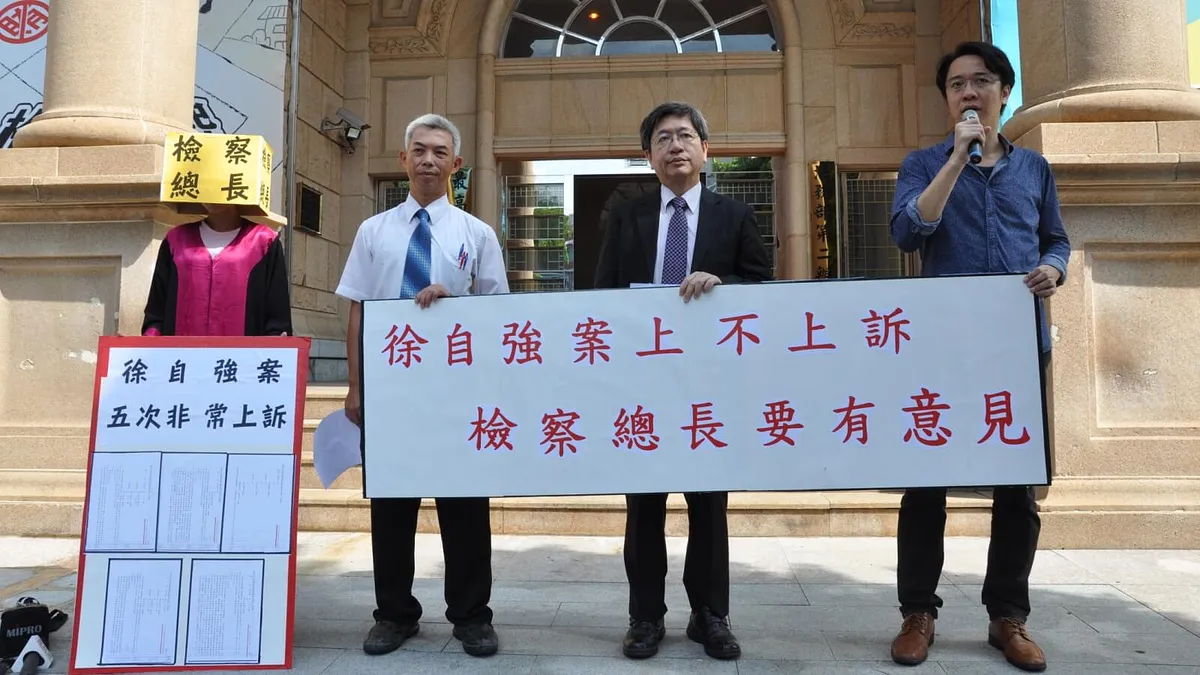
To Appeal or Not: The Prosecutor-General Must Take a Stand — Press Conference Calling on the Prosecutor-General to Forego Appeal in the Hsu Tzu-chiang Case
Last edited: 2026-08-26
Filing appeals is the power of prosecutors. Frivolous appeals have long been a judicial affliction suffered by the people.
After the Taiwan High Court rendered a not-guilty verdict in the ninth retrial of the Hsu Tzu-chiang case on September 1, the Taiwan High Prosecutors Office filed an appeal again on September 19. According to law, the Supreme Prosecutors Office has the authority to direct and supervise whether an appeal should be filed, but it has historically only acted as a transit point, "forwarding" cases directly to the Supreme Court. Even when frivolous appeals occur, it frequently turns a blind eye, a practice long criticized by the public.
Comparison Table of Reasons: Taiwan High Prosecutors Office's Ninth Retrial Appeal Brief V.S. The Prosecutor-General's Five Extraordinary Appeals
| Ninth Retrial Appeal Brief | 1st Extraordinary Appeal | 2nd Extraordinary Appeal | 3rd Extraordinary Appeal | 4th Extraordinary Appeal | 5th Extraordinary Appeal | |
| Was Huang Chun-chi tortured? | Not tortured | - | - | Should be investigated | - | Inadequately investigated, lacking admissibility of evidence |
| Is Huang Chun-chi's confession credible? | Reasonably credible | Unreliable | Unreliable | Unreliable | Unreliable | |
| Is Chen I-lung's confession credible? | Reasonably credible | Unreliable | Unreliable | Unreliable | Unreliable | |
| Was Hsu Tzu-chiang absent from the scene? | Unreliable | Should be investigated | Reasonably credible | Should be investigated | Reasonably credible | - |
| Was there corroborating evidence? | Evidence exists | No evidence | No evidence | No evidence | No evidence | No evidence |
Unlike other cases, the Prosecutor-General had previously filed five extraordinary appeals in the Hsu Tzu-chiang case. The not-guilty verdict in the ninth retrial achieves the goal of those five extraordinary appeals; under the principle of the unity of the prosecution service, such self-contradiction should not occur. Comparing the reasoning of the ninth retrial appeal brief with the five extraordinary appeal briefs (see the table above), one will find that the prosecutors of the High Prosecutors Office completely fail to appreciate the painstaking efforts of the Prosecutor-General to safeguard human rights and adhere to the principle of the presumption of innocence, turning back the wheel of justice.
Most absurdly, the ninth retrial appeal brief argues to refute the ninth retrial judgment's finding that co-defendant Huang Chun-chi suffered torture by stating: "According to ordinary social experience, the slight visible injuries recorded in the health examination record can be easily manufactured by accomplice Huang Chun-chi himself"; and "According to accomplice Huang Chun-chi's testimony, since he already knew or foresaw that the police would torture him, why did he state that he did not need appointed defense counsel to be present? Thus, his defense of torture is merely an attempt to evade criminal liability for confessing the truth, and is difficult to credit." This makes one feel as though time has reversed, returning to the Martial Law era.
Faced with such subordinate prosecutors, the Prosecutor-General cannot remain silent on whether an appeal should be filed in the Hsu Tzu-chiang case. Pursuant to Article 93 of the Judges Act, the Prosecutor-General may personally handle matters concerning prosecutors under their direction and supervision. We hereby call upon the Prosecutor-General to personally handle the appeal in the Hsu Tzu-chiang case, set a model for upholding judicial justice, and drop the appeal since it should not be filed. If there are indeed legal disputes that require clarification through an appeal, the reasons for the appeal must be made public, and a request should be made to hold oral arguments at the Supreme Court to ensure public confidence.
Attachment Downloads
- 104st-Su-96th - Ninth Retrial Appeal Brief
- 90th-Fei-Su-105th - Extraordinary Appeal Brief
- 91st-Fei-Su-109th - Extraordinary Appeal Brief
- 92nd-Fei-Su-67th - Extraordinary Appeal Brief
- 92nd-Fei-Su-334th - Extraordinary Appeal Brief
- 93rd-Fei-Su-188th - Extraordinary Appeal Brief
- 102nd-Su-Chung-Keng-(9)-5th - Ninth Retrial Judgment
Attendees
Hsu Tzu-chiang Case Pro Bono Defense Counsel Team / Attorney Lin Yung-sung, Attorney Yü Po-hsiang
Civil Judicial Reform Foundation Executive Director / Attorney Kao Jung-chih
Press Contacts
Civil Judicial Reform Foundation Executive Director / Attorney Kao Jung-chih 02-25231178
This article is an AI-generated translation of the original Chinese text. In the event of any discrepancy, the Chinese version shall prevail.