
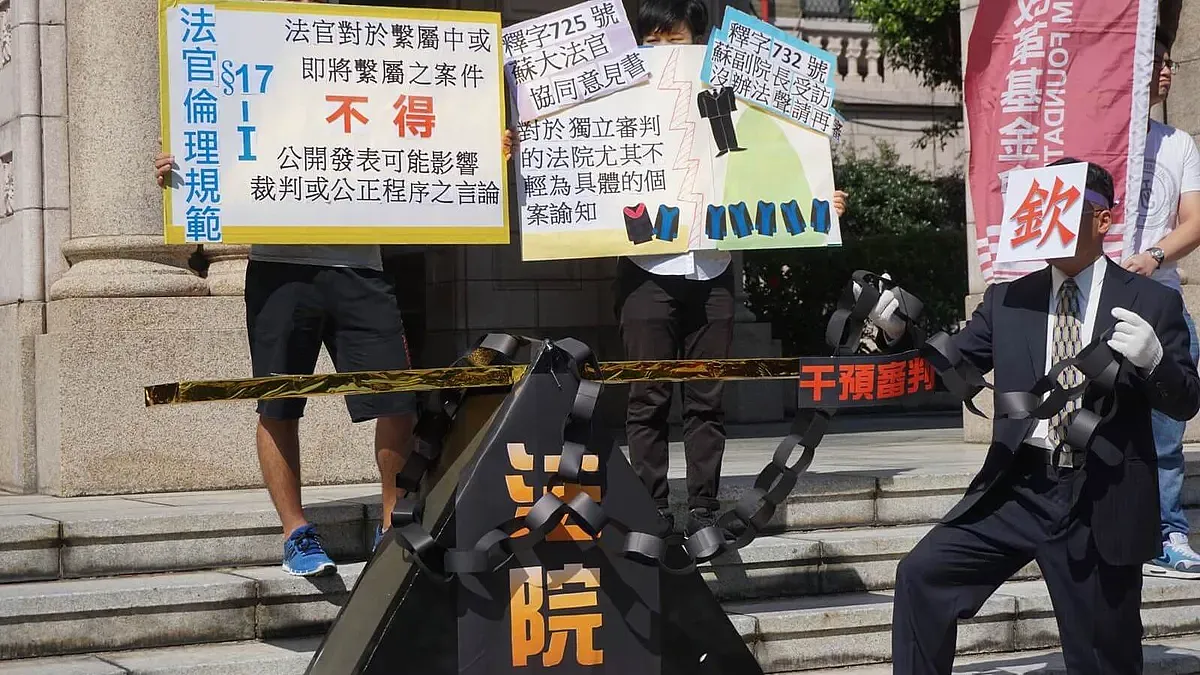
Severing the Chains of Judicial Interference: Calling for the Accountability of Unfit Grand Justice and Disqualified Judicial Yuan Vice President Su Yeong-chin — Press Conference on Referral for Case Evaluation
Last edited: 2026-08-26
The Grand Justices recently rendered Judicial Yuan Interpretation No. 732, declaring that the relevant provisions governing the expropriation of adjacent land under the Mass Rapid Transit Act shall cease to apply as of the date of the announcement of the interpretation, reigniting hope for the landowners of the Meihe City development project who were among the petitioners for constitutional interpretation.
However, shortly after the Judicial Yuan published this interpretation, Su Yeong-chin, who is one of the Grand Justices who rendered this interpretation and concurrently serves as the Vice President of the Judicial Yuan, proactively claimed during his speech at the farewell gathering for four Grand Justices, including Lee Chen-shan, that "media reports" were inaccurate. Subsequently, he stated in an interview that the Taipei City Government's expropriation in the "Meihe City land case was not adjacent land," was not within the scope of unconstitutionality, and that in the future, the Meihe City landowners "cannot apply for a retrial" to overturn the ruling.
We believe that these remarks by Grand Justice Su Yeong-chin overstepped the proper role of a Grand Justice, constituted an intentional personal manipulation, attempted to interfere with adjudication, and severely compromised judicial independence. He is already unfit to serve as a Grand Justice and disqualified as Vice President; unless he immediately apologizes and resigns, he should be referred for individual judicial evaluation.
Overstepping the Proper Role of a Grand Justice:
Historically, Grand Justices have exercised self-restraint and maintained integrity, never publicly voicing opinions directly on the substance of an interpretation. Moreover, the Council of Grand Justices operates with a Secretariat and an appointed spokesperson. Su Yeong-chin is neither the Chief Justice nor the spokesperson and is not qualified to speak on behalf of the Grand Justices as a whole. Arbitrarily speaking publicly and commenting on the interpretation text risks overstepping his authority, let alone attempting to "feign" an explanation of "abstract law" while "smuggling in" definitive conclusions regarding a "specific individual case."
Intentional Manipulation Rather Than Inadvertent Oversight: Contradicting His Long-Standing Position Opposing Grand Justices "Deliberating on Specific Cases"
It is well known within legal circles that Su Yeong-chin is precisely the representative figure opposing the "constitutional complaint system."[1] The so-called "constitutional complaint system" means that in addition to determining whether an "abstract law" is unconstitutional, the Grand Justices may concurrently assess whether the "underlying case" (namely, the "individual case") initiating the petition for constitutional interpretation is also illegal and unconstitutional. Su Yeong-chin has consistently opposed this system and has never hesitated to demonstrate the attitude that Grand Justices should stay "as far away from individual cases as possible."
For instance, regarding "constitutional review" and "whether a petitioner for constitutional interpretation can obtain relief," Su Yeong-chin clearly stated his view as early as his concurring opinion in Judicial Yuan Interpretation No. 725, arguing that the two should be "decoupled from each other":
The procedure for petitions filed by the public, as stipulated in Article 5, Paragraph 1, Subparagraph 2 of the current Constitutional Interpretation Procedure Act, is a purely objective norm control procedure; this is why the outcome of an interpretation merely determines the constitutionality of the disputed law, and neither the holding nor the reasoning contains any description or response to the claims of the petitioner, nor does it provide any explanation regarding the underlying case that initiated the procedure.
Evidently, Su Yeong-chin's public remarks on this occasion, in addition to overstepping the proper role of a Grand Justice as mentioned above, not only "described" and "responded" to the "claims of the petitioner," but also provided what can be characterized as a concrete and explicit "explanation" regarding the "underlying case that initiated the procedure"—asserting that "the landowners of the Meihe City development project cannot apply for a retrial." One can no longer find any trace of the "respect" and "prudence" toward the independent trial courts that "Grand Justice Su" previously demonstrated in his concurring opinion in Interpretation No. 725.
Attempting to Leverage the Status of Vice President to Influence Fair Adjudication by the Courts:
Furthermore, Su Yeong-chin holds the high office of Vice President and is undoubtedly fully aware of his influence and potential to undermine the judiciary. Through the authority over judicial personnel administration, he can oversee the promotion, discipline, and transfer of judicial personnel, thereby affecting trial independence. When Vice President Su publicly expresses such definitive "personal opinions" on a specific individual case, if judges reject retrials in the future, it might be due to consideration of promotion prospects or anticipating the will of the superior. Even if the decision is based on genuine legal conviction, it would easily be subject to such suspicion. In any case, it causes harm to public trust in the judiciary. As the Vice President of the Judicial Yuan, Su Yeong-chin should know this well; yet rather than meticulously safeguarding the judiciary, he showed complete disregard, proving himself to be an utterly unfit head of judicial administration.
Grand Justices are also judges as defined under the Judges Act, and like all judges, they bear the responsibility of safeguarding the fairness of adjudication. Article 17, Paragraph 1 of the Code of Judicial Ethics provides: "A judge shall not publicly make statements on pending or impending cases that may affect the fairness of the judgment or the proceedings..." Leveraging his position as Vice President, Su Yeong-chin publicly commented on the "individual case" of the Meihe City land development and substantially determined the scope of the "facts" and "subsumption." This is equivalent to giving remote directives to the judges of the High Administrative Court, severely violating trial independence and betraying his oath as a Grand Justice and as a judge to defend the legal order, rendering him unfit to be a Grand Justice.
For these reasons, the Judicial Reform Foundation will submit a request for an individual judicial evaluation of Grand Justice Su Yeong-chin and calls on Grand Justice Su to proactively resign, taking due responsibility for the damage his inappropriate words and actions have inflicted upon judicial independence.
Attendees: Lin Yung-sung, Chairperson, Judicial Reform Foundation / Attorney-at-Law
Kao Yung-cheng, Secretary-General, Taiwan Forever Association / Attorney-at-Law
Kao Jung-chih, Executive Director, Judicial Reform Foundation / Attorney-at-Law
Press Contact: Kao Jung-chih, Executive Director, Judicial Reform Foundation / Attorney-at-Law
[1] See Su Yeong-chin, "A Constitutional Complaint on Judicial Decisions?" published in The Law Monthly, Vol. 58, No. 3 (March 2007), pp. 4–22.
This article is an AI-generated translation of the original Chinese text. In the event of any discrepancy, the Chinese version shall prevail.