
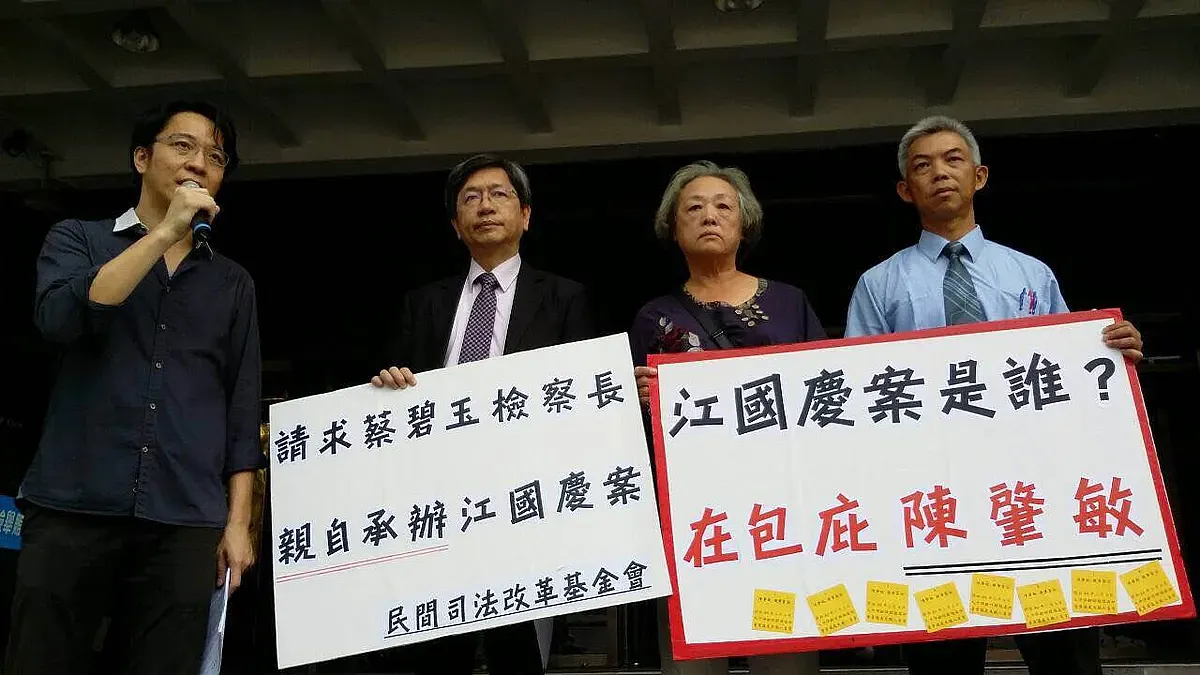
Who is Protecting Ch'en Chao-min?~Press Conference Requesting "Chief Prosecutor Tsai Pi-yu to Personally Handle the Chiang Kuo-ching Case"
Last edited: 2026-08-26
October 10 of this year marks what would have been Chiang Kuo-ching's 40th birthday. Yet, infuriatingly, even though Chiang's miscarriage of justice was vindicated more than four years ago, and prosecution against Chen Chao-min began in 2011, the culprits responsible for Chiang's death remain at large.
Around December 10, 2012, the Taiwan High Prosecutors Office remanded the non-prosecution disposition upon a second request for reconsideration, instructing the Taipei District Prosecutors Office to continue investigating the criminal case against Chen Chao-min. Nearly three years have passed since, and the case sits untouched at the Taipei District Prosecutors Office, far exceeding a reasonable investigation period.
In July of last year, the Control Yuan uncovered that former Minister of National Defense Chen Chao-min had issued eight slips of paper interfering with military trials, exposing the evil truth behind Chiang Kuo-ching's wrongful death. (See the appended Control Yuan investigation report.) Such new evidence severely undermines the legitimacy of the Taipei District Prosecutors Office's previous non-prosecution decision regarding Ch'en Chao-min. In a word, the reason Chen Chao-min and others interfered with Chiang Kuo-ching's trial from the very beginning was simply the fear that Chiang's case would be overturned and that they would be held accountable. For these individuals to disregard human life in pursuit of their own careers is the utmost depravity! Consequently, the prosecutors' previous argument—that "because military trials were 'independent,' the 'causal relationship' between the military's torture and Chiang Kuo-ching's death was severed, and therefore Chen Chao-min and others bear no responsibility for torture resulting in death, or even murder"—can no longer stand!
New evidence shows that three months before Chiang Kuo-ching was executed by firing squad on August 13, 1997, Hsu Jung-chou, a soldier in the same camp, confessed to being the real culprit. Upon learning of this, the presiding judge and public prosecutor handling the retrial attached great importance to it and intended to suspend the trial to clarify whether Hsu Jung-chou was indeed the real culprit before concluding the Chiang Kuo-ching case. Unexpectedly, high-ranking officials of the General Headquarters of the Air Force, led by Chen Chao-min, opposed and vetoed this. They even went so far as to issue unlawful notes interfering with the military trial, ultimately leading to Chiang Kuo-ching—who otherwise had a chance of escaping his unjust death—being wrongfully executed.
Previously, many assumed that these high-ranking officials, including Chen Chao-min, were simply so eager to solve the case that they resorted to unlawful torture and coercion, which, coupled with erroneous forensic identification, resulted in the miscarriage of justice against Chiang Kuo-ching. While their crimes were unforgivable, their motives were perhaps understandable. Now, we are shocked to realize that these high-ranking officials, including Chen Chao-min, knew full well that Chiang Kuo-ching was likely not the culprit, but chose to let a suspected real killer go free and murder Chiang Kuo-ching to cover up their prior crimes of torture and coercion. Afterwards, they even "lost" the key piece of physical evidence from the crime scene—the "blood-stained wooden stick from the crime scene bathroom"—making it difficult to identify the true culprit to this day.
The acts of Chen Chao-min and others, extinguishing their consciences for the sake of self-preservation, are utterly unforgivable. Armed with the Control Yuan's investigation report, physical evidence of the "issued notes," and testimonies from the presiding judge and other military officers in the Chiang case who clearly pointed to Chen Chao-min's interference in the trial during interviews, these concrete facts long ago crossed the threshold for indictment. Yet prosecutors at the Taipei District Prosecutors Office have turned a deaf ear and ignored the criminal complaint filed by Chiang's mother.
Given the passive and unusual investigative approach of the Taipei District Prosecutors Office, we reasonably suspect this reflects the ongoing implementation of former Taipei District Prosecutors Office Chief Prosecutor Yang Chih-yu's will. Yet he consistently hides behind the handling prosecutors, remaining silent and refusing or unwilling to step forward to take responsibility. He fails to exercise the principle of prosecutorial unity by directing or personally handling individual cases, and bravely bearing ultimate responsibility for indictment or non-prosecution, leading to a severe blurring of authority and accountability.

After Chief Prosecutor Tsai Pi-yu took the helm of the Taipei District Prosecutors Office on May 7 of this year, the Judicial Reform Foundation immediately sent a letter to Chief Prosecutor Tsai on the 19th inquiring about the progress of the investigation into the Chiang Kuo-ching case. Chief Prosecutor Tsai also replied in writing that the investigation was ongoing. However, five months have passed, and there is still no progress whatsoever in the case. What exactly is obstructing the pursuit of accountability in the Chiang Kuo-ching case? And who is protecting murderers like Chen Chao-min? Chief Prosecutor Tsai Pi-yu bears an unshirkable duty and must answer these questions to the public nationwide.
We specifically suggest that Chief Prosecutor Tsai Pi-yu invoke the provisions of Article 93, Paragraph 1 of the Judges Act to personally handle or direct the handling of the Chiang Kuo-ching case, thereby establishing public credibility, aligning authority with responsibility, and preventing any recurrence of unjustified delays.
At the same time, we also advocate that based on the relevant evidence investigated by the Control Yuan, as well as the civil first-instance trial case files and evidence regarding the Ministry of National Defense seeking compensation from civil servants such as Chen Chao-min, and considering the complex legal application involved in the Chiang Kuo-ching case, it is appropriate for the court to render a final adjudication. The Judicial Reform Foundation calls upon the Taipei District Prosecutors Office to promptly investigate and indict former Air Force Commander-in-Chief Chen Chao-min and others, initiate criminal proceedings, and hold Ch'en Chao-min and others accountable.
Appendix
Control Yuan Investigation Report 103000337
Attendees
Chiang Kuo-ching's Mother / Ms. Wang Tsai-lien
Chairman of the Judicial Reform Foundation / Attorney Lin Yung-sung
Director of the Judicial Reform Foundation / Attorney Yü Po-hsiang
CEO of the Judicial Reform Foundation / Attorney Kao Jung-chih
Press Contacts
CEO of the JRF / Attorney Kao Jung-chih
Executive Secretary of the JRF / Hsiao I-min
This article is an AI-generated translation of the original Chinese text. In the event of any discrepancy, the Chinese version shall prevail.