
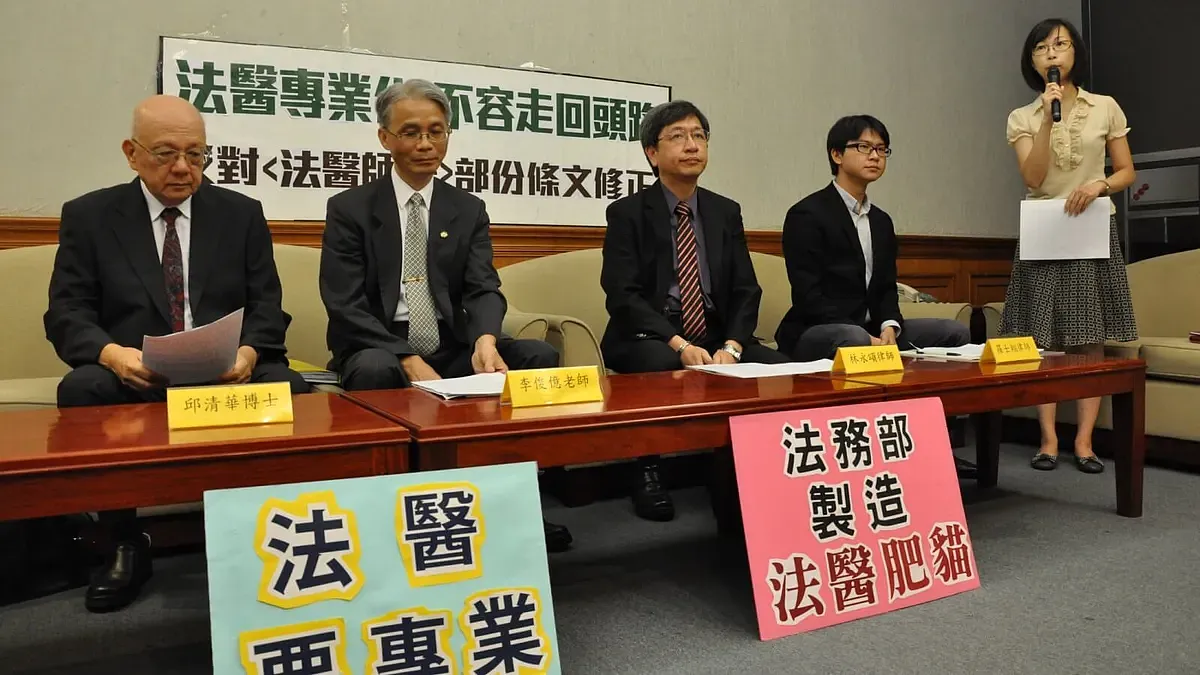
Defending Forensic Professionalism: No Turning Back on Reform — Press Conference Opposing Partial Amendments to the Forensic Pathologist Act
Last edited: 2026-08-26
Articles 3 and 4 of the current Forensic Pathologist Act stipulate that individuals must undergo specialized training in forensic medicine and pass the national examination to qualify as forensic pathologists, thereby ensuring their professional competence. However, on the grounds of "meeting workforce demands in forensic operations," the Ministry of Justice intends to amend the law to allow pathologists to obtain forensic pathologist qualifications simply upon application, exempt from specialized forensic training and examinations. This approach undermines the professionalism of forensic medicine and must be opposed.
Forensic pathologists possess expertise distinct from that of general pathologists. The training of a general pathologist is aimed at identifying the etiology of "natural death" (such as liver disease, kidney disease, lung disease, etc.), whereas a forensic pathologist must determine the manner of death in "unnatural or suspected unnatural deaths"—whether it constitutes suicide, homicide, or an accident. The training required for such determinations differs substantially from that of a general pathologist. Permitting general pathologists to obtain forensic pathologist qualifications without examination could result in erroneous cause-of-death determinations due to a lack of specialized expertise, thereby creating wrongful convictions. For instance, the forensic examiner in the wrongful conviction of Chiang Kuo-ching was originally a pathologist who, due to a lack of understanding of DNA testing, erroneously implicated Chiang in the crime.
A small number of forensic pathologists with pathology backgrounds who monopolize domestic autopsy cases are the primary drivers behind this regressive legislative amendment. Because they hold positions at the Institute of Forensic Medicine under the Ministry of Justice, or maintain close ties with the Institute, they secure large volumes of autopsy cases and thereby generate substantial extra income (as compensation is paid on a per-case basis). This is evidenced by the data in the Control Yuan's investigation report dated April 9, 2014 :
| Internal Forensic Physicians of the Institute of Forensic Medicine (Total: 3) | External Part-Time Forensic Physicians Retained by the Institute of Forensic Medicine (Top 3) | ||||||
| Name | Autopsies (Cases) | Cause of Death Determinations (Cases) | Total Annual Remuneration Received (NTD) | Name | Autopsies (Cases) | Cause of Death Determinations (Cases) | Total Remuneration Paid by the Institute (NTD) |
| Hsiao ○-ping | 345 | 359 | 4,264,423 | Chen ○-hung | 278 | 271 | 5,177,000 |
| Pan ○-hsin | 405 | 406 | 4,053,248 | Jao ○-tung | 298 | 295 | 5,621,000 |
| Tseng ○-yuan | 104 | 104 | 2,588,780 | Sun ○-tung | 276 | 284 | 5,364,000 |
| Total | 854 | 869 | 10,906,451 | Total | 852 | 850 | 16,162,000 |
Safeguarding Forensic Independence: Resisting Monopolization and Preserving Professional Integrity in Death Investigation
Figure 1: Case numbers and corresponding remuneration for the three full-time forensic physicians on staff and the top three part-time forensic physicians handling the highest caseloads at the Institute of Forensic Medicine, Ministry of Justice, in 2013 (ROC Year 102). Not only must these forensic physicians travel across the entire country to handle cases, but the part-time personnel may also have their primary occupations; with an average caseload of nearly one case per day, it is truly questionable whether high quality can be maintained.
The aforementioned forensic physicians fail to reflect on the shortcomings of this regressive legislative amendment, and even obstruct the implementation of the current Forensic Pathologist Act. Under the current Forensic Pathologist Act, those who graduate from a graduate institute of forensic medicine and complete their internship are eligible to take the national examination for forensic physicians; those who pass the examination acquire the qualification of a forensic physician and may conduct forensic physician services. This legislation was introduced in response to the past dilemma where students trained at government expense to hold dual qualifications as both medical doctors and forensic physicians were all unwilling to become full-time forensic physicians upon graduation, choosing instead to practice as clinical doctors. To resolve this dilemma, graduate institutes of forensic medicine opened their admissions to non-medical graduates, requiring them to make up medical school credits while restricting them from practicing as clinical doctors, permitting them only to serve as forensic physicians; through this, a cohort of younger public forensic physicians has been trained. However, the aforementioned forensic physicians use the pretext that these public forensic physicians do not hold "medical doctor" qualifications to refuse to supervise these younger public forensic physicians in performing autopsies, nor do they allow them to perform autopsy operations, continuing to monopolize autopsy work themselves and causing a generational gap in the succession of the forensic field.
Therefore, we urge that the Legislative Yuan must not pass the regressive amendment to the Forensic Pathologist Act promoted by the Ministry of Justice, and the relevant competent authorities should effectively resolve the phenomenon of a minority of forensic practitioners monopolizing autopsy operations and the resulting succession gap in the forensic field, so as to conform to the current legal framework and strengthen the professionalism of forensic medicine.
Attachments
- Amending the Medical Examiners Act Without Reviewing Wrongful Convictions: Ministry of Justice Lacks Oversight and Lowers the Bar ◎ Prof. Li Chun-i
- The Truth Behind the Ministry of Justice's Creation of Forensic "Fat Cats"
Attendees
Chairman, National Association of Forensic Physicians, R.O.C. / Dr. Ch'iu Ch'ing-hua
Professor, Department and Graduate Institute of Forensic Medicine, College of Medicine, National Taiwan University / Prof. Li Chun-i
Chairperson, Judicial Reform Foundation / Lawyer Lin Yung-sung
CEO, Taiwan Association for Innocence / Lawyer Lo Shih-hsiang
Press Contacts
Professor, Department and Graduate Institute of Forensic Medicine, College of Medicine, National Taiwan University / Prof. Li Chun-i
Chairperson, Judicial Reform Foundation / Lawyer Lin Yung-sung
This article is an AI-generated translation of the original Chinese text. In the event of any discrepancy, the Chinese version shall prevail.