
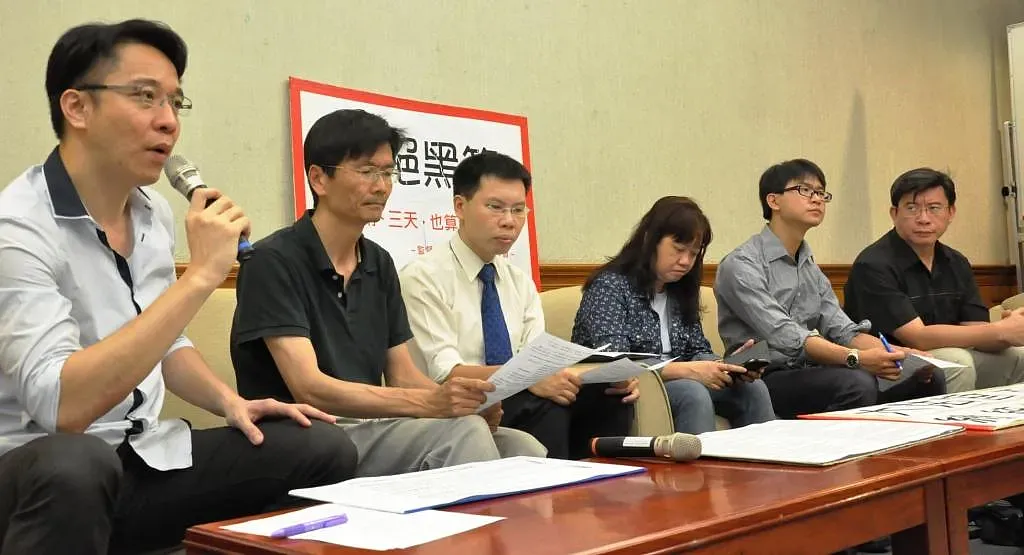
Reviewing Them in Two or Three Days—Is That Really Rigorous? ~ Press Conference by the Alliance for Citizen Monitoring of Grand Justices
Last edited: 2026-08-26
The Legislative Yuan will hold public hearings and review sessions for the Grand Justices nominees this Wednesday and Thursday (June 10 and June 11), and is very likely to complete the exercise of its consent power before Friday. In response, both the KMT and the DPP have stated they will conduct a rigorous review. However, the KMT caucus has also admitted that it did not send out questionnaires to the Grand Justices nominees this time. For as many as four Grand Justices nominees, scheduling only two days for public hearings and review sessions casts doubt on the rigor of the process from the procedural standpoint alone. Furthermore, why did the DPP—which not long ago repeatedly questioned the legitimacy of President Ma's nominations—agree to such a perfunctory and irresponsible review schedule? How can the public be convinced when Grand Justices are held in such high esteem, yet the review process is treated like a black box, threatening to replay the farce of "half a minute"?
Taking the Alliance's 2008 observation report as an example, a single committee simultaneously reviewed five nominees, giving each nominee less than an hour of review time. Not to mention that more than half of the legislators' questions were extremely hollow, showing a complete lack of adequate preparation and treating the review of Grand Justices as child's play. During the 2011 reviews, the Legislative Yuan similarly scheduled only one day for public hearings and one day for review sessions before voting on the four nominees. At that time, the KMT relied on its majority advantage to rush the appointment of Grand Justices so carelessly, drawing repeated criticism. Today, even if the KMT refuses to make progress, are the DPP and the Taiwan Solidarity Union (TSU) still going to act as enablers?
With the lessons of sloppy reviews not far behind, failing to conduct a substantive, cautious, and rigorous review is not only a dereliction of duty by legislators, but also hinders civic monitoring. Therefore, this Alliance raises the most solemn questions:
- The exercise of the consent power by the Congress must not be perfunctory or resemble the "half-minute" black-box process of the Cross-Strait Trade in Services Agreement. If they stubbornly proceed down this path, it demonstrates that the ruling party remains uncivilized, and the opposition is also seriously derelict in its duties. The opposition, especially the largest opposition caucus, the DPP, must answer why it agreed to such a review procedure and why it is rushing for fast-track and simplified reviews.
- What exactly are the "active qualifications" for this batch of Grand Justices nominees? If they were selected merely because they "lack disqualifying conditions," given how many such candidates exist, why these specific individuals? What kind of "active positive contributions" have these candidates actually "demonstrated" regarding constitutional rights?
All of these questions require time to investigate in order to be clearly and thoroughly explained, especially to "concretely" examine the "active positive contributions" they have "made" to constitutional rights.
At the same time, this Alliance opposes "fast-tracking" and "simplified reviews," demands that this personnel appointment be handled through a "deliberate procedure," and calls on the Legislative Yuan to immediately:
- Reschedule the review timeline and, following past precedent, first issue questionnaires to the nominees, giving them at least two weeks to respond in writing to various questions as reference materials during the review.
- The review of Grand Justices should broadly incorporate public opinions and grant civic groups sufficient preparation time to conduct separate evaluations of each nominee to serve as a reference for congressional review.
- For a single nominee, individual public hearings should be held for at least three days, followed by two days of review sessions, and the review report should be released one month before the exercise of the consent power to implement public oversight through a cautious and rigorous process.
Last week, the Alliance sent the "Personal Information Questionnaire for Judicial Yuan Grand Justices Nominees" to each nominee, hoping they would truthfully fill it out and return it to the Alliance as one of the evaluation standards. Meanwhile, the Alliance has also prepared more than thirty question sets, hoping the nominees can provide responses matching a constitutional stature.
Furthermore, given the tight schedule, the Alliance can only preliminarily gather specific questions and demand specific nominees to answer:
-
Question for Nominee Lin Chün-i (林俊益):
Chief Judge Chang Chun-tsung (張淳淙) declined the Grand Justiceship on the grounds that he had served as the presiding judge in President Ma's special-expenses case; do you think this is necessary from the perspective of judicial ethics? Back then, you chipped in to build a four-tael gold ship as a congratulatory gift for President Lin Kuo-hsien's (林國賢) promotion; how do you view that action today? -
Question for Nominee Wu Chen-huan (吳陳鐶):
Do you support the complete separation of trials and prosecution? Do you have a different view regarding Grand Justices Interpretation No. 729, which resolved that the Legislative Yuan may inspect investigative case files? -
Question for Nominee Huang Hung-hsiang (黃虹霞):
What concrete contributions have you made to constitutional maintenance and the protection of human rights? -
Question for Nominee Tsai Ming-cheng (蔡明誠):
Please elaborate on your view of freedom of the press based on Interpretation No. 689. -
Question for all four nominees:
Do you agree that the people possess the right to constitutional petition?
Finally, the Alliance releases the "2015 Question Bank of the Alliance for Citizen Monitoring of Grand Justices Nomination" and the "Personal Information Questionnaire for Judicial Yuan Grand Justices Nominees," and solemnly calls on the Legislative Yuan to reschedule the review timeline and ensure a cautious and rigorous review of the nominees' suitability.
As guardians of the constitutional order, the quality of Grand Justices directly affects the future well-being of all citizens nationwide. Therefore, from both "professional" and "democratic" perspectives, the nomination and appointment process of Grand Justices should be open, rigorous, and transparent; furthermore, the values and legal interpretations of the nominees should be made clear to the general public through a rigorous and deliberate review process. At the same time, legislators represent the country and its people in exercising the consent power over Grand Justices and should be entirely free of party baggage.
Appendices
- 2015 Question Bank of the Alliance for Citizen Monitoring of Grand Justices Nomination
- Personal Information Questionnaire for Judicial Yuan Grand Justices Nominees
Alliance Members
Taiwan Law Society
Hsueh-she
Taiwan Democracy Watch
Taiwan Association for Human Rights
Citizen's Constitutional Action Alliance
Taiwan Association for Innocence
Citizen's Congress Watch
Judicial Reform Foundation
Press Conference Representatives
Prof. Liu Ching-i (劉靜怡) / President of Hsueh-she, Convenor of the Alliance
Attorney Tu Yü-yin (涂予尹) / Executive Committee Member of the Taiwan Association for Human Rights
Prof. Hsu Wei-chün (徐偉群) / Board Member of Taiwan Democracy Watch
Attorney Lo Shih-hsiang (羅士翔) / Executive Director of the Taiwan Association for Innocence
CEO Chang Hung-lin (張宏林) / CEO of Citizen's Congress Watch
Attorney Kao Jung-chih (高榮志) / Executive Director of the Judicial Reform Foundation, Spokesperson of the Alliance
This article is an AI-generated translation of the original Chinese text. In the event of any discrepancy, the Chinese version shall prevail.