
Weaponizing the Zero-Day Flaw: The Alchemy of Payment Orders — Press Conference on Reforming the Payment Order System
Last edited: 2026-08-26
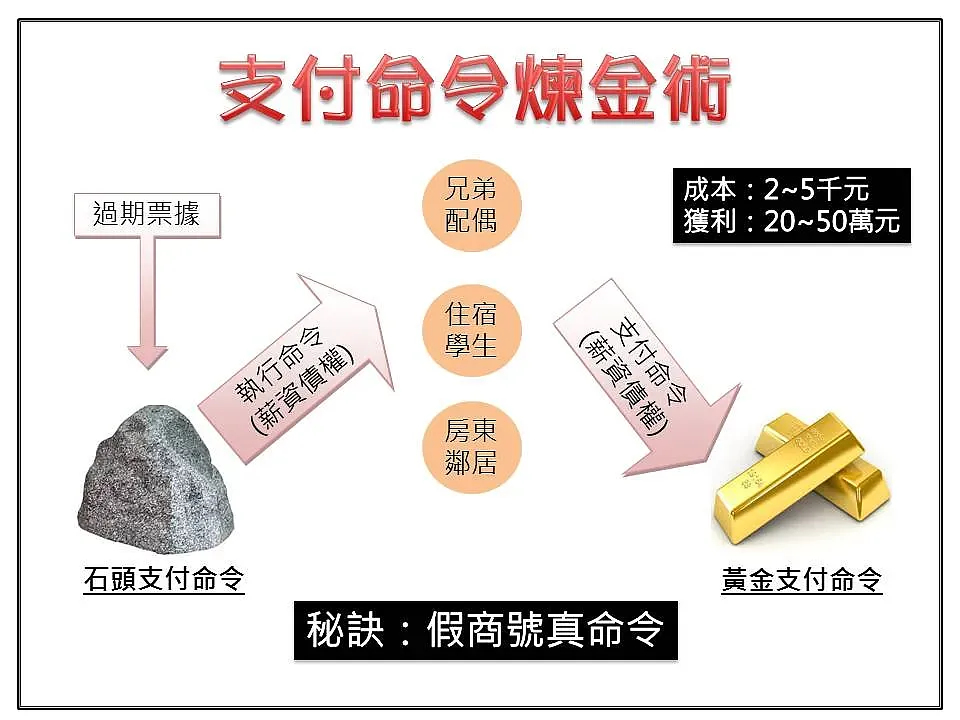
These people cannot be called a "fraud ring" because their methods of exploiting orders for payment to reap exorbitant profits have been certified by the courts as legal and innocent; we can only call them "order for payment alchemists." The alchemical process is as follows:

The alchemical process detailed above is compiled from the Kaohsiung District Court 2013 Criminal Judgment Yi-Zi No. 1184 (see Exhibit 1): "Defendant Chuang Yu-yen is a scrivener (i.e., a land registration agent), and her husband Li Kuo-hsiang (who is separately wanted as a fugitive) once served as the director of Hung-Fa Law Firm. Both are well-versed in the law... and deeply understand that regarding applications for the "seizure order and transfer order" over wage claims under the Compulsory Enforcement Act, as well as applications for issuing an "order for payment" based on urging procedures under the Code of Civil Procedure, the courts adopt merely a formal examination. Harboring evil intentions and fabricating facts without conducting actual investigations, based on a joint intent to commit the offense of making false entries in official documents, they first collected bad debts from external sources. Using these bad debts as a foundation, they applied for compulsory enforcement against the debtors of those bad debts, and then targeted relatives and friends of the debtors who owned assets. In the application for compulsory enforcement, they falsely claimed that the execution debtors were employed by such relatives and friends and that they held wage claims against them, and subsequently applied to the court for the issuance of seizure orders and transfer orders against those relatives and friends. Should such relatives and friends fail to file an objection according to law after receiving the seizure and transfer orders from the execution court, the two would proceed to apply to the court for orders for payment against those relatives and friends, thereby causing the execution court to record these untruthful matters in the seizure and transfer orders, and further causing the civil court to issue orders for payment containing untruthful contents against those relatives and friends based on the false transfer orders (as detailed in Schedule 1)." The victimization process experienced by the victims in this case is as follows:
-
A-Chueh, owner of a seafood restaurant:
A-Chueh runs a stir-fry seafood restaurant in Kaohsiung. The small shop has only four or five tables, which she usually tends to herself, with her son and husband helping out on holidays. One day when she returned home, the proprietress of the neighboring tea shop came to see her, saying she had just collected a court document on her behalf. When A-Chueh opened it, she saw the recipient listed as Yin-Chueh Snack Bar (i.e., A-Chueh), and the court was ordering the Yin-Chueh Snack Bar to withhold one-third of her husbands salary. Thinking that they were the Shun-Hsing Seafood Restaurant and that she did not pay her husband a salary, she assumed it was a fraud ring and ignored it. After a while, another court document arrived, with the recipient also listed as Yin-Chueh Snack Bar, which she again assumed to be a fraud ring. It was not until A-Chueh's bank account was completely emptied and her seafood restaurant was attached that she realized the order for payment she received was genuine, but it was already too late. A-Chueh questioned her husband about why he owed money to Chuang Yu-yen, and her husband stated that he had truly never borrowed money from anyone externally. As it turned out, the couple Chuang Yu-yen had somehow obtained a promissory note previously issued by A-Chueh's husband that had long since expired, used an order for payment to establish a claim against her husband, and then targeted A-Chueh.
The matter did not end there. Not long afterward, the proprietress of the neighboring tea shop also received a court document stating that A-Chueh's husband worked at the tea shop, and the court was ordering the tea shop proprietress to withhold one-third of his salary. It turned out that upon seeing the receipt signed by the tea shop proprietress for taking delivery of the mail, Chuang Yu-yen used this information to target the tea shop next. Fortunately, learning from A-Chueh's cautionary tale, the tea shop proprietress filed an objection in a timely manner and was not deceived.
-
Hsiao-Hui, a female college student:
Hsiao-Hui was born in Pingtung, moved to Kaohsiung to settle down after elementary school, and moved to Taipei to live in student housing after entering college. Her mother loved Hsiao-Hui dearly and had long ago registered the old family home in Pingtung under Hsiao-Hui's name, so Hsiao-Hui's household registration remained listed at the old Pingtung home. One day, her mother returned to the old home and saw a court document. Upon opening it, she saw the recipient listed as Pino Auto Repair Shop (i.e., Hsiao-Hui), and the court was ordering the Pino Auto Repair Shop to withhold one-third of her second uncle's salary. Thinking that Hsiao-Hui was busy studying and could not possibly run an auto repair shop, and that her second uncle had been working in China for many years and could not possibly be working here either, her mother thought it was fraud and ignored it. After a while, another court document arrived, with the recipient also listed as Pino Auto Repair Shop, which she again assumed to be a fraud ring. It was not until Hsiao-Hui entered the workforce and her employer unexpectedly received an execution order for wage garnishment that Hsiao-Hui and her mother discovered the orders for payment received were genuine. Her mother tracked down Hsiao-Hui's second uncle, filed four lawsuits, and spent over 200,000 NTD in attorney fees just to figure out that her second uncle did not owe Chuang Yu-yen money at all, successfully revoking Chuang Yu-yen's claim against her second uncle (Pingtung District Court Dec. 22, 2009 Pingtung District Court Hui-Fei-Li-Zi No. 90-Cu-21578 Letter). Even so, this could not undo the damage; for a decade, whenever Hsiao-Hui started a job at any company, she could not escape the nightmare of having her wages garnished.
The matter did not end there. Later, Hsiao-Hui's third uncle also received a similar court document stating that the third uncle was the owner of a certain auto repair shop, and the court was ordering the third uncle to withhold one-third of the second uncle's salary. It turned out that Chuang Yu-yen had somehow looked up Hsiao-Hui's third uncle's address and targeted him next. Fortunately, learning from Hsiao-Hui's cautionary tale, the third uncle filed an objection in a timely manner and was not deceived.
A query of district court judgments using the names of the couple Chuang Yu-yen and Li Kuo-hsiang reveals over 261 rulings on orders for payment (see table below). In this case, Li Kuo-hsiang (the husband) first applied for the first order for payment (the stone), then transferred the claim to Chuang Yu-yen (the wife), who then applied for the second order for payment (the gold). The judge held that Chuang Yu-yen's application for an order for payment based on lawful seizure and transfer orders was not unlawful, and even if the business entity declared was inaccurate, it was Li Kuo-hsiang's responsibility; therefore, Chuang Yu-yen was acquitted. Consequently, Chuang Yu-yen cannot be called a "fraud ring"; she can only be called an "order for payment alchemist."
| Court | Taipei | Shihlin | New Taipei | Keelung | Taoyuan | Hsinchu | Taichung | Changhua | Yunlin | Chiayi | Kaohsiung | Hualien | Pingtung | Total |
| Cases | 21 | 1 | 10 | 3 | 3 | 1 | 9 | 14 | 2 | 1 | 189 | 1 | 6 | 261 |
Source of Data: LawSource Legal Web (Full text: Chuang Yu-yen + Li Kuo-hsiang; Cause of action: Order for payment)
Because Li Kuo-hsiang (the husband) was sentenced to 5 years and 6 months of imprisonment for attempted murder with finality, he has been wanted as a fugitive since November 2011. However, according to an order for payment issued by the Kaohsiung District Court on April 22, 2015 (104年度司促字第11942號), Li Kuo-hsiang was still applying for orders for payment, suspected of continuing his alchemy out in the open. Even more terrifyingly, at the JRF press conference on May 14, 2015, to assist victims of orders for payment, "Wu Chun-hung," who victimized the country chicken restaurant owner Hsiao-Feng, was found to have previously served as a litigation agent alongside Chuang Yu-yen, suggesting possible mutual cooperation (Taichung District Court 101st Year Chung-Jian-Zi No. 258, Tainan Summary Court 100th Year Nan-Jian-Zi No. 308).
The legal loopholes exploited in orders for payment allow legal professionals to lawfully abuse them, a situation even more terrifying than a fraud ring, leaving victimized citizens with grievances they can hardly articulate. In fact, Taiwan is not the only country to experience this situation. After the bursting of Japan's economic bubble in the 1990s, orders for payment were similarly abused by debt collection agencies. To resolve the problem of victimized citizens, the Japanese legal community decided to abolish the res judicata (i.e., substantial conclusive effect) of orders for payment. The new law came into effect on January 1, 1998, and has been in place for 17 years. It has been highly successful in reforming the malpractice and did not reduce the public's utilization rate of payment urging. According to statistics from Japanese District Courts, in the 9th year of Heisei (1997), the number of newly received court cases (referring specifically to ordinary civil litigation cases) was 138,752. Following the implementation of the new law, from the 10th to 12th year of Heisei (1998–2000), the average annual number of newly received court cases was approximately 144,947, representing an increase of only 6,194 cases compared to the year before the amendment, accounting for 0.5% of the 3-year average total of newly received cases (1,134,359 cases) (see table below).
Statistics of Japanese District Courts

According to statistics from Japanese Summary Courts, in the 9th year of Heisei (1997), the number of newly received court cases (specifically ordinary civil litigation cases) was 276,120. Following the implementation of the new law, from the 10th to 12th year of Heisei (1998–2000), the average annual number of newly received court cases was approximately 302,040, an increase of only 25,920 cases compared to before the amendment, accounting for 1% of the 3-year average total of newly received court cases (1,830,812 cases) (see table below). The newly received court cases for summary court small-claims lawsuits introduced as a supplementary measure that year stood at 8,348 cases, and in subsequent years (1999–2009) the number of newly received court cases has been maintained at around 18,000.
Statistics of Japanese Summary Courts

Since the implementation of Japan's new law to this day, orders for payment (referred to as payment urging under the new Code of Civil Procedure) as a proportion of total litigation cases in summary courts have maintained a utilization rate of approximately 27% to 30% between the 21st and 25th years of Heisei (i.e., 2009–2013) (see table below). As seen from the above data, abolishing the res judicata of orders for payment under Japan's new law had a minimal impact on the total number of newly received civil court cases, and the utilization rate of orders for payment also remained at a steady proportion. The domestic reform of orders for payment in Japan has also been affirmed.

The Judiciary and Organic Laws and Statutes Committee of the Legislative Yuan passed the preliminary review of the draft amendments to partial articles of the Code of Civil Procedure and the Enforcement Act of the Code of Civil Procedure on May 25, stipulating that:
- Creditors applying for an order for payment shall bear the obligation of explanation and substantiation.
- The res judicata (conclusive effect) of orders for payment is abolished, but the enforcement power to apply for compulsory enforcement is still retained.
- Victims may file for a retrial within two years after the enactment of the law to be exempted from unsettled debts.
The entire bill is currently undergoing cross-caucus negotiations. Referring to Japanese legislative examples, abolishing orders for payment is an effective measure, and Taiwan's current reform has fallen many years behind Japan. We hereby call upon the legislators to pass the draft amendments to the order for payment before the end of the current legislative session on June 15 to safeguard the rights and interests of good citizens, and prevent the courts from degenerating into a tool for amassing illicit wealth.
Attending Representatives
Legislators / Lin Kuo-cheng, Lü Hsüeh-chang, Yü Mei-nu
JRF Executive Committee Members / Attorney Lin Yi-chih, Attorney Li I-ting
JRF Executive Secretary / Hsiao I-min
Press Contacts
JRF Executive Committee Member / Attorney Lin Yi-chih
This article is an AI-generated translation of the original Chinese text. In the event of any discrepancy, the Chinese version shall prevail.