
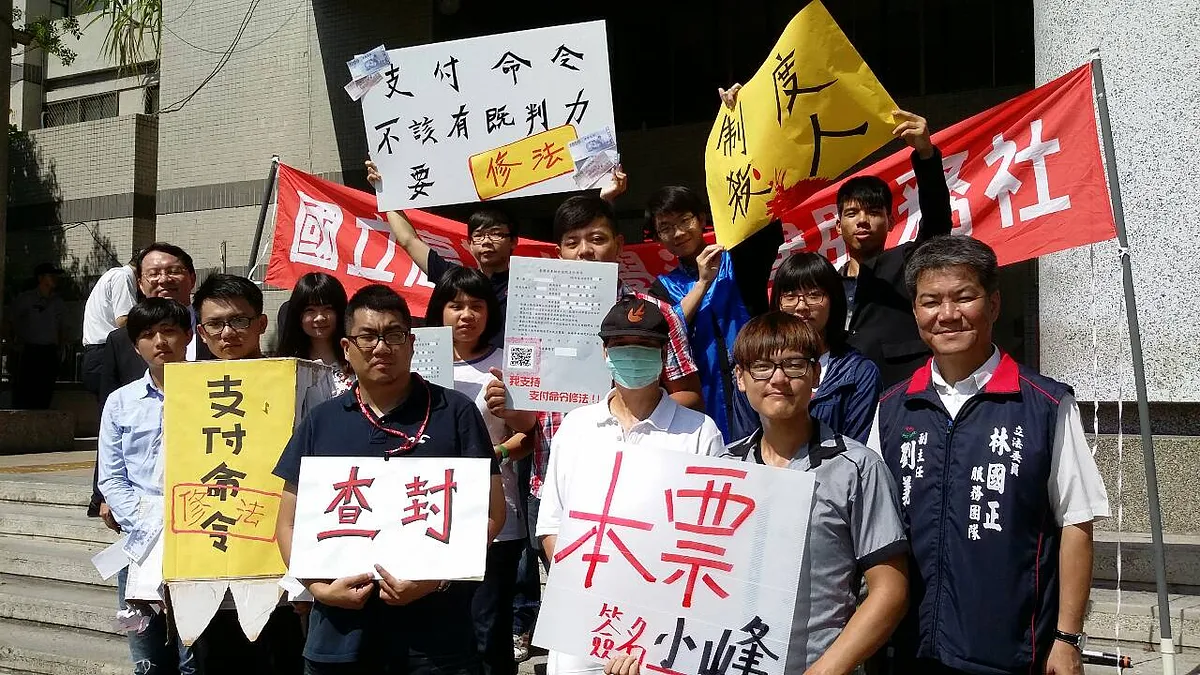
A Payment Order Injustice That Even Sherlock Holmes, Conan, CSI, or Dr. Henry Lee Could Not Vindicate ~ Press Conference to Rescue Victims of Payment Orders
Last edited: 2026-07-27
Hsiao-feng (a pseudonym) is a native of Kaohsiung. Although not highly educated, he is hardworking and diligent, starting out as a spray painter in an auto repair shop. After marriage, he and his wife jointly ran a free-range chicken restaurant to make a living. One day, a court bailiff suddenly appeared and sealed the restaurant, yet Hsiao-feng had no idea where the debt came from. Upon inquiring at the court, he learned that someone had applied for a payment order using a promissory note. Because Hsiao-feng did not file an objection within the 20-day statutory period, the creditor was able to apply for the compulsory execution of Hsiao-fengs assets. Hsiao-feng then recalled receiving a payment order previously, but assuming he had never issued a promissory note, he figured it must be a new scam and ignored it, never expecting he would actually fall victim to it.
An enraged Hsiao-feng immediately filed a complaint at the prosecutors office against the holder of the note (the creditor). The prosecutor commissioned the Criminal Investigation Bureau to examine the promissory notes (totaling 10 notes, with a principal of NT$300,000 plus approximately NT$15,000 in interest), confirming that none of the signatures belonged to Hsiao-feng, nor did the fingerprints on the issuer line. However, the signatures and fingerprints did not belong to the noteholder either, meaning there was no proof the noteholder had forged the instruments. Consequently, the prosecutor had no choice but to issue a non-prosecution disposition. Thinking it was enough to prove he did not sign the notes, Hsiao-feng applied for a retrial based on the Criminal Investigation Bureaus expert report, hoping to have the debt revoked. To his dismay, the Kaohsiung District Court still refused to revoke the payment order issued on the fake promissory note, reasoning that Hsiao-feng had failed to find the perpetrator who forged the note or have the perpetrator convicted, and thus under the law, he was not permitted to apply for a retrial. (See Kaohsiung Summary Court 102年度雄再簡字第3號; Kaohsiung District Court 102年度再簡抗字第1號) Although forensic science cleared Hsiao-fengs name, the prosecutors office and the court were powerless to vindicate him.
Upon examining Hsiao-fengs case, it became apparent that this was not an isolated incident, but rather a premeditated syndicated crime. Take the noteholder in this case, Wu Chun-hung (吳春宏), for example. Between 2010 and 2014, Wu Chun-hung applied for payment orders in district courts across the country in over 100 cases, with the Kaohsiung District Court accounting for over 80 of them, making it the most frequent venue. Hsiao-feng was merely one of the victims. Wu Chun-hung was also indicted and convicted of offenses such as forgery and fraud in connection with his applications for payment orders.
| Court Name | Case Number | Defendants | Case Summary | Judgment Result |
| Kaohsiung District Court (Jan 16, 2015) |
103-Yi-364 | Wu Chun-hung Hung Shang-cheng |
Falsely claiming an executive title to apply for a payment order | 1 year imprisonment |
| Kaohsiung District Court (Jan 12, 2015) |
102-Su-721 | Wu Chun-hung | Stealing and affixing others seals to apply for a payment order | 2 years imprisonment |
| Kaohsiung District Court (Jul 4, 2013) |
102-Shen-Su-67 | Wu Chun-hung Hung Shang-cheng |
Obtaining blank IOUs and filling in his own name to apply for a payment order | 2 months imprisonment, commutable to a fine |
| New Taipei District Court (Dec 19, 2012) |
101-Su-583 | Wu Chun-hung Hung Shang-cheng |
Fraudulently obtaining blank IOUs and filling in his own name to apply for a payment order | 3 months imprisonment, commutable to a fine |
As seen from the aforementioned judgments, Wu Chun-hung acquired proofs of debt such as blank IOUs, blank checks, and blank promissory notes through usurious syndicates, and then targeted individuals and owners of small restaurants and eateries using personal information gathered through illicit channels to randomly apply for payment orders. As long as someone inadvertently failed to file an objection, a legitimate debt claim would be established. Wu Chun-hungs methods were virtually impossible to guard against; once targeted, even if the victim knew how to file an objection, he would change addresses and repeatedly file for payment orders over and over again until the scam succeeded. An analysis of Wu Chun-hungs scam utilizing payment orders reveals the following characteristics:
- The contact address of the creditor applying for the payment order is a post office box rather than a regular address.
- Mass applications for payment orders are made by an individual (who is not a financial or legal professional), or multiple repeated applications are made against the same debtor.
- Payment order rulings are frequently used as an opportunity to access the debtors household registration transcript, business registration, or other personal information.
- Payment orders are applied for using seizure orders and transfer orders.
- Payment orders are applied for using checks or promissory notes whose statutory limitation periods have expired.
Courts Should Not Be Accomplices to Crime: Victims of Payment Orders Need Rescue
Hsiao-feng is an innocent victim of a crime, yet because courts indiscriminately issue payment orders, his property was auctioned off and his lifelong hard work reduced to nothing. Although forensic science has proven that the promissory note was not signed by Hsiao-feng, the court still refuses to vindicate him, thereby allowing the criminals to go unpunished while acting as an accomplice to fraud. We demand:
- The Kaohsiung District Prosecutors Office must reopen the investigation into Hsiao-fengs case and identify the perpetrator who forged the promissory note.
- The litigation guidance unit of the Kaohsiung District Court should establish a special research project to find lawful and effective litigation pathways and guide Hsiao-feng in revoking the improper payment order to prevent his property from being subjected to execution again.
- The Judicial Yuan and the Kaohsiung District Court should review the current payment order issuance procedures to prevent them from continuing to be abused by criminal syndicates.
Hsiao-fengs case is merely the tip of the iceberg regarding the abuse of payment orders, and the Kaohsiung District Court is not the only court targeted and exploited by criminal syndicates. The payment order system is in urgent need of legislative reform. To help all sectors gain an in-depth understanding of the reform demands and accelerate the legislative process, the Judicial Reform Foundation has compiled a legislative advocacy brief on payment orders, calling upon the Legislative Yuan to expedite its review process and reform the deeply flawed payment order system.
[Attendees]
Payment Order Victim / Hsiao-feng
President of the Providence University Legal Aid Club / Student Li Chao-chi
Standing Executive Committee Member of the Judicial Reform Foundation / Attorney Liu Chia-jung
Representative of the Payment Order Reform Team / Attorney Liu Che-hung
Service Team of Legislator Lin Kuo-cheng / Deputy Director Liu I-lung
[Press Contact]
CEO of the Judicial Reform Foundation / Attorney Kao Jung-chih 02-25231178
This article is an AI-generated translation of the original Chinese text. In the event of any discrepancy, the Chinese version shall prevail.