
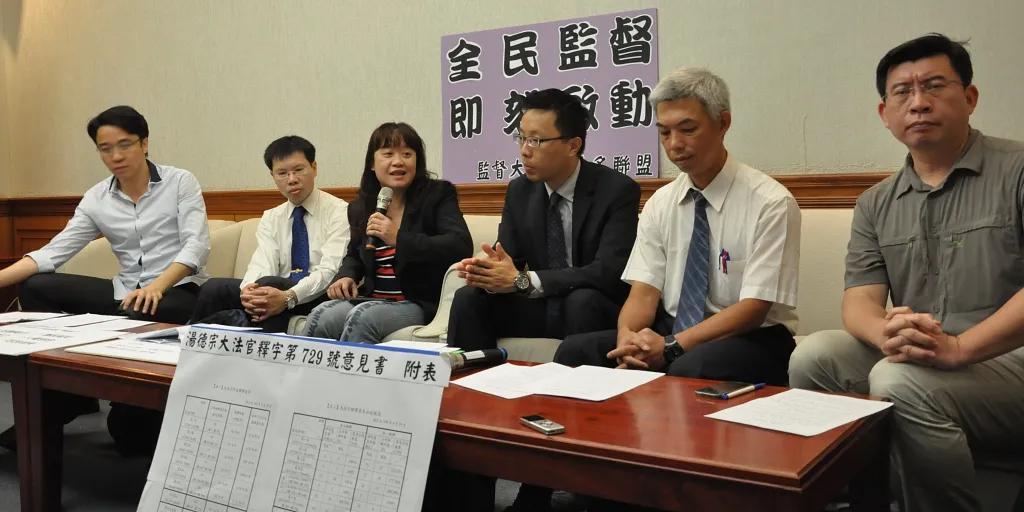
Mobilizing Public Oversight: Coalition for the Monitoring of Grand Justices Inaugural Press Conference
Last edited: 2026-08-26
The terms of four Grand Justices—Lin Hsi-yao, Chih Chi-ming, Lee Chen-shan, and Tsai Ching-yu—will expire at the end of September this year. Consequently, the Office of the President recently nominated Judge Lin Chun-yi, Prosecutor Wu Chen-huan, Attorney Huang Horng-shya, and Professor Tsai Ming-cheng as new Grand Justices, sending official requests to the Legislative Yuan to exercise its power of consent. As guardians of the Constitution, the selection of Grand Justices must be approached with utmost prudence. Therefore, several civil society organizations—including the Taiwan Law Society, Taipei Society, Taiwan Democracy Watch, Taiwan Association for Human Rights, Citizen Constitutional Reform Alliance, Taiwan Alliance to End Wrongful Convictions, Citizen Congress Watch, and Judicial Reform Foundation—will reactivate the "Coalition for the Monitoring of Grand Justice Nominations" to examine the suitability of the current nominees through comprehensive evaluation and public oversight.
As the ultimate interpreters of the law, the interpretations rendered by the Grand Justices have a far-reaching impact. Therefore, in theoretical discourse and the defense of human rights, Grand Justices should demonstrate even greater perseverance and lead legal development. Specifically, candidates for Grand Justice should possess the following positive qualifications:
- They should possess concrete achievements that sufficiently demonstrate their human rights philosophy, constitutional awareness, democratic literacy, and professional competence.
- They should have a strong sense of mission to defend judicial independence, safeguard people's rights, pioneer progress, and lead the needs of the times.
- They must have no stains on their moral character and integrity, nor any conduct inconsistent with the reputation of a Grand Justice.
- Nominations of Grand Justices should not be based primarily on ethnicity, geography, background, or ideology.
To examine whether the current Grand Justice nominees meet the aforementioned qualifications, the Coalition will form a "Grand Justice Nominees Evaluation Committee" to review the nominees' moral character, integrity, academic ability, professional performance, constitutional awareness, human rights philosophy, and judicial reform policies, and will publish the evaluation results in the near future as a reference for the public to assess the suitability of the current nominees.
Secondly, as candidates nominated for Grand Justice, they should have an obligation to inform the public of their past achievements in legal work and relevant background information to serve as subjects for public scrutiny. Therefore, the Coalition will also send a "Grand Justice Nominee Information Questionnaire" to each nominee, hoping that each nominee can concretely explain their professional performance and, through the disclosure of information, articulate the grounds justifying their appointment as Grand Justice.
Finally, the Coalition will also openly solicit questions from all sectors of society to be used in questioning the Grand Justice nominees. Because the scope encompassed by constitutional interpretation is broad and cannot be accomplished through legal expertise alone, it is hoped that through the questions provided by various sectors, the Grand Justice nominees will be encouraged to state their positions on issues such as human rights, gender, the environment, ethnicity, and labor[1].
In recent years, the average number of interpretations published annually by the Grand Justices has declined drastically, while the degree of division in opinions has remained consistently high (see the appendix table of Grand Justice Tang Te-chung's opinion in Interpretation No. 729). This creates a substantial gap between the reality and the public's expectation for Grand Justices to lead the changes of the times and defend the people's rights. At this moment when the new Grand Justice nominees have emerged, the public should keep their eyes open and strive to scrutinize whether each nominee is qualified, thereby urging the Legislative Yuan to fulfill its oversight duties and prevent unqualified candidates from becoming the next Grand Justices.
Coalition Members Taiwan Law Society
Taipei Society
Taiwan Democracy Watch
Taiwan Association for Human Rights
Citizen Constitutional Reform Alliance
Taiwan Alliance to End Wrongful Convictions
Citizen Congress Watch
Judicial Reform Foundation
Press Conference Representatives in Attendance Professor Liu Ching-yi / President of Taipei Society, Coalition Convener
Attorney Yu Po-hsiang / Director of Taiwan Democracy Watch
Attorney Weng Kuo-yen / Vice President of Taiwan Association for Human Rights
Attorney Tu Yu-yin / Executive Committee Member of Taiwan Association for Human Rights
Executive Director Chang Hung-lin / Executive Director of Citizen Congress Watch
Attorney Kao Jung-chih / Executive Director of Judicial Reform Foundation, Coalition Spokesperson
[1] Regarding "Questions for Grand Justices" or other related inquiries, please send them to the Coalition Secretariat mailbox: din@jrf.org.tw ※ For "Questions for Grand Justices," please refer to: Civil Coalition for Monitoring Judicial Yuan Grand Justice Candidates 2008 Question Bank
This article is an AI-generated translation of the original Chinese text. In the event of any discrepancy, the Chinese version shall prevail.