
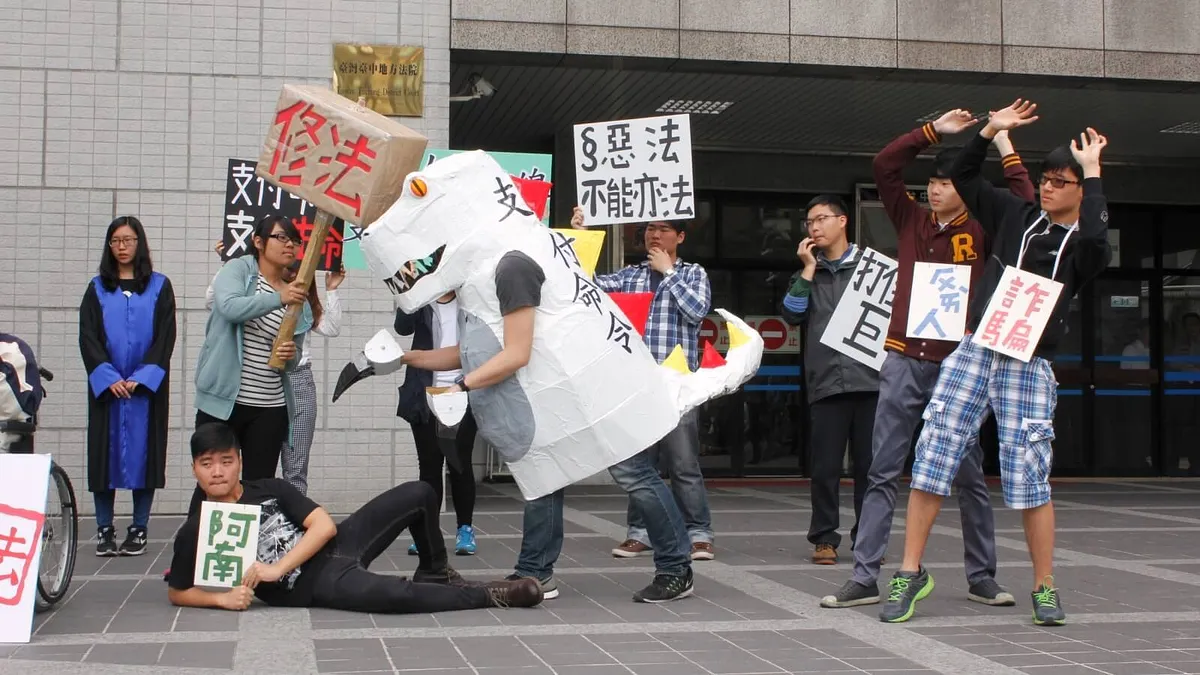
Victims of Payment Orders: Pleading with the Court for a Way Out — Press Conference on Reforming the Payment Order System
Last edited: 2026-08-26
Restoring Procedural Justice: Systemic Failures in Taiwan's Payment Order Regime and the Imperative for Legislative Action
On January 13 of this year, the Judicial Reform Foundation held a press conference to propose draft amendments to Articles 514 and 521 of the Code of Civil Procedure as well as the addition of Articles 4-4 and 12 to the Enforcement Act of the Code of Civil Procedure, aiming to reform the defects of the current payment order system. The foundation also publicly solicited cases from victims of payment orders to continually reflect the public's suffering!
The payment order is a system provided under Articles 508 to 521 of the Code of Civil Procedure for the expeditious realization of creditor claims; upon a creditor's application, without the need to attach evidence and without a judge holding a hearing, the court will issue it. After receiving it, if the debtor does not raise an objection within 20 days, the payment order will have "the same effect as a final and binding judgment," the claim will become finalized, and compulsory execution can be carried out. The issuance of payment orders is lax, and the service process often suffers from slipshod defects; in recent years, it has been abused by fraud syndicates, with victims spread all across Taiwan. Because ex post remedies are virtually nominal, calls for legal reform have arisen across various sectors.
Over the past two months, we have collected many egregious cases and adapted selected highlights into short stories published online. The sympathetic experiences of these victims have elicited widespread public resonance:
Short Stories of Payment Orders:
- Why Repay Credit Card Debt When No Credit Card Debt Was Owed
- Revenge from an Ex-Wife
- Those Who Trusted the Court Were Ultimately Betrayed by the Court
- A Sudden Backstab from the Most Familiar Stranger
Among these, the most outrageous and tragic experience happened to a kind citizen, "A-nan," in Taichung City. A-nan is the person in charge of a small and medium-sized enterprise who often had business dealings with A-hui's company. A client of A-hui defaulted on debts, dragging down the company's finances; in desperation, A-hui forged the seals of A-nan and another affiliated vendor to endorse promissory notes/checks issued by his company to turn over loan funds. However, the checks ultimately bounced! A-nan only learned of this after receiving notices from Bank A and Bank B; he immediately filed a criminal complaint against A-hui for forgery of documents and notified Bank A and Bank B.
Bank A sued A-hui and A-nan in the Taipei District Court for payment on negotiable instruments, but the judge ruled that A-nan was not jointly and severally liable because the endorsement on the checks was forged. Bank B, on the other hand, applied to the Taichung District Court for the issuance of a payment order; coincidentally, A-nan's company had relocated, and no one was present at the original business address to receive documents. Completely unbeknownst to A-nan, the payment order was served by deposit (affixed to the mailbox), and because the 20-day statutory period for objection lapsed, it became final and binding; Bank B then applied for compulsory execution accordingly. A-nan only became aware of the payment order when his deposit account was subjected to compulsory execution. He was furious that Bank B still sought debt recovery from him despite clearly knowing that the check endorsement was forged, but Bank B ignored him; with no other recourse, he could only apply to the Taichung District Court for a retrial against the payment order.
A-nan presented proof of A-hui's confession before the prosecutor, hoping that the Taichung District Court would revoke the payment order. Unexpectedly, the judge stated that a mere confession was insufficient and that A-hui's conviction must become final and binding to satisfy the requirements for a retrial; the Taichung District Court dismissed A-nan's retrial application. A-nan appealed to the collegial panel of the Taichung District Court, but it was dismissed again, on the identical grounds that an application for retrial could only be made once A-hui's guilt was finalized.
After a long wait, the Taiwan High Court rendered a final and binding judgment convicting A-hui of forgery of documents, sentencing him to two years of fixed-term imprisonment. A-nan promptly filed a second application for retrial. Out of all expectations, the retrial was dismissed once again. The Taichung District Court's rationale was that pursuant to Paragraph 2, Article 500 of the Code of Civil Procedure, a retrial must be filed within five years after the payment order becomes final and binding; Bank B's payment order became final on June 20, 2008, meaning that filing for a retrial before June 19, 2013 was lawful, but the Taiwan High Court's judgment finalizing A-hui's conviction was rendered on December 25, 2013, which already exceeded the five-year period, barring an application for retrial. A-nan filed an interlocutory appeal to the Taichung Branch of the Taiwan High Court, but it was still dismissed, citing the "Supreme Court 1972 Tai-Kang-Zi No. 407" civil precedent to explain that A-hui's finalized conviction for forgery of documents actually could not serve as a ground for retrial against a payment order. Therefore, even if the five-year retrial period had not expired, an application for retrial would still be barred. It turns out that for victims of payment orders, legal remedy is a complete dead end.
| Date | Chronology of A-Nan's Payment Order Case | Judgment Reference Number |
| Since Nov 2007 | A-Hui forged seals and fraudulently endorsed multiple checks from Banks A and B in A-Nan's name | |
| Since Feb 2008 | Banks A and B notified A-Nan of bounced checks; A-Nan filed a criminal complaint against A-Hui for forgery and notified Banks A and B | |
| Mar 31, 2008 | Bank A sued A-Hui and A-Nan for payment of the instrument; Taipei District Court ruled that the check endorsements were forged impersonations and A-Nan was not required to bear joint liability | Taipei District Court 97, Bei-Chien, 2192 |
| May 1, 2008 | A-Nan moved out of his original registered business location and applied for an address change | |
| May 9, 2008 | Bank B applied for a payment order demanding A-Nan pay the instrument; Taichung District Court approved and issued it | Taichung District Court 98, Si-Chu, 11098 |
| Jun 20, 2008 | Payment order served to A-Nan's original registered business location via service by leaving documents at the premises. Exceeding the 20-day objection period, Bank B's payment order became final and binding | |
| Jun 29, 2009 | Bank B applied for compulsory execution, attaching funds in A-Nan's account. A-Nan only then learned of the Taichung District Court payment order | |
| Jul 16, 2009 | A-Nan applied for a retrial against Bank B's payment order | |
| Oct 7, 2009 | Taichung District Court dismissed A-Nan's application for retrial on the grounds that A-Hui's criminal offense of forgery had not yet been finalized by a criminal judgment | Taichung District Court 98, Zhong-Zai-Chien, 5 |
| Dec 30, 2009 | Taichung District Court dismissed the appeal against the retrial judgment dismissing A-Nan's case on the grounds that A-Hui's criminal offense of forgery had not yet been finalized by a criminal judgment | Taichung District Court 98, Zai-Chien-Shang, 1 |
| Jul 17, 2013 | Shihlin District Court ruled that out of the 10 checks A-Hui was prosecuted for forging by the prosecutors, 8 were guilty (including the check endorsed by A-Nan), sentencing him to an executed term of 2 years in prison. The prosecutor appealed the dissatisfied parts | Shihlin District Court 101, Su, 195 |
| Dec 25, 2013 | Taiwan High Court dismissed the prosecutor's appeal, finalizing A-Hui's conviction for forgery (including the check endorsed by A-Nan) with an executed prison term of 2 years | Taiwan High Court 102, Shang-Su, 2510 |
| Sep 26, 2014 | A-Nan applied for a retrial on the grounds of A-Hui's finalized conviction for forgery. Taichung District Court dismissed the retrial application on the ground that the case had exceeded the 5-year statute of limitations for retrials as of Jun 20, 2013 | Taichung District Court 103, Zai, 8 |
| Nov 21, 2014 | Taichung High Court cited Supreme Court Ruling 61-Tai-Kang-407, dismissing the interlocutory appeal on the grounds that a finalized conviction for forgery does not constitute grounds for a retrial either | Taichung High Court 103, Kang, 505 |
Protecting Victims of Fraudulent Claims: Ending Judicial Complicity and Guaranteeing Legal Remedies in Payment Order Injustices
Courts Must Not Act as Accomplices to Crime: Pleading for a Way Out for Victims of Payment Orders
A-nan is an innocent crime victim, yet because the court indiscriminately issued a payment order and slipshodly executed service procedures, his company accounts were frozen, resulting in severe financial losses and reducing a lifetime of hard work to nothing. What is most unacceptable is that although the perpetrator has already received a final conviction, the court still refuses to exonerate A-nan, continuing to demand that A-nan compensate for a debt he never owed and thereby benefiting the perpetrator. The court has shockingly degenerated into an accomplice to fraud.
In this case, the court first stated that a retrial could only proceed after the criminal judgment became final and binding; once the criminal judgment became final and binding, it then stated that because the five-year period had lapsed, no retrial could be initiated; it further stated that payment orders differ from ordinary civil cases and cannot be subjected to retrial even after a criminal judgment becomes final and binding. Such contradictory judicial chaos leaves the public at a complete loss. We demand:
- The litigation assistance units of the Taichung District Court and the Judicial Yuan should immediately establish a dedicated research project
- Identify lawful and effective litigation avenues to assist A-nan in revoking the improper payment order
- Extensively list remedy methods for payment orders and make them publicly known to assist citizens in safeguarding their rights
- The litigation guidance units of the Taichung District Court and the Judicial Yuan should immediately establish a research project.
- They must find lawful and effective litigation pathways and guide A-Nan in revoking the improper payment order.
- They should itemize remedies for payment orders, publicize them widely, and assist the public in safeguarding their rights.
| Flaws of Payment Orders | Lessons from A-Nan's Case |
| Payment orders require no review of evidence and are issued indiscriminately. | Bank A pursued the instrument debt through a lawsuit, and the judge held a hearing to examine evidence, successfully uncovering that the check endorsement was forged. Bank B pursued the instrument debt via a payment order, which the judge issued without holding a hearing, failing to uncover that the check endorsement was forged. |
| Service procedures are sloppy and easily exploited by actors with malicious intent. | Knowing that A-Nan stated the check endorsement was forged and possessing his phone number and residential address, Bank B took advantage of A-Nan's change of company address to skillfully maneuver the court into issuing a payment order to A-Nan's company, resulting in no one being present to accept the mail and allowing the payment order to become final and binding. |
| Remedy pathways are chaotic, rendering the retrial system practically useless. | The court first told A-Nan that a retrial was possible as soon as the criminal judgment became final, but once the judgment was finalized, it claimed that the 5-year limit had been exceeded and retrials were barred, and further claimed that finalized criminal judgments do not permit retrials either. These shifting and contradictory views leave people with nowhere to turn. |
| Compulsory execution procedures for payment orders cannot be halted. | When Bank B executed against A-Nan's account, pursuant to Supreme Court Ruling 71-Tai-Shang-1742, an action for confirmation cannot be brought against a payment order, nor can an action of objection by the debtor be brought during compulsory execution. Even if the debt does not exist, execution cannot be suspended. |
Reforming Summary Debt Enforcement: Safeguarding Due Process and Amplifying Victims' Voices Against Procedural Abuse
Payment Orders Must Be Reformed; Victims Must Speak Out
Regarding the civil society calls demanding the reform of the payment order system, the Judicial Yuan has failed to take them seriously, asserting that "it is inappropriate to rashly alter the current system based on these few exceptional circumstances, which would severely affect the interests of creditors who legitimately utilize this procedure in more than 400,000 cases annually to establish rights and obligations relationships" (see Judicial Yuan Press Release, January 14, 2015). Today, we once again present the aforementioned four real cases to sternly inform the Judicial Yuan that the payment order system indeed has systemic flaws and is by no means confined to a few exceptions. In particular, the lessons from A-nan's case compiled in the table above all the more highlight the defects of payment orders. We demand:
- The Legislative Yuan should expeditiously review the civil society version of the draft amendment to the payment order provisions to remedy the loopholes in the current system.
- The Judicial Yuan should face the defects of payment orders directly and propose solutions to assist innocent victims.
- Victims of payment orders should unite together; welcome to contact the Judicial Reform Foundation to jointly push for legal reform.
Press Conference Representatives Payment Order Victim / A-nan (Please assist in protecting real name and identity)
Judicial Reform Foundation Standing Executive Committee Member / Attorney Liu Chia-jung
Judicial Reform Foundation Standing Executive Committee Member / Attorney Lin Chih-chung
President of the Legal Service Club of Providence University / Student Chang Yu-chu
Press Contact Judicial Reform Foundation / Attorney Kao Jung-chih 02-2523-1178
This article is an AI-generated translation of the original Chinese text. In the event of any discrepancy, the Chinese version shall prevail.