
No Credit Card Debt Owed, Why Pay Credit Card Debt?! — Real-Case Adapted Story on Payment Orders (Part 1)
Last edited: 2026-08-26
Hsiao-Hua applied for a credit card with Bank A in 1999. In September 2000, she lost the card and reported it lost to Bank A in October 2000. To her surprise, in 2010, Hsiao-Hua received a payment order applied for by Company B from the OO District Court. Company B claimed that between September 30, 2002, and January 30, 2007, Hsiao-Hua had accumulated a total of NT$266,881 in unpaid credit card debt with Bank A, which Bank A had subsequently assigned to Company B, prompting Company B to petition the court for a payment order against Hsiao-Hua.
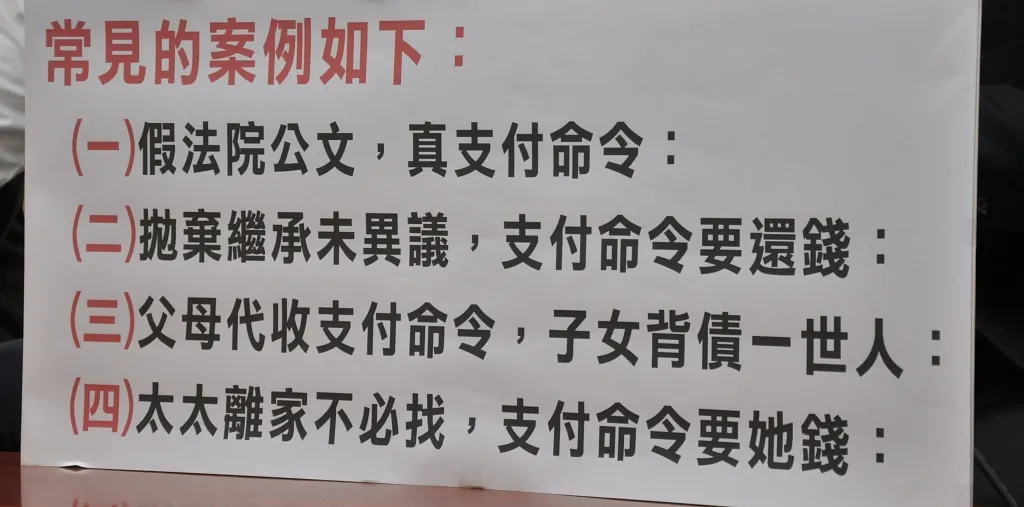
Upon receiving the payment order, Hsiao-Hua thought to herself, "I reported Bank A's credit card lost back in October 2000, how could I possibly owe Bank A over NT$260,000 in credit card debt between September 2002 and January 2007?" Therefore, although she received the payment order, believing firmly that she did not owe Bank A any money, she simply left it alone and did not file an objection to the payment order. To her astonishment, a few months later, Company C, where Hsiao-Hua was employed, informed her that because an attachment order from the court had been received a few days prior, one-third of Hsiao-Hua's salary would be garnished every month starting next month and paid to Company B. Hearing this, Hsiao-Hua was utterly shocked and realized that Company B had used the previously petitioned payment order to request the court to attach her salary.
Consequently, Hsiao-Hua immediately filed a retrial suit against the payment order with the court, requesting the court to revoke Company B's payment order on the grounds that she never owed Bank A credit card debt from the very beginning. Regrettably, not only did the court fail to require Company B to submit evidence proving that Hsiao-Hua indeed owed Bank A NT$266,881 in debt, but it also held that since Hsiao-Hua knew at the time that she did not owe Bank A money, she should have filed an objection with the court in the first place rather than leaving the payment order unattended. Furthermore, the court held that since Hsiao-Hua had long known that Company B used her alleged credit card debt to Bank A as the reason for petitioning the court for a payment order, she failed to file for a retrial immediately after the payment order became final; instead, she waited until her salary was attached before filing for retrial, which had long exceeded the statutory time limit for filing a retrial. Consequently, the court dismissed Hsiao-Hua's petition for retrial.
Upon receiving the judgment, Hsiao-Hua was filled with helplessness and confusion. "Why is it that even though I don't owe Bank A money, I still had to file an objection with the court stating that I don't owe Company B money? Also, since Company B is the one claiming that I owe Bank A money, why doesn't Company B need to present evidence to the court to prove that I *truly* owe them money? Isn't a court a place that values evidence? Why did the court believe what Company B said without requiring them to submit any evidence?"
If you are Hsiao-Hua, or have experienced something similar to Hsiao-Hua, please fill out the Payment Order Victim Complaint Form immediately and join us in fighting against payment orders! If you do not know anyone, you are also welcome to share this post so you can help Hsiao-Hua or friends in a similar situation.
The above story is excerpted and adapted from the contents of "Taiwan Kaohsiung District Court 100-Su-Tzu-No. 1 Judgment".
This article is an AI-generated translation of the original Chinese text. In the event of any discrepancy, the Chinese version shall prevail.