
Betrayed by the Courts in the End Despite Trusting Them?! ~ A Short Story Adapted from Real Judicial Judgments - Part 3
Last edited: 2026-08-26
If you were to ask Ah-Nan what day he could never forget in his lifetime, I think it would undoubtedly be June 20, 2008.
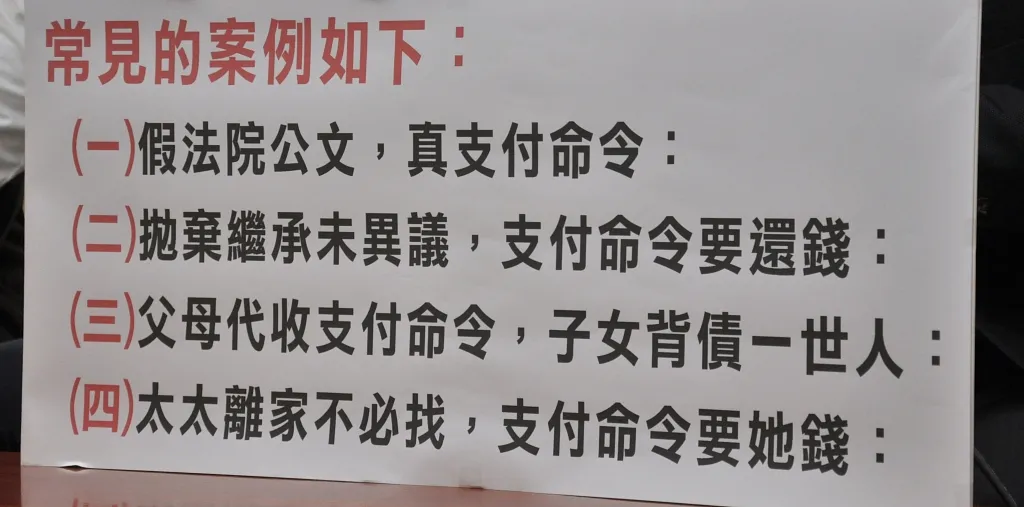
Around July 2009, Ah-Nan went to Bank A to withdraw money, only to discover that his account at Bank A had been frozen for no apparent reason. Bank A told him that his deposits were frozen because Bank B had applied to the court to seize them. Ah-Nan was baffled because he had never owed money to Bank B. Therefore, on July 15 of that same year, Ah-Nan applied to inspect the court files. Upon doing so, he discovered that Bank B was holding a promissory note issued by a man named Ah-Hui. Because the note bore an endorsement stamp in Ah-Nan's name, Bank B had applied to the court for a payment order against Ah-Nan.
However, as far as Ah-Nan could recall, he had never known anyone named Ah-Hui, had never stamped the back of this promissory note, and certainly had never received this payment order in the first place. To whom, exactly, was this payment order sent, and who had received it? Upon further investigation, it turned out that the payment order had been sent to Ah-Nan's registered household address—his old family home in Pingtung. Because no one currently lived at his registered address, the payment order was deposited at the local police substation, thus producing the legal effect of constructive service. In other words, although Ah-Nan did not actually receive the payment order, the law deemed that he had received it. Since the law deemed that Ah-Nan had received the payment order, and he failed to file an objection with the court within 20 days of receipt, the payment order lawfully acquired the effect of a final and binding judgment on June 20, 2008.
Through subsequent investigation, Ah-Nan learned that an individual named Ah-Hui did indeed exist, but the stamp of Ah-Nan's name on the back of the promissory note had been illicitly carved and affixed without his knowledge by a person named Yueh-Tzu. Moreover, because Yueh-Tzu had forged stamps for numerous people, he had already turned himself in to the Taipei District Prosecutors Office back in January 2008. Consequently, on July 16, 2009, Ah-Nan filed for a retrial under Article 496, Paragraph 1, Subparagraph 9 of the Code of Civil Procedure, arguing that "the foundational evidence upon which Bank B's payment order was based had been forged," hoping to have Bank B's payment order revoked. After all, since Ah-Nan never endorsed the promissory note, he naturally should not bear any debt to Bank B.
Regrettably, however, the court dismissed Ah-Nan's request for a retrial. The court's grounds for dismissal were based on Article 496, Paragraph 2 of the Code of Civil Procedure, which stipulates that to claim the foundational evidence of a payment order is forged, one must wait until the person who committed the forgery has been convicted by a final and binding judgment before filing for a retrial. In other words, whether Ah-Nan could file for a retrial regarding Bank B's payment order depended entirely on when Yueh-Tzu was convicted of forgery by a final judgment. As long as Yueh-Tzu had not been convicted by a final judgment, Ah-Nan could not initiate a retrial. Upon receiving the ruling, Ah-Nan was furious and appealed, but the appellate court dismissed his appeal on the exact same grounds.
After a long and drawn-out wait, on July 17, 2013, Yueh-Tzu was convicted of forgery in the first instance by the Taipei District Court, and his appeal was dismissed by the Taiwan High Court on December 25, 2013. This meant that in early 2014, Yueh-Tzu was finally convicted of forgery by a final and binding judgment. Although Ah-Nan did not learn of Yueh-Tzu's final conviction until July 2014, he immediately filed for a retrial against Bank B on July 22, 2014, based on the fact that Yueh-Tzu had been convicted by a final judgment, pursuant to Article 496, Paragraph 1, Subparagraph 9 of the Code of Civil Procedure. Ah-Nan thought to himself that this time, the retrial would surely succeed. However, things once again turned out beyond Ah-Nan's imagination.
On September 26, 2014, the court once again dismissed Ah-Nan's application for a retrial. The reason was that, pursuant to Article 500, Paragraph 2 of the Code of Civil Procedure, as long as five years have elapsed since the payment order acquired the effect of a final and binding judgment, even if the retrial plaintiff can indeed prove that the evidence was forged, a retrial is still barred! Since Bank B's payment order had already acquired the effect of a final and binding judgment on June 20, 2008, the period leading up to Ah-Nan's filing for a retrial on July 22, 2014, clearly exceeded five years; thus, Ah-Nan naturally could not initiate this retrial. In other words, even though the court already acknowledged that Yueh-Tzu had forged Ah-Nan's stamp for the endorsement, Ah-Nan still had no way to petition for a retrial. Even though Ah-Nan did not owe any money, he was still destined to repay Bank B.
Looking out at the boundless sea, Ah-Nan wanted to ask the court one question: "When I applied for a retrial in 2009, you, the court, told me that I had to wait until Yueh-Tzu was convicted by a final judgment before I could seek a retrial. So, I listened to you and waited for over five years, finally seeing Yueh-Tzu convicted by a final judgment. But then, you told me that because I waited for Yueh-Tzu's final conviction and exceeded the five-year limit, I still couldn't file for a retrial.... I trusted you so much, yet you ultimately betrayed me in this way? You clearly knew that I was forged against and wronged, yet you were unwilling to let me vindicate myself. Since injustices have no path to redress, what practical use is there for the courts to even exist?"
If you are Ah-Nan, or share a similar experience, please immediately fill out the Payment Order Victim Grievance Form and join us in our fight against payment orders! You are also welcome to share this post to help friends who may have gone through similar experiences.
The above story is excerpted and adapted from the contents of "Taiwan Taichung District Court Judgments 2009 Su-Tsai-Chien No. 5, 2009 Tsai-Chien-Shang No. 1, and 2014 Tsai No. 8." Furthermore, the content of the story above does not reflect the actual circumstances of the parties involved in those judgments, which is hereby stated for clarification.
This article is an AI-generated translation of the original Chinese text. In the event of any discrepancy, the Chinese version shall prevail.