
A Counterattack from the Most Familiar Stranger ~ A Short Story Adapted from Real Judicial Judgments - 4
Last edited: 2026-08-26
If there were truly a pair of scissors in this world that could cut through everything, Hsiao-mei wished she could sever the ill-fated relationship between herself and Hsiao-kang.
About four to five years ago, Hsiao-mei and Hsiao-kang met through mutual friends and began dating. One evening, Hsiao-kang mysteriously led Hsiao-mei into a pitch-black garage. While Hsiao-mei was filled with suspicion, Hsiao-kang turned on the garage light. A brand-new MAZDA sports car appeared quietly before Hsiao-mei’s eyes, noble and elegant. Then, Hsiao-mei only heard Hsiao-kang whispering close to her ear, "Happy birthday, honey. This is your birthday present." As it turned out, this sports car was indeed Hsiao-kang’s birthday gift to Hsiao-mei. However, although nominally a birthday gift to Hsiao-mei, Hsiao-kang had only paid the down payment of NT$270,000 for the sports car, while the remaining balance had to be amortized by Hsiao-mei herself. Thus, for the sake of this "sweet burden," Hsiao-mei began her journey of making monthly installment payments of NT$16,000.
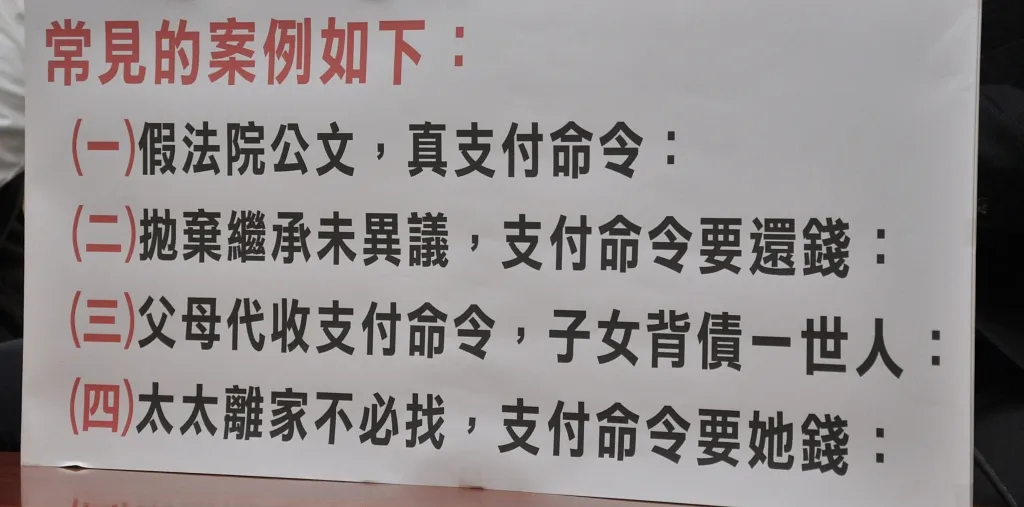
After Hsiao-mei had paid installments for six months totaling NT$960,000, she and Hsiao-kang broke up following a fierce argument. Hsiao-mei felt that since they had parted ways, there was no longer any need to keep the car, so she returned the sports car to Hsiao-kang. Unexpectedly, Hsiao-kang applied to the court for a payment order, demanding that Hsiao-mei repay him NT$270,000! Although the payment order was delivered to Hsiao-mei's residence, because she was not at home at the time, the payment order was deposited at the police station of her residence, thereby creating the legal effect of constructive service in accordance with the provisions of Taiwan's Code of Civil Procedure. Since Hsiao-mei did not file an objection within 20 days after the legal service of the payment order, the payment order attained the effect of a final and binding judgment, equivalent to the matter of "Hsiao-mei owing Hsiao-kang NT$270,000" having been finalized through all three instances of court trials.
Refusing to accept this, Hsiao-mei filed an application for retrial with the court pursuant to Subparagraph 13, Paragraph 1, Article 496 of the Code of Civil Procedure on the grounds of discovering evidence that had not been taken into consideration, but her application was dismissed by the court. The court held that while Hsiao-mei might be able to present relevant evidence to prove that what she said was true, Taiwan's Supreme Court has held that because payment orders do not undergo oral argument proceedings, the unconsidered evidence mentioned in the aforementioned retrial provision refers strictly to evidence that already existed during oral argument proceedings; therefore, payment orders naturally cannot apply the aforementioned provision. In other words, because payment orders are essentially inapplicable to retrial proceedings, even if Hsiao-mei has one hundred percent evidence to prove that the facts she stated are true, it is of no avail.
Although Taiwan's Code of Civil Procedure explicitly provides that a payment order can be subject to retrial, in reality, there is simply no way to seek a retrial for a payment order.
If you are Hsiao-mei, or have had an experience similar to Hsiao-mei's, please immediately fill out the Payment Order Victim Complaint Form and work with us to fight against payment order abuses! You are also welcome to share this, as you may help friends with similar experiences.
The above story is excerpted and adapted from the contents of the Taiwan Taoyuan District Court 2014 Li-Zai-Jian-Zi Ruling No. 2. Furthermore, it is hereby clarified that the contents of the above story do not reflect the actual circumstances of the parties involved in the ruling.
This article is an AI-generated translation of the original Chinese text. In the event of any discrepancy, the Chinese version shall prevail.