
Civil Society Joint Statement: Opposing the Ministry of Justice’s Nomination of Judges Academy President Lin Huei-huang as Grand Justice
Last edited: 2026-08-26
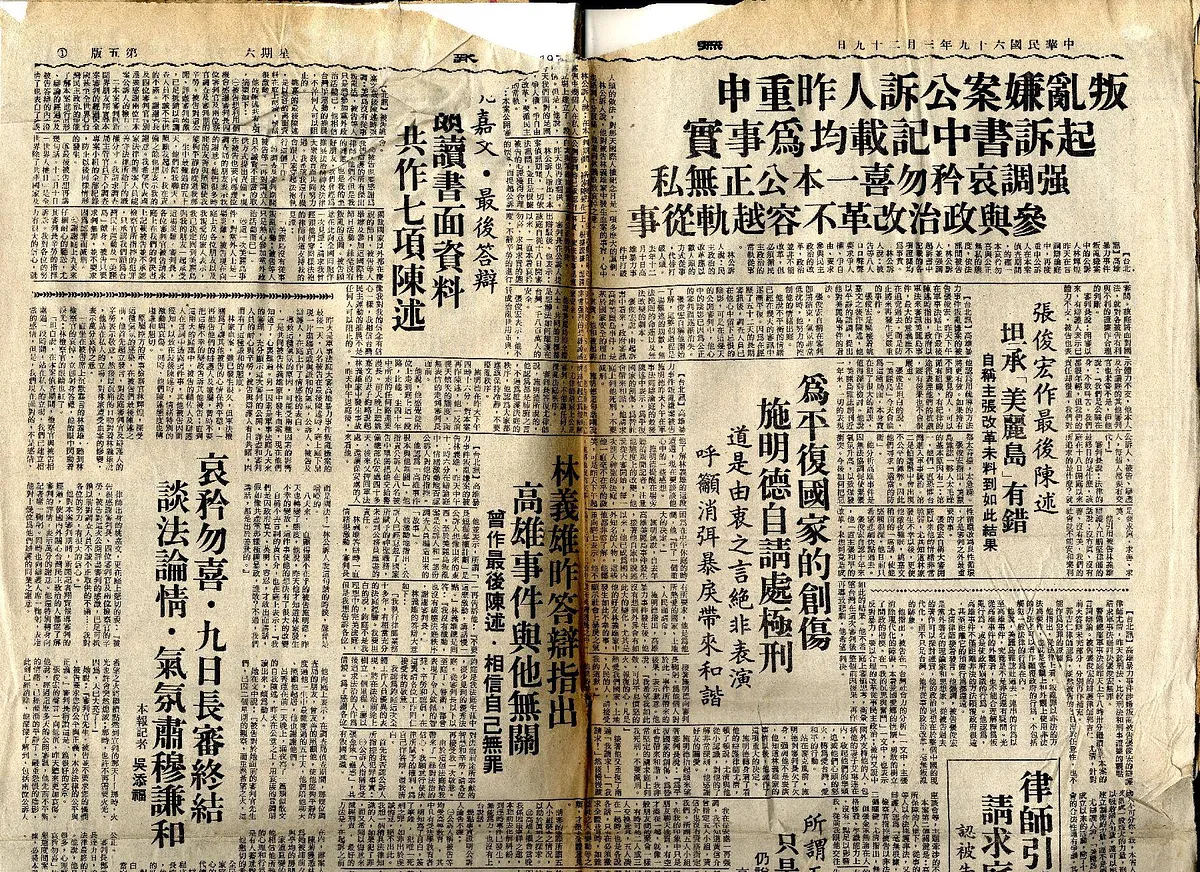
Images and newspaper clippings sourced from the Taiwan Database for Empirical Legal Studies.
It is reported that the Ministry of Justice will recommend Judges Academy President Lin Huei-huang for appointment as a Grand Justice. Mr. Lin was the military prosecutor holding the rank of second lieutenant who indicted the defendants during the Formosa Incident. This action by the Ministry of Justice is inconsistent with the fundamental spirit of transitional justice and undermines Taiwan’s democratic culture. We urge the "Grand Justice Nomination Review Committee" and President Ma to exercise utmost caution and refrain from nominating a member of the judiciary who, during the authoritarian era, entrenched the party-state apparatus, suppressed citizens' fundamental rights, and stifled democratic participation, to serve as a guardian of the Constitution in a democratic society.
The Formosa Incident stands as one of the most critical events in Taiwan's contemporary political history, where elites of the opposition movement gathered to challenge the authoritarian regime. Following the round-up of Dangwai elites and the supporters who sympathized with or assisted their escape, Lin Huei-huang, then serving as a second lieutenant military prosecutor, indicted eight individuals—including Huang Hsin-chieh—on charges of "sedition." In the indictment, he alleged that the Formosa Magazine "used legality to cover illegality, exploited slogans such as fighting for human rights, democracy, and freedom to propagate extremist rhetoric, defamed the government, fractured unity, deliberately caused disturbances, manufactured conflict, and simultaneously executed 'long-range and short-range plans to seize power' to achieve the illegal overthrow of the government." During oral arguments, Lin Huei-huang presented himself as an impartial and selfless public prosecutor, asserting that the facts stated in the indictment were true. He emphasized that political reform was not impossible, but had to follow the standard track of democratic politics, asserting that democratic reform should proceed by counting heads rather than breaking them.
The role played by Lin Huei-huang in the trial proceedings catered to the needs of the Kuomintang's authoritarian rule, utilizing military trials to solidify the foundation of authoritarian governance. He not only failed to uphold the explicit provisions of the Constitution to safeguard the people's fundamental right to political participation and freedom of assembly and association, but also actively undermined the Taiwanese people's pursuit of democracy. His insistence that reform must follow established rules was evidently conceived from a position of institutional privilege, ignoring the reality that when the power to make and enforce rules is monopolized by an unchecked authoritarian government, the formalistic application of legal provisions constitutes the very political logic of authoritarian dictatorships. Moreover, a critical context of the Formosa Incident was the Kuomintang government's abrupt suspension of elections due to a diplomatic crisis.
Past transitional justice initiatives in Taiwan have largely been "victim-centered." In the collective memory of the Formosa Incident, society remembers the unyielding figures of opposition elites, while the roles of military judges and prosecutors seated in the courtroom have rarely been scrutinized. Due to Taiwan's lack of judicial or administrative mechanisms—such as truth and reconciliation commissions, trials, or lustration laws—to prompt systematic societal reflection on the apparatus of perpetration and the settlement of responsibility, we have not had the opportunity to hear these military legal officers explain their roles within that repressive system: Did they actively embrace it? Did they accept assigned tasks without refusal, or were they unable to refuse? Were they mere cogs in the machine, simply following orders, or did their loyalty to the party-state waver when confronted by the rising tide of democracy? Has President Lin, who has spearheaded judicial training for many years, ever reflected on his past actions, and how will he interpret the Constitution in the future without succumbing to internal moral contradictions?
As guardians of the Constitution, the Grand Justices are pivotal to our country’s constitutional development and the protection of fundamental human rights; their dedication to and understanding of democracy and human rights are essential qualifications. Yet, Taiwan’s judiciary has never confronted its own dark history of complicity in authoritarian rule. In the early days, some Grand Justices were even recruited directly from party cadres, and Grand Justice Interpretations repeatedly accommodated authoritarian rulers (such as Interpretation No. 85 prior to the lifting of martial law, and Interpretation No. 272 thereafter), illustrating a judiciary subservient to the ruling regime and failing to meet the high expectations placed on constitutional interpreters by the public. Nominating a judicial figure who once participated in the persecution of political freedom to serve as a Grand Justice demonstrates a total lack of reflection on authoritarian rule and a disregard for the people.
Taiwan’s democratic achievements are built upon the blood, sweat, and sacrifices of countless individuals. We believe that Lin Huei-huang, having participated in political persecution and contributed to such suffering without ever publicly offering self-reflection, is unfit for this significant responsibility. We call upon the Nomination Review Committee and President Ma to reflect on the negative ramifications of this nomination for Taiwan's democracy, the rule of law, and transitional justice, and to withhold his nomination. We further urge the judiciary to thoroughly reflect on the legacy of authoritarian rule so that it may truly transform into a guardian of the people's rights.
Initiating Organization
Taiwan Association for Truth and Reconciliation
Endorsing Organizations
Covenants Watch
Taiwan Association for Human Rights
Taiwan March
Judicial Reform Foundation
Taiwan Alliance to Protect the Unjustly Convicted
Taiwan Alliance to End the Death PenaltyTaipei Society
This article is an AI-generated translation of the original Chinese text. In the event of any discrepancy, the Chinese version shall prevail.