
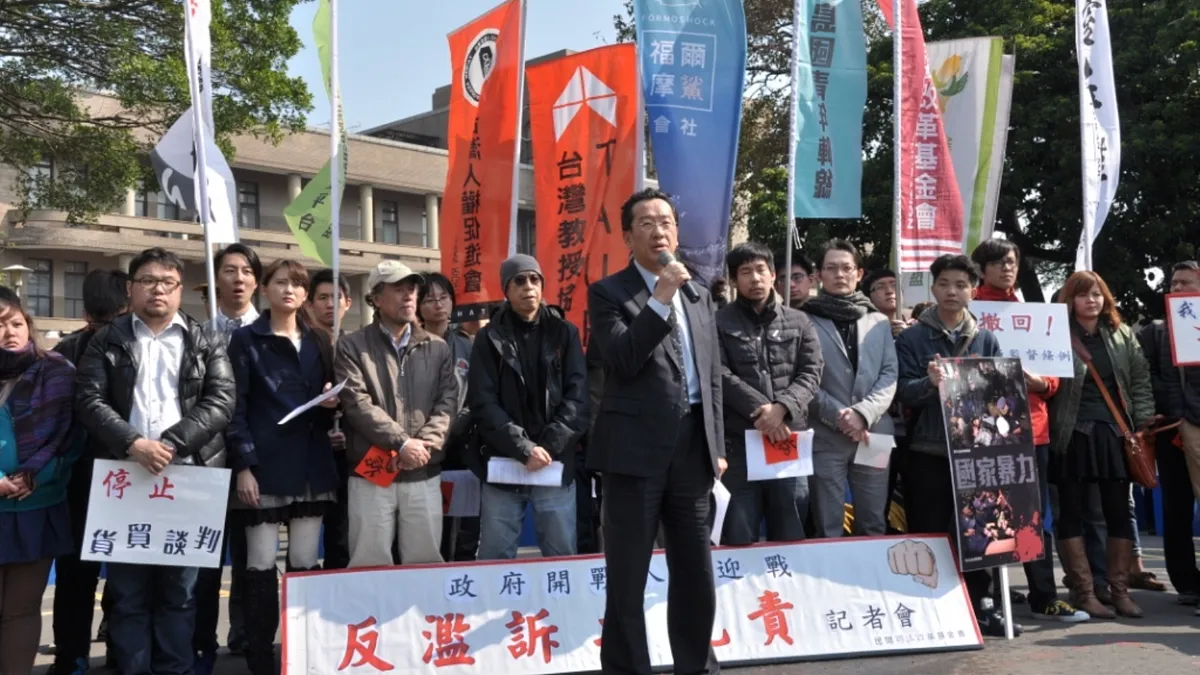
State Power vs. Public Rights: Press Conference on Combating Malicious Prosecution and Demanding State Accountability
Last edited: 2026-08-26
Resisting State Retaliation and Judicial Harassment: Civil Society Demands Accountability Over the Crackdown on Democratic Protests
On February 10, the Ma administration indicted 119 students and citizens who participated in the "March 18 Occupation of the Legislative Yuan," the "March 24 Executive Yuan Bloody Eviction Incident," and the "April 11 Passing by the Zhongzheng First Police Precinct." Some of the parties involved, along with the March 18 volunteer defense attorneys and civil society groups, held a press conference in front of the Executive Yuan at 10:00 AM in response. We protest against the prosecutorial abuse of power and malicious prosecution, demand accountability for the police officers who committed violence during the "March 24 Executive Yuan Incident," uphold the March 18 movement’s demand for "legislation before review," call for the withdrawal of the "Executive Yuan's version of the oversight bill," urge the passage of the civil society's version of the "Cross-Strait Agreement Oversight Act," and demand the suspension of the 10th round of Cross-Strait Trade in Goods Agreement negotiations scheduled to take place after the Lunar New Year.
The Ma administration has responded to the people with malicious prosecution, evasion of responsibility, and perfunctory attitudes, and the people will rise up to take on the challenge. We demand the "indictment" of Premier Jiang Yi-huah, Director-General Wang Cho-chiun, and the violent police officers who abused state violence. We accuse this unjust government. After the press conference, we will paste red papers bearing the words "Indictment" and the inverted character for "Justice" on the gates of the Executive Yuan, declaring that the people have formally indicted this government, and signifying that the government's indictment of more than a hundred people right before the Lunar New Year is entirely a political purge—reducing the judiciary to a political henchman rather than a manifestation of justice.
I. Protesting Against the Prosecutorial Abuse of Power and Malicious Prosecution:
The Ma administration's large-scale indictment of 119 people is intended to create a "chilling effect" to restrict the actions of citizens expressing their opinions. Regarding the largest category of indictments—"entering buildings of the Executive Yuan without cause (77 people)"—the vast majority were indicted simply for following the crowd into the Executive Yuan and being detained by the police. Even a visually impaired massage therapist with mobility difficulties was taken back to the police station in a police van for a statement and became a defendant. Furthermore, the Ma administration specifically targeted Professor Tsay Ting-kwei and other members of the Alliance of Referendum for Taiwan by indicting them with the felony of assembling a crowd to obstruct public duties under Article 136 of the Criminal Code of the Republic of China (punishable by imprisonment for not less than one year but not more than seven years for ringleaders and perpetrators), and specifically targeted Lin Fei-fan, director Kevin H.J. Lee, and others by indicting them with offenses against public order under Article 135 of the Criminal Code of the Republic of China (punishable by imprisonment for not more than three years). This stems entirely from extra-legal political considerations aimed at cracking down on active practitioners, leaders, and media workers. We must emphasize that all participants engaged in peaceful and nonviolent actions. When Chang Ching-chung took 30 seconds to unilaterally announce that the review of the Cross-Strait Service Trade Agreement was completed without any deliberation or voting, the parliament lost its fundamental function. With no internal channels of relief left within the institutional system, the people had no choice but to adopt self-help measures. It was precisely such actions that allowed Taiwan to preserve its democratic system, which by no means constitutes "inciting others to commit offenses," "entering buildings without cause," or "obstructing public duties."
II. Demanding Accountability for State Violence:
The Executive Yuan incident was an act of active civil disobedience by the people after witnessing the Ma administration's arrogant rejection of the demands of the March 18 movement. Throughout the action, the people firmly adhered to the principle of nonviolence, yet the Executive Yuan deployed heavy police force to conduct a bloody, violent beating and eviction of the citizens. To date, not a single police officer or commanding officer has been punished for using excessive force, demonstrating that the state condones police abuse of power and violence while repeatedly suppressing the people's rights to peaceful assembly and free expression. The photographs of citizens beaten to a pulp by police batons remain vividly clear, yet the Taipei District Prosecutors Office has shown no sign of indicting the police brutality. When the public filed private prosecutions with the courts, the Supreme Court absurdly treated private prosecution cases involving different perpetrators and different victims as the same case, refusing to accept them and denying justice. Such a move is tantamount to depriving the people of their right to institute legal proceedings, leaving victims of violence with no legal recourse. The various civil society groups, involved parties, and volunteer defense attorneys present today in solidarity all stated that they will continue to take concrete actions to pursue accountability for state violence.
III. Withdrawing the Executive Yuan Version of the Oversight Bill and Halting Trade in Goods Negotiations:
The Ma administration's black-box negotiations with China were the primary trigger for the March 18 movement. Kuan Chung-ming, then-Minister of the National Development Council who defended the black-box Cross-Strait Service Trade Agreement policy, has resigned and stepped down, admitting that he "clearly saw the dissatisfaction and impatience of the majority of voters regarding the current political and economic situation." However, Premier Mao Chi-kuo stubbornly continues to list the "Cross-Strait Service Trade Agreement" as a priority bill for the next legislative session. While the people demand the enactment of an external negotiation legal framework that enforces parliamentary oversight and public participation, Jiang Yi-huah and Wang Yu-chi merely converted the existing "four-stage oversight points" into statutory clauses to perfunctorily placate the public. Now that the primary instigators Jiang Yi-huah and Wang Yu-chi have stepped down, Premier Mao Chi-kuo continues to stall the public by claiming that he "holds no presupposed stance toward the Executive Yuan's version of the oversight bill."
We hereby demand that Premier Mao Chi-kuo explicitly withdraw the "Executive Yuan's version of the oversight bill," allow the parliament to pass the civil society's version of the "Cross-Strait Agreement Oversight Act," and demand the suspension of the 10th round of Cross-Strait Trade in Goods Agreement negotiations scheduled for after the Lunar New Year. This is to avoid a black-box trade in goods agreement following the black-box trade in services agreement, which sacrifices the interests of farmers and workers in livelihood industries in exchange for the interests of specific conglomerates in China.
Press Conference Attendees
Involved Parties / Tseng Po-yu, Huang Yu-fen, Chen Wei-ting, Tsay Ting-kwei, Lin Chih-lung, Chen Ting-hao, Liu Ching-wen, Wang Yi-kai, Hung Chung-yen
Defense Attorney Representatives / Attorney Wellington Koo, Attorney Chen Meng-hsiu
Solidarity Organization Representatives / Son Yu-liam, Secretary-General of Taiwan Labour Front; Hsieh Yi-ting, Representative of Democratic Progressive Youth; Lai Pin-yu, Black Island Youth Front; Lin Yu-lun, Convener of Taizuo Weixin; Chang Hsin-tang, President of Taiwan Association of University Professors; Chiu E-ling, Secretary-General of Taiwan Association for Human Rights; Bo Tedards, Secretary-General of Amnesty International Taiwan; Lee Gen-zheng, Co-convener of Green Party Taiwan; Tsai Chung-yueh, Director of the Taipei Office of Citizen of the Earth, Taiwan; Lai Chung-chiang, Convener of Economic Democracy Union
Press Contacts
Lai Chung-chiang, Economic Democracy Union
Chen Kuan-yu, Economic Democracy Union
This article is an AI-generated translation of the original Chinese text. In the event of any discrepancy, the Chinese version shall prevail.