
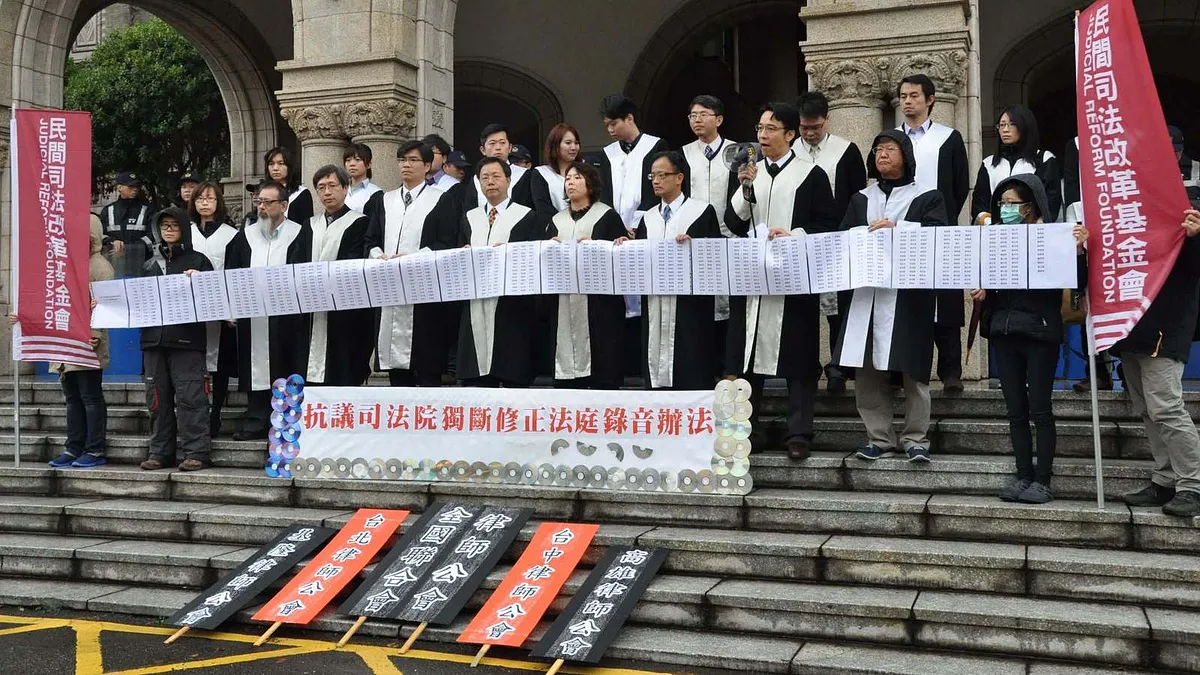
Is It Reasonable to Sentence Anyone Who Publishes Court Recordings to Imprisonment? ~ Joint Statement Opposing the Draft Article 90-4 of the Court Organization Act
Last edited: 2026-08-26
Defending Judicial Transparency and Open Justice: Civil Society Joint Statement Against Criminal Sanctions Under Draft Article 90-4 of the Court Organization Act
On January 7, 2015, the Judiciary and Organic Laws and Statutes Committee of the Legislative Yuan reviewed and passed the first reading of the draft amendment to Article 90-4 of the Court Organization Act, which is expected to be submitted to the floor of the Legislative Yuan to complete the legislative process. The text of the article reads as follows:
"A person who has been permitted to record audio or video on their own, or who possesses the contents of courtroom audio or video recordings, shall not distribute, publicly broadcast, or use the obtained audio or video contents for purposes other than asserting or defending their legal interests.
Whoever violates the provisions of the preceding paragraph shall be punished with imprisonment for not more than one year, detention, or a fine of not more than NT$100,000."
We do not oppose establishing certain regulations or penalties for the arbitrary distribution or public broadcasting of courtroom audio or video recordings. However, what is unreasonable is that if this article is passed without exception clauses, anyone who directly or indirectly discloses courtroom audio or video recordings will face criminal penalties of up to one year of imprisonment. Those acting in the public interest who are most likely to become targets of punishment are news media, teachers and scholars, legal personnel, attorneys, or public interest groups.
Public trial is the most fundamental principle of the rule of law. Except for cases where open trials are explicitly prohibited by law, properly disclosing the audio and video recordings of trials to allow the news media to make reasonable references in reporting, to allow educators to use them for teaching purposes, to allow legal personnel or attorneys to make fair use of them in cases, and to allow public interest groups to conduct court evaluations based on them are all reasonable uses, which truly should neither be prohibited nor penalized.
The Judicial Yuan's proposed draft of Article 90-4 of the Court Organization Act, without distinguishing the purpose and justification of use, categorically prohibits the distribution and public disclosure of courtroom audio and video recordings and further imposes criminal penalties of up to one year of imprisonment. Compared to the current provisions of the chapter on Offenses Against Privacy in the Criminal Code of the Republic of China, which limit culpability to acts committed without legitimate cause, this draft severely violates the principle of proportionality. We maintain that, jurisprudentially, courtroom audio and video recordings of public trials should in principle be permitted to be made public, and may only be prohibited pursuant to law in exceptional circumstances. If criminal penalties are to be imposed on extremely severe and unreasonable uses, the targets and scope of punishment must be strictly limited, and criminal liability must adhere to the principle of proportionality.
Therefore, we express our stern opposition to the draft article's approach of imposing blanket criminal penalties on those who disclose courtroom audio and video recordings without limitation, without differentiation, and without exception, and we urge legislators not to pass legislation that represents such a grave regression for the rule of law.
Joint Statement Organizations
Federation of Taiwan Bar Associations
Keelung Bar Association
Taipei Bar Association
Taoyuan Bar Association
Hsinchu Bar Association
Taichung Bar Association
Changhua Bar Association
Tainan Bar Association
Taitung Bar Association
Kaohsiung Bar Association
Pingtung Bar Association
Judicial Reform Foundation
Press Contact
Deputy Executive Director of the Judicial Reform Foundation / Attorney Chen Yu-fan 02-2523-1178
This article is an AI-generated translation of the original Chinese text. In the event of any discrepancy, the Chinese version shall prevail.