
Now is the Optimal Time to Amend the Order for Payment: A Response to the Judicial Yuan's Press Release of January 15, 2015
Last edited: 2026-08-26
Reforming Summary Injustice: Overhauling Taiwan’s Flawed Payment Order System to Safeguard Due Process and Fundamental Rights
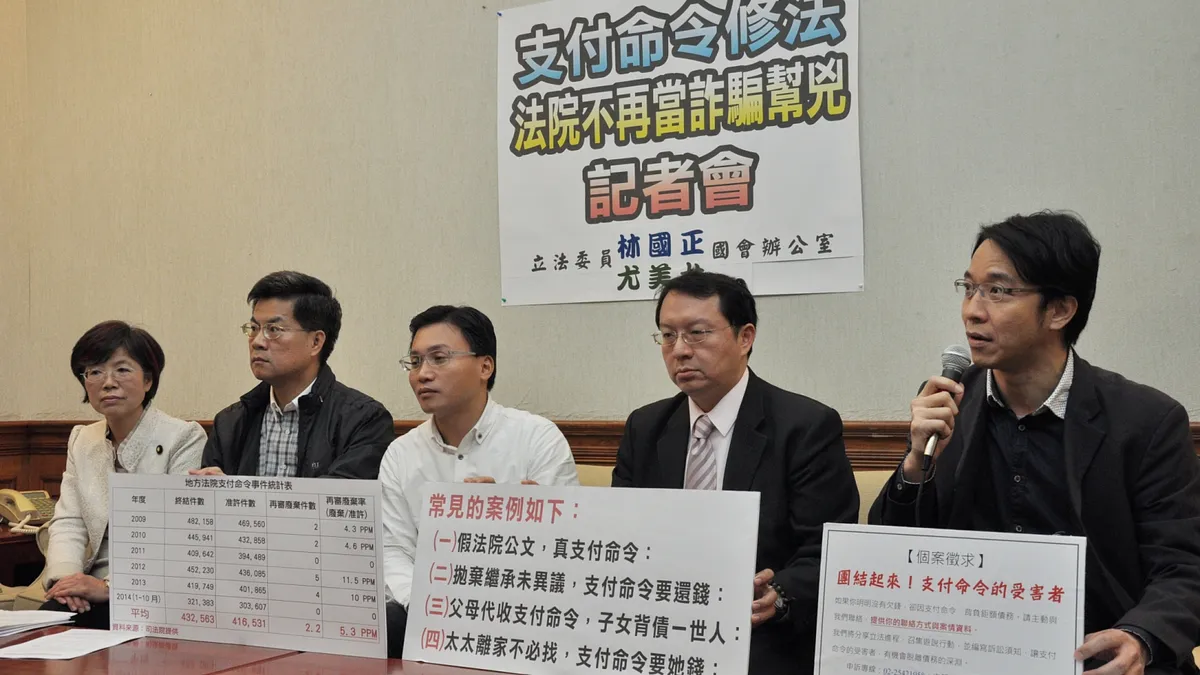
On January 13, 2015, the Foundation held a press conference regarding the legislative amendment of payment orders and announced draft amendments to provisions governing payment orders in the Code of Civil Procedure and the Enforcement Act of the Code of Civil Procedure. The Judicial Yuan also issued a press release on January 15, 2015 in response. Regarding the content of the Judicial Yuan's press release, the Foundation states as follows:
Payment Orders Shifted to Issuance by Judicial Associates, and Their Legal Effect Should Be Amended Accordingly as a Package:
After the Judicial Yuan promulgated and issued the Directions Governing Dunning Procedures by Judicial Associates on February 5, 2009, via Letter Yuan-Tai-Ting-Min-Yi-Tzu No. 0980002966, the method of issuing payment orders was changed from being issued by judges to being issued by judicial associates. According to the incidental resolution of the 713th meeting of the Judicial Yuan's Civil Procedure Law Research and Amendment Committee in 2000: "If the dunning procedure is handled pursuant to Paragraph 2, Article 508 or by persons other than judges, rigorous procedural safeguards should be designed, and consideration should be given to whether its legal effect remains identical to Paragraph 1, Article 521." The reason was that participating committee members, such as Professor Chiu Lien-cong, Professor Sun Sen-yen, and Professor Chen Rong-tsong, all harbored serious concerns regarding whether the strength of legal effect and procedural guarantees were adequate when payment orders are issued through computer equipment or by persons other than judges. That meeting conclusion was reached only after consulting the new legislative amendments in Japan (issued by court clerks) and the German provisions on payment orders (issued by judicial officers/Rechtspfleger), both of which recognize that payment orders possess only executory power. Now that the issuance of payment orders is predominantly carried out by judicial associates, it is indeed an opportune time to review and amend the procedural safeguards and legal effect of payment orders, thereby putting into effect the incidental resolution made at the aforementioned Judicial Yuan Civil Procedure Law Research and Amendment Committee meeting.
Payment Orders Require No Substantive Review, Have Extremely High Issuance Rates, and Standards Vary Across Courts Nationwide:
Pursuant to the provisions on payment orders in Article 511 et seq. of the Code of Civil Procedure and the holding of the Supreme Court 1972 Tai-Kang No. 407 Precedent, creditors are not required to provide evidence for the facts underlying the application for a payment order, and courts are not required to examine the veracity of such facts. Coupled with the low cost of applying for a payment order, applicants have flocked to use it, leading to widespread abuse of applications for various purposes. This is evident from the recent food safety incident where Dr. Chiang's Fish Shop applied for the issuance of a payment order requesting NT$1 billion in compensation from Ting Hsin, and the Taipei District Court granted and issued it.
For example, in the entire year of 2014, the Taipei District Court handled a total of approximately 313,171 cases and dismissed only about 9,641 cases, with an issuance rate of approximately 96.9%, and a total of 2 retrials were filed against payment orders, both of which were dismissed; the New Taipei District Court handled a total of approximately 47,056 cases and dismissed only about 2,736 cases, with an issuance rate of approximately 94.2%, and 1 retrial was filed against payment orders, which was also dismissed; the Yilan District Court handled a total of approximately 6,657 cases and dismissed only about 501 cases, with an issuance rate of approximately 92.5%, and 0 retrials were filed against payment orders; the Keelung District Court handled a total of approximately 11,108 cases and dismissed only about 311 cases, with an issuance rate of approximately 97.2%, and 0 retrials were filed against payment orders; the Changhua District Court handled a total of approximately 18,072 cases and dismissed only about 1,880 cases, with an issuance rate of approximately 89.6%, with 2 objections filed, and 1 retrial was filed against payment orders, which was also dismissed; the Yunlin District Court handled a total of approximately 313,171 cases and dismissed only about 9,641 cases, with an issuance rate of approximately 96.9%, and 0 retrials were filed against payment orders; the Tainan District Court handled a total of 14,972 cases and dismissed only 41 cases, with an issuance rate of 99.7%, and a total of 2 retrials were filed against payment orders, both of which were dismissed; the Kaohsiung District Court handled a total of 53,757 cases and dismissed only about 31 cases, with an issuance rate of 99.9%, and 0 retrials were filed against payment orders. Furthermore, looking at the circumstances of approval across courts, there are even instances where specific facts were not stated and approval was granted merely upon application, with generic reasons stating only "as stated in the application form," while the grounds for dismissal by district courts nationwide mostly pertained to jurisdiction, the debtor's death, failure to make corrections, or similar technical reasons.
Therefore, the so-called leniency in issuing payment orders lies not only in the flood of abusive applications, but also in the fact that under current law, courts are neither required nor empowered to review whether the factual evidence supporting the application for a payment order is sufficient. However, not every respondent to a payment order possesses sufficient legal knowledge like the Ting Hsin Group to know that they should file an objection upon receiving a payment order. In addition to the aforementioned changes in the method of issuing payment orders, a comprehensive review of the payment order system is indeed necessary.
Payment Orders Possess Res Judicata, Amounting to a Lack of Legal Remedy:
Furthermore, the Judicial Yuan claimed that various litigation systems established by law are predicated on parties acting in good faith and making legitimate use thereof, and that payment orders already possess relevant remedy channels—such as claiming damages based on torts if obtained by fraudulent means. In reality, demanding that everyone act in good faith and make legitimate use of all legal systems is no different from climbing a tree to catch a fish. A sound institutional design aims to prevent various abuses, potential dangers, and damages through the compromise of multiple objectives, rather than relying on wishful thinking that everyone will use them properly in good faith, and still considering no review or change necessary even after the system has devolved into a tool for infringing upon the rights of others.
Secondly, existing remedy channels for payment orders are extremely narrow, and in judicial practice, it is difficult to cover the various malpractices arising from payment orders. For example, although there are remedies for improper service, situations often occur where service is legally constructive but the party did not actually receive the payment order—such as service by deposition, or receipt on behalf by cohabitants or employees who neglected to forward or notify the party; situations also often arise where parties do not understand the law and do not know they should file an objection, or where parents of minors receive the service on their behalf but neglect to file an objection. In none of these situations can relief be sought through procedures for improper service of payment orders; the only recourse is to file an action for retrial. However, the requirements for an action for retrial are extremely stringent, and the probability of success is minuscule; this is by no means a rare circumstance as claimed by the Judicial Yuan.
Furthermore, regarding the Judicial Yuan's assertion that tort claims for damages can be brought against those who abuse dunning procedures to manufacture bogus claims or against fraud syndicates, the Supreme Court in recent years has held differing views, ruling that because payment orders have res judicata effect, other determinations contrary to the facts established by that res judicata cannot be made even in separate actions (Supreme Court 2004 Tai-Shang No. 1432 Judgment, 2007 Tai-Shang No. 1629 Judgment, and Taiwan High Court 2006 Chong-Shang No. 500 Judgment). Under these circumstances, it is naturally impossible to allow persons whose rights have been impaired by finalized payment orders to seek claims based on torts. Therefore, this issue is by no means free from controversy in judicial practice, and re-evaluating and amending the res judicata effect of payment orders will also help resolve this dispute.
Granting Payment Orders Executory Power Only Can Still Preserve Procedural Speed and Simplicity:
The direction of amending the law so that payment orders possess only executory power has been advocated in published works by civil procedure law scholars Shen Kuan-ling and Huang Kuo-chang, representing the prevailing view in jurisprudence, which universally maintains that procedural speed and simplicity can still be preserved. In addition, drawing on the system governing rulings on promissory notes—which likewise requires swiftness and convenience—the proposed draft amendment grants payment orders executory power only as a balanced compromise. Looking at the promissory note ruling system, which has similarly operated with executory power only for many years, there is no evidence of what the Judicial Yuan claimed regarding noteholders being unwilling to utilize the procedure and causing a massive influx of non-contentious matters into regular court litigation. Therefore, the approach proposed in the draft amendment is entirely feasible.
This article is an AI-generated translation of the original Chinese text. In the event of any discrepancy, the Chinese version shall prevail.
