
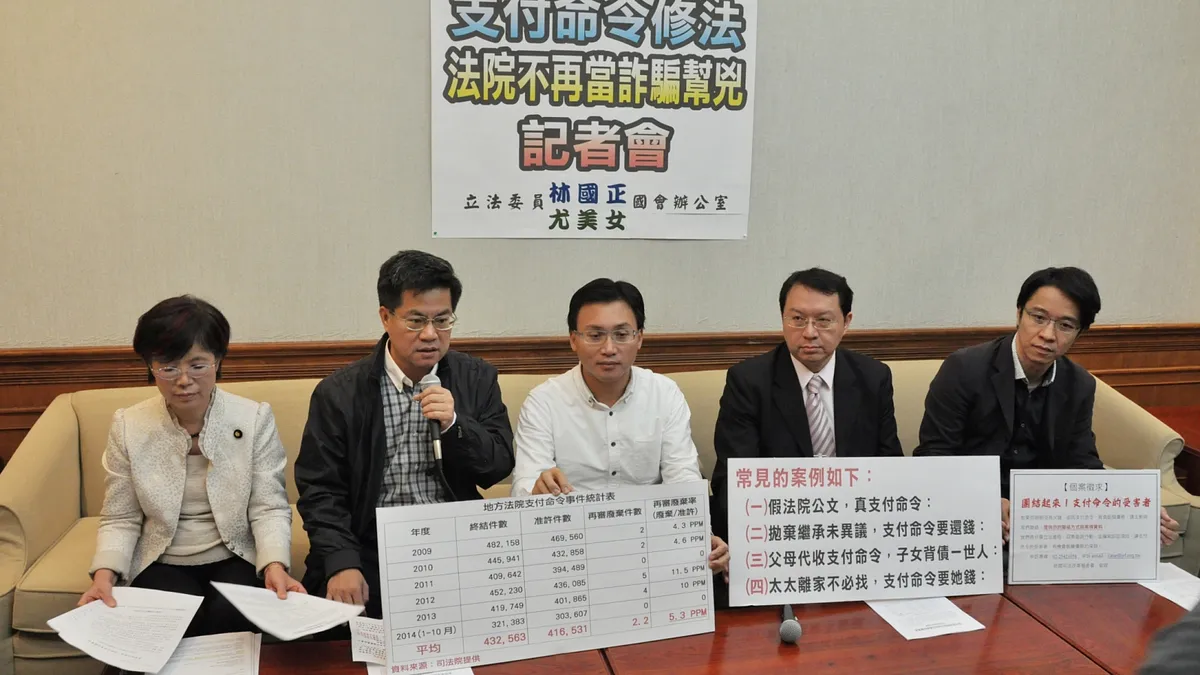
Amendment of the Payment Order System to Stop Courts from Being Accomplices to Fraud – Press Conference on Payment Order System Amendments
Last edited: 2026-08-26
Since November 2, 1971, when Article 514, Paragraph 2 of the Code of Civil Procedure was amended to provide for the declaration of provisional execution regarding payment orders, our country has streamlined the creditor application and court ruling procedures in urging procedures. This was coupled with the amendment to Article 521, which stipulates that if a debtor fails to legally file an objection to a payment order within the statutory period of 20 days, the payment order shall have the same effect as a final and binding judgment. Having been implemented for over 40 years, the payment order system has been widely utilized by all sectors of society, with an average of over 400,000 cases issued annually, effectively contributing to the settlement of disputes and the cessation of litigation. (See table below)
Statistical Table of Payment Order Cases in District Courts
| Year | Cases Concluded | Cases Approved | Cases Retried and Vacated | Retrial Vacate Rate (Vacated / Approved) |
| 2009 | 482,158 | 469,560 | 2 | 4.3 PPM |
| 2010 | 445,941 | 432,858 | 2 | 4.6 PPM |
| 2011 | 409,642 | 394,489 | 0 | 0 |
| 2012 | 452,230 | 436,085 | 5 | 11.5 PPM |
| 2013 | 419,749 | 401,865 | 4 | 10 PPM |
| 2014 (Jan.-Oct.) | 321,383 | 303,607 | 0 | 0 |
| Average | 432,563 | 416,531 | 2.2 | 5.3 PPM |
Closing the Legal Loophole: Overhauling Taiwan’s Payment Order System to Safeguard Due Process and Prevent Fraud
However, due to the lenient issuance of payment orders and the common malpractices occurring in the service of process, the mechanism has been widely abused in recent years—serving as a criminal tool for fraud syndicates, an improper debt-collection tactic for financial institutions, or a means for unscrupulous individuals to extort wealth. Common illustrative cases include the following:
Counterfeit Court Notices Followed by an Authenticated Payment Order
A fraud syndicate repeatedly sent forged official documents in the court’s name to Mr. A. After several occurrences, Mr. A began to ignore them. The fraud syndicate then used fabricated documents to petition the court for the issuance of a genuine, legally valid payment order. When Mr. A received it, he assumed it was just another fraudulent notice and failed to file a statutory objection within the 20-day statutory period. Consequently, the fraud syndicate used the finalized payment order to auction off Mr. A’s house. Under current law, Mr. A possesses no effective legal remedy.
Waiver of Inheritance Rendered Futile by an Uncontested Payment Order
Following the death of Mr. B’s father, who had accumulated excessive debt during his lifetime, Mr. B went to court to complete the waiver of inheritance. A few days later, Mr. B received a payment order petitioned from the court by Bank A, a creditor of his late father. Believing that he had already waived his inheritance, Mr. B ignored the notice. Once the 20-day statutory period for objection lapsed, Bank A used the payment order to enforce compulsory execution against Mr. B’s salary. Under current law, Mr. B possesses no effective legal remedy.
Payment Orders Received by Parents, Forcing Children into Lifelong Debt
After graduating from university, Ms. C successfully secured employment, only for her employer to unexpectedly receive a court notice for wage garnishment. Upon reviewing court records, Ms. C discovered that many years earlier, her mother had taken out a bank loan and, without her consent, designated the then-minor Ms. C as a guarantor. To circumvent provisions of the Civil Code designed to protect minors, the bank applied to the court for a payment order, served it upon the mother in her capacity as statutory agent, and instructed her not to file an objection. As a result, the bank was able to initiate compulsory execution against Ms. C based on the payment order, leaving her with no effective legal remedy under current law.
Domestic Abuse and Substituted Service Exploited for Financial Extortion
Having suffered domestic violence from her husband, Ms. D took her children and returned to her maternal home in distress. Because Ms. D had not yet transferred her household registration, the husband fabricated a debt claim and applied to the court for a payment order. Once the court served the payment order to the registered domicile, the husband accepted the service on her behalf and concealed the notice from Ms. D. After stalling past the 20-day statutory objection period, he enforced compulsory execution against real estate registered under Ms. D’s name. Under current law, Ms. D possesses no effective legal remedy.
The above accounts are adapted from real cases, and similar victims are spread across Taiwan. At its core, the problem with payment orders lies not in their procedural simplicity, but in their absolute legal effect combined with the utter absence of effective remedies. Under the current Code of Civil Procedure, a finalized payment order can only be set aside through retrial proceedings. However, judicial practice imposes exceedingly stringent requirements for retrials, resulting in a five-year average revocation rate of merely 5.3 per million, rendering legal remedies virtually non-existent. (See table above). With countless victims denied judicial redress, public outrage has surged, prompting persistent criticisms that courts have been reduced to accomplices in fraud. It is imperative to swiftly amend the law to close these loopholes.
To resolve the widespread abuses associated with payment orders, the Judicial Reform Foundation drafted proposed amendments to Articles 514 and 521 of the Code of Civil Procedure, as well as the addition of Articles 4-4 and 12 to the Enforcement Act of the Code of Civil Procedure. The legislative proposal has been sponsored and endorsed by 25 legislators, including Lin Kuo-cheng and Yu Mei-nu, and referred to the Judiciary and Organic Laws and Statutes Committee for review. Key points of the draft include:
Amending provisions so that a finalized payment order serves as an executive title possessing only executory power, without res judicata effect. (Amended Paragraphs 1 and 2, Article 521 of the Code of Civil Procedure)
Adding a remedy allowing a debtor, when initiating an action to confirm the non-existence of a claim specified in a payment order, to petition the court for a stay of compulsory execution upon providing adequate security. (Added Paragraph 3, Article 521 of the Code of Civil Procedure)
Establishing a two-year transition period under the new law, allowing payment orders that became final under the former law to be petitioned for retrial and set aside within two years from the implementation of the new law based on dedicated statutory grounds, including: (1) The evidence submitted by the creditor in the dunning procedure was forged or altered; (2) The debtor was a person without legal capacity or with limited legal capacity at the time the payment order was served and failed to file an objection within the statutory period prior to the enforcement of the amendment; (3) Evidence exists that would lead to a more favorable ruling; (4) The circumstances are manifestly unfair or unlawful. However, to preserve legal certainty, these dedicated retrial remedies shall not apply to debts that the debtor has already fully or partially satisfied after the payment order became final. (Added Paragraphs 3 and 5, Article 4-4 of the Enforcement Act of the Code of Civil Procedure)
The defining feature of this draft is that while preserving the swiftness and simplicity of payment orders, it introduces an ex-post judicial review mechanism (actions to confirm the non-existence of claims and debtor's actions of objection), thereby enhancing procedural rigor to prevent malicious actors from exploiting legal loopholes. Simultaneously, the two-year transitional provision provides a pathway to deliver justice to unfortunate victims, relieve them of fabricated debts, and clear the courts of the stigma of being accomplices to fraud.
Attachment Downloads
Draft Amendments to the Code of Civil Procedure
Draft Amendments to the Enforcement Act of the Code of Civil Procedure
Press Conference Representatives
Yu Mei-nu / Legislator
Lin Kuo-cheng / Legislator
Liu Chia-jung / Working Committee Member of the Judicial Reform Foundation, Attorney
Kao Jung-chih / Executive Director of the Judicial Reform Foundation, Attorney
Press Contact
Executive Director of the Judicial Reform Foundation / Kao Jung-chih 02-2523-1178
This article is an AI-generated translation of the original Chinese text. In the event of any discrepancy, the Chinese version shall prevail.
