
Unite for Legal Redress: Mobilizing Victims of Payment Order Injustices
Last edited: 2026-08-26
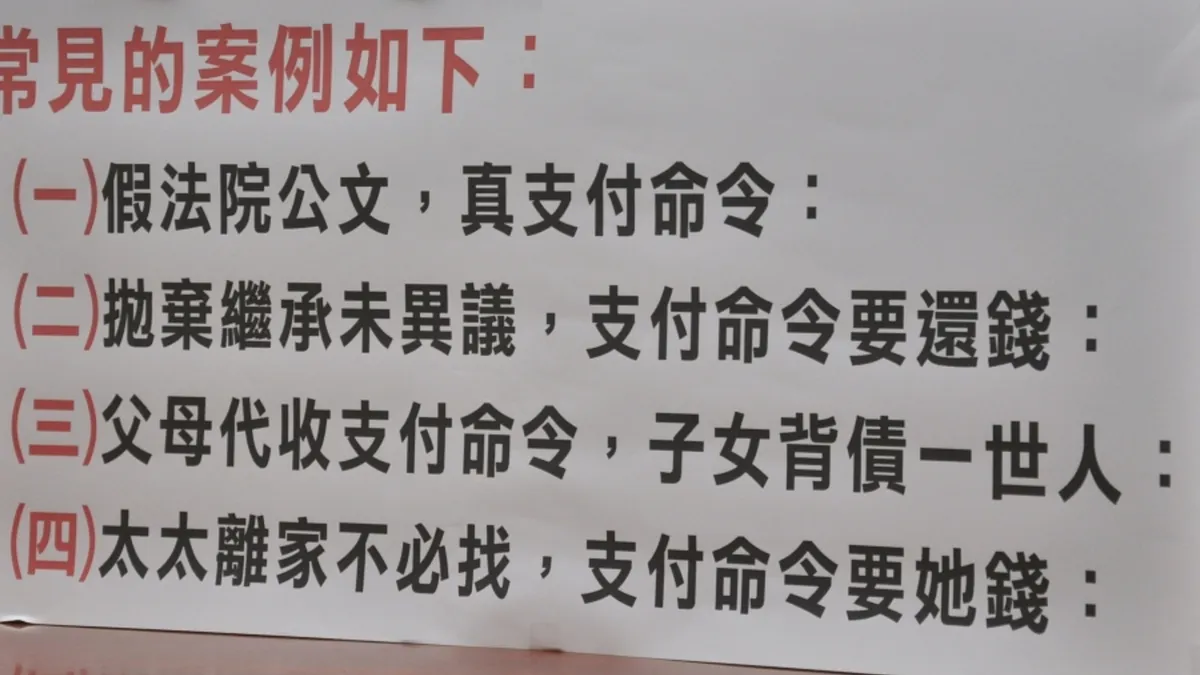
Due to lenient issuance standards and rampant flaws in the service process, payment orders have been widely abused in recent years—serving as criminal instruments for fraud rings, improper debt collection methods for financial institutions, and predatory extortion schemes by unlawful individuals. Common cases include:
Counterfeit Court Documents Followed by a Real Payment Order
A fraud ring repeatedly sent forged official court documents to Mr. A under the name of the court. After several instances, Mr. A began to disregard them. The fraud ring then used fabricated documents to apply to the court for a genuinely valid payment order. Upon receiving it, Mr. A assumed it was just another fake document and failed to file an objection within the statutory 20-day period. The fraud ring then used the payment order to auction off Mr. A’s house.
Waived Inheritance Without Filing an Objection, Yet Bound to Repay Debt via Payment Order
After Mr. B's father passed away, Mr. B went to court to handle the waiver of inheritance because his father had accumulated excessive debts during his lifetime. A few days later, Mr. B received a payment order applied for from the court by Bank A, a creditor of his father during his lifetime. Mr. B felt that since he had already waived the inheritance, there was no need to pay any attention to it. After the statutory 20-day objection period elapsed, Bank A used the payment order to initiate compulsory execution against Mr. B’s salary.
Parents Received Payment Orders on Their Behalf, Forcing Children into Lifelong Debt
After graduating from university, Ms. C successfully found a job, only to discover that her employer received an official court notice for wage garnishment. Upon retrieving records from the court, Ms. C discovered that years ago, when her mother took out a loan from a bank, she had listed Ms. C—who was still a minor at the time—as a guarantor without her consent. To circumvent provisions of the Civil Code protecting minors, the bank applied to the court for the issuance of a payment order, which was served upon and received by the mother in her capacity as statutory agent, with instructions not to file an objection. In this manner, the bank was able to enforce compulsory execution against Ms. C based on the payment order.
No Need to Search for an Estranged Wife When a Payment Order Can Seize Her Assets
Ms. D suffered domestic violence from her husband and left for her maternal home with their child in anger. Because Ms. D had not yet transferred her household registration, the husband fabricated a claim and applied to the court for a payment order. Once the court served the payment order to the registered household address, the husband accepted service on her behalf, concealed it from Ms. D, and stalled until the statutory 20-day objection period had passed, subsequently executing compulsory enforcement against the real estate registered under Ms. D’s name using the payment order.
If you have had similar experiences—clearly owing no money, yet burdened with massive debts due to a payment order—we know your pain. We have already introduced draft amendments to the Code of Civil Procedure and the Enforcement Act of the Code of Civil Procedure in the Legislative Yuan seeking to resolve this issue.
To lobby for the bill, we need to gather public support and unite victims of payment orders to demand reform. We welcome all individuals who have been saddled with debts that do not belong to them due to payment orders to proactively contact the Judicial Reform Foundation (JRF) and provide your contact information and case details. The Judicial Reform Foundation will share legislative progress, mobilize lobbying actions, and compile viable litigation guidelines following the implementation of the new law, giving victims of payment orders an opportunity to escape the abyss of debt.
File a Complaint
Case Officer: Executive Secretary Hsiao Yi-min
Hotline: 02-25421958
Complaint Email: case@jrf.org.tw
Mailing Address: 7F., No. 3, Ln. 90, Songjiang Rd., Taipei City 104, Taiwan
This article is an AI-generated translation of the original Chinese text. In the event of any discrepancy, the Chinese version shall prevail.