
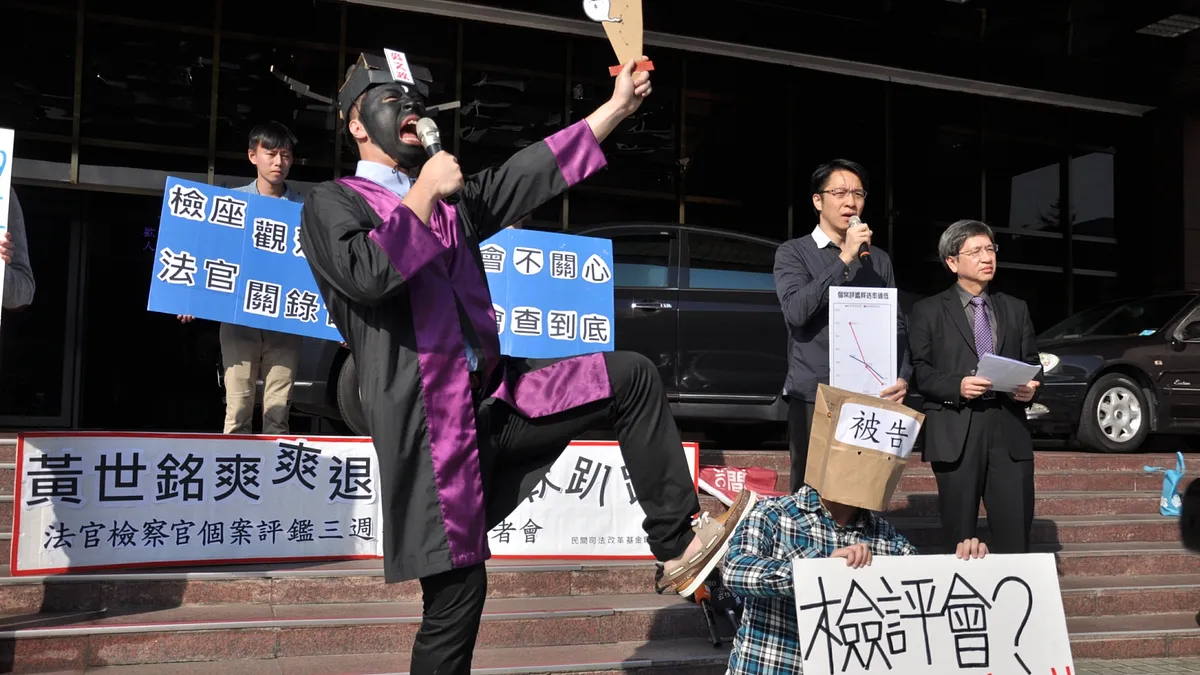
Huang Shih-ming Retires Carefree, Evaluation System Lacks Teeth: Press Conference on the 3rd Anniversary Review of the Judge and Prosecutor Individual Case Evaluation System
Last edited: 2026-08-26
Three years after its implementation on January 6, 2012, the "individual case evaluation system" under the Judges Act has proven capable of swatting flies at best, while entirely powerless to tackle tigers. Taking Huang Shih-ming as an example, to date he has faced zero administrative sanctions and will retire on January 6 to begin drawing generous pension benefits protected by the Judges Act—how can this be considered fair or reasonable? Over the past three years, the Judicial Reform Foundation (JRF) has received 328 public complaints against judges and filed 19 evaluation requests, accounting for 63% of the cases accepted by the Judges Evaluation Committee; it has received 230 public complaints against prosecutors and reported 38 prosecutors, accounting for 86% of the cases accepted by the Prosecutors Evaluation Committee (see Appendix 1). However, over these three years, the Judges Evaluation Committee and the Prosecutors Evaluation Committee have referred only 7 judges and 10 prosecutors to the Control Yuan, falling far short of public expectations. Notably, following the restructuring of the second-term evaluation committees in 2014, referral rates plummeted sharply (see table below), prompting serious doubts over whether the evaluation committees are providing oversight or merely acting as a shield (see Appendix 2).

Year |
Judges Evaluation Commission | Prosecutors Evaluation Commission | ||
| Number Referred to Control Yuan / Cases Reviewed | Referral Rate | Number Referred to Control Yuan / Cases Reviewed | Referral Rate | |
| 2012 | 2 persons / 4 cases | 50% | 1 person / 1 case | 100% |
| 2013 | 3 persons / 8 cases | 37% | 8 persons / 21 cases | 38% |
| 2014 | 2 persons / 13 cases | 15% | 1 person / 17 cases | 6% |
Reforming Judicial Accountability: Proactive Investigation vs. Institutional Inertia Under the Judges Act
The inefficiency of the new individual case evaluation system stems from institutional flaws, and the Judicial Reform Foundation (JRF) has already proposed a draft amendment to the Judges Act in the Legislative Yuan to actively address the issue. However, necessary institutional and legislative reform must not serve as an excuse for inaction. In 2014, the JRF submitted 27 individual evaluation requests, reporting 14 judges and 20 prosecutors. Most of the evaluated individuals were not first-time offenders, and the reported misconduct was merely the tip of the iceberg. If the evaluation committee members took the initiative to conduct thorough investigations, the results would certainly not be so dismal. The two cases cited today illustrate that whether investigators adopt a passive or proactive attitude has a decisive impact on the effectiveness of the evaluation mechanism. Otherwise, the Judges Act will be reduced to nothing more than an act protecting judges.
Case 1: A Prosecutor Channeling Spirits? The Prosecutors Evaluation Committee Doesn’t Care!
Prosecutor: "If you are not honest, his ghost will return to settle the score with you."
Prosecutor: "Maybe you'll face retaliation from his ghost, could that happen?"
Prosecutor: "He came into my dream and told me that whoever is dishonest, he will go after them."
The above is an excerpt of a prosecutorial interrogation from Criminal Judgment 2014 Shang-Su-Zi No. 196 of the Taiwan High Court Kaohsiung Branch Court, which rarely ruled that the interrogation transcript lacked evidentiary capacity on the grounds that the prosecutor used improper methods involving ghostly retribution. (See Appendix 3)
At the end of last year, a concerned citizen reported this judgment. The JRF investigated and discovered that the person involved was Prosecutor Wu Wen-cheng of the Pingtung District Prosecutors Office, who has long been controversial in his conduct. Wu Wen-cheng is not a first-time offender; in 2010, he was stripped of his Chief Prosecutor qualification by the Prosecutors Personnel Review Committee due to lobbying in a personnel matter at Kinmen Kaoliang Liquor Inc. The JRF first reported him in 2013 for abusing his authority to intervene in temple elections, and reported him again in 2014 for poor courtroom demeanor and discriminatory language. Regarding the temple election case, following the investigation and referral by the Prosecutors Evaluation Committee, the Control Yuan impeached him on December 19, 2014; the courtroom demeanor case remains under investigation by the Prosecutors Evaluation Committee; and now, this bizarre "prosecutor channeling spirits" case has erupted.
"No complaint, no trial" and compartmentalizing individual cases represent the current passive approach of the Prosecutors Evaluation Committee. Taking the temple election case as an example, the JRF requested to retrieve the audio and video recordings of the prosecutor's interrogation, but the Prosecutors Evaluation Committee disregarded the request, conducted only a paper review, and even recommended the lightest penalty of a written reprimand, entirely failing to realize the gravity of the problem. In fact, both the spirit-channeling case and the temple election case occurred at the end of 2012. The Prosecutors Evaluation Committee is equipped with abundant administrative resources. If the JRF, with its constrained civil resources, can discover so many problematic cases, the Prosecutors Evaluation Committee could certainly uncover more if it adopted a slightly more proactive attitude to review the past records and conducts of evaluated individuals. The indifferent and passive attitude of the Prosecutors Evaluation Committee is the real reason why referral rates are so low.
Case 2: A Judge Turning Off Recordings? The Judges Evaluation Committee Investigates to the Bottom!
The JRF reported Judge Tseng Yu-ming of the Taoyuan District Court for verbally humiliating a defendant and exhibiting an appalling attitude during the court session of Case 2013 Yi-Zi No. 225 on May 15, 2013, and requested that the Judges Evaluation Committee retrieve the courtroom recording CD as evidence. Unexpectedly, the CD provided by the Taoyuan District Court contained only 14 seconds of audio. Suspecting foul play, the Judges Evaluation Committee took the initiative to retrieve all courtroom audio recordings from Judge Tseng's court sessions that day, discovering the findings shown in the table below:
Courtroom Audio Recording Status for 14 Court Sessions at Taoyuan District Court on May 15, 2013
| Court Session Order | Case Number | Start Time | End Time | Audio Duration |
| 1 | 2013-* Case No. * | 09:39 | 10:21 | 39 min 16 sec |
| 2 | 2013 Yi-Zi Case No. 225 | 10:23 | 12:01 | 14 sec |
| 3 | 2013-* Case No. * | 12:03 | 12:18 | 14 min 47 sec |
| 4 | 2012-* Case No. * | 14:17 | 15:41 | 1 hr 24 min 20 sec |
Among the four cases heard on that day, only the audio recording of the second case—the one subject to the complaint—disappeared, while the recordings of the other three cases were completely intact. To investigate who possessed such extraordinary influence to make the audio recording of a reported case vanish, the Judges Evaluation Committee is conducting a thorough investigation. In addition to uncovering the truth behind the disappeared recording, the Judges Evaluation Committee also accepted recommendations to proactively investigate whether the evaluated individual's poor courtroom demeanor was habitual and requested that the Judicial Reform Foundation (JRF) assist in providing additional materials to facilitate its inquiry. To this end, the JRF specially issued a public call for cases to collect information on Judge Tseng Yu-ming's unfitness. The proactive attitude of the Judges Evaluation Committee in handling the case deserves public recognition; indeed, only this approach of investigating to the very bottom can effectively deter unscrupulous judicial personnel and give full play to the supervisory function of the evaluation system.
Three-Year Work Report and Demands on the Individual Case Evaluation System for Judges and Prosecutors
The JRF established a complaint center to receive public reports against judges and prosecutors, aiming to enhance the case-handling quality and moral integrity of judicial personnel. Regarding the merits, shortcomings, gains, and losses on the third anniversary of the implementation of the individual case evaluation system, a work report has been prepared, identifying key issues and putting forward the following four demands:
Because the civil society version of the draft amendment to the Judges Act is already under review in the Judiciary and Organic Laws and Statutes Committee of the Legislative Yuan, awaiting only the official version from the authorities to proceed to substantive article-by-article review, the Foundation calls on the Judicial Yuan and the Ministry of Justice to expeditiously review existing deficiencies and submit counter-proposals to the Legislative Yuan, rather than engaging in administrative boycotts that delay the legislative process.
Regarding the fact that the Ministry of Justice only staffed one specialist from the Department of Personnel to concurrently handle all administrative affairs of the Prosecutors Evaluation Committee, which clearly indicates an attempt to severely diminish the function of the Prosecutors Evaluation Committee, the Foundation expresses its stern condemnation and demands that the Ministry of Justice provide sufficient and independent personnel to support the administrative work of the Prosecutors Evaluation Committee, at least comparable to the Judicial Yuan. At the same time, any form of administrative interference in individual case evaluations must be halted.
Prosecutor Wu Wen-cheng conducted illegal interrogations using absurd claims such as "ghostly retribution" and "the deceased appearing in dreams," which severely damaged the image of the judiciary. The Foundation demands that he be suspended from duty pursuant to Subparagraph 6, Paragraph 1, Article 43 of the Judges Act, and that a comprehensive review of all cases handled by him be conducted to rectify official discipline.
The Foundation calls on the Judges Evaluation Committee and the Prosecutors Evaluation Committee to operate the individual case evaluation system proactively to strengthen supervisory power and win the public's trust in the judiciary.
Download Attachments
Statistics on Evaluation Cases
List of Cases Decided by Evaluation Committees
Criminal Judgment 2014 Shang-Su-Zi No. 196
Draft Amendment to Partial Articles of the Judges Act
Three-Year Work Report on Individual Case Evaluations Under the Judges Act
Press Contact
Judicial Reform Foundation, Attorney Kao Jung-chih 02-2523-1178
This article is an AI-generated translation of the original Chinese text. In the event of any discrepancy, the Chinese version shall prevail.