
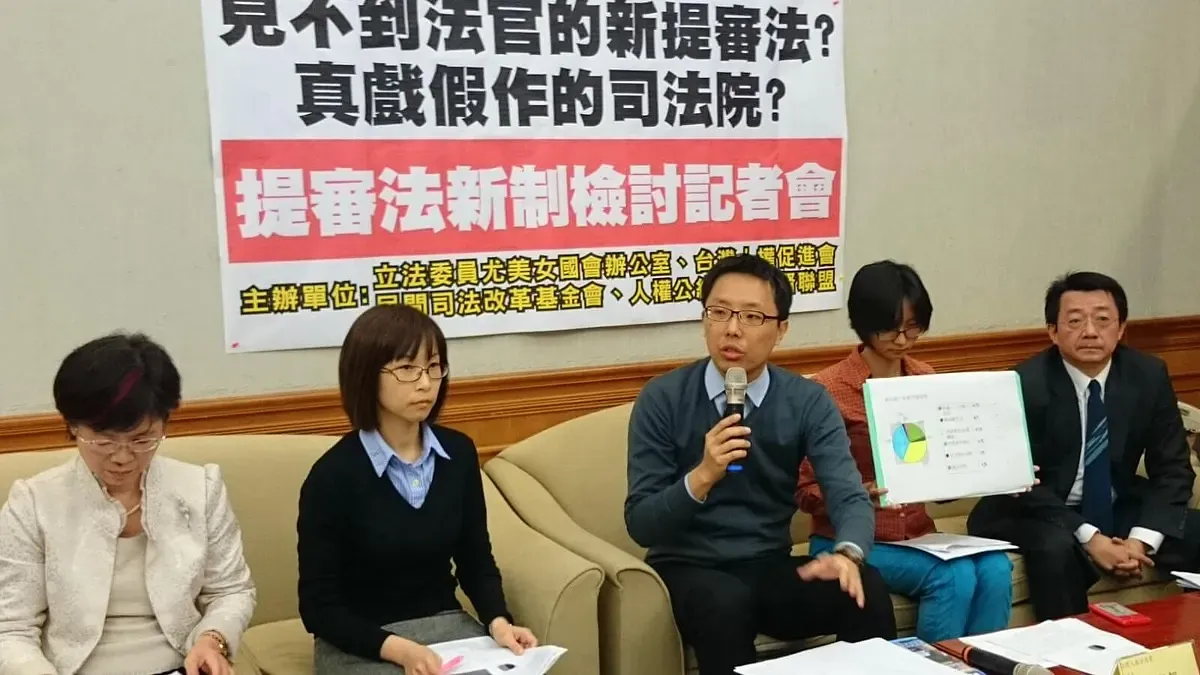
A Hollow Promise of Due Process? Reviewing the New Habeas Corpus Mechanism: Press Conference on the Implementation of the Habeas Corpus Act
Last edited: 2026-08-27
The Judicial Yuan proclaimed that the newly amended Habeas Corpus Act represents "progress in human rights," actively promoting that any detained person can claim "I want to see a judge" to initiate habeas corpus proceedings within 24 hours. The act was passed by the Legislative Yuan on January 8, 2014, and in accordance with the sunrise clause in Article 12, officially came into effect on July 8 of the same year.
Legislator Yu Mei-nu, together with the Taiwan Association for Human Rights, the Judicial Reform Foundation, and the Covenants Watch, jointly held a press conference today (the 6th) to review the implementation outcomes of the new habeas corpus system. Since the new law came into effect, the number of habeas corpus applications has shown an upward trend. As of January 5 of this year, a cumulative total of 111 habeas corpus cases have been filed (compared to only 259 cases from 2000 to the present).
However, while the Judicial Yuan extensively promotes that the public can immediately "see a judge" under this new law, it has instructed grassroots judges handling habeas corpus petitions to conduct merely formal reviews, excluding the substantive legality and necessity of the detention. As stated in item 3 of the legislative rationale for Article 8 in the "Draft Amendment to the Habeas Corpus Act" submitted by the Judicial Yuan to the Legislative Yuan (Yuan Zong No. 986, Government Proposal No. 14789): "The court's review of the legality of an arrest or detention is solely to examine the procedural legality of the arrest or detention, not to determine the substantive grounds or necessity for the arrest or detention of the person; thus, the rule of evidence applied requires only free proof." If the Judicial Yuan maintains this stance in promoting the new Habeas Corpus Act, several problems may arise: first, it contradicts the text of the Habeas Corpus Act; second, it may violate the Constitution and the International Covenant on Civil and Political Rights; third, it lacks theoretical grounds; and fourth, most importantly, it will render the function of habeas corpus entirely obsolete.
Lawyer Weng Kuo-yen, Vice President of the Taiwan Association for Human Rights, stated that when courts accept habeas corpus cases, their review should not be limited to formal procedural requirements, as the Habeas Corpus Act itself contains no such restriction. Furthermore, according to Article 8 of the Constitution, Article 9 of the International Covenant on Civil and Political Rights, and the spirit of General Comment No. 35, arrested or detained persons inherently possess the right to request judicial review over the legality of detention decisions. The scope of judicial review should cover all requirements—particularly substantive issues such as the necessity of arrest or detention and whether alternative measures exist—rather than being restricted to formalities, with variations in the "standard of review" applying only where administrative discretion and expertise are involved. Therefore, grassroots judges need not unduly limit themselves, nor should the Judicial Yuan implement policies urging judges to retreat and perform only formal reviews.
Lawyer Weng Kuo-yen criticized the Judicial Yuan's Department of Criminal Affairs, which oversees the Habeas Corpus Act, for instructing judges to limit their scope to formal legality while steering clear of substantive justifications for deprivations of personal liberty. Fortunately, over the six months since the new law's implementation, a few judges have actively exercised judicial oversight by examining the necessity of administrative arrests and detentions. Examples include Ruling 2014 Xing-Ti No. 1 of the Tainan District Court, Rulings 2014 Xing-Ti No. 1 and No. 2 of the Taoyuan District Court, Rulings 2014 Xing-Ti No. 1 and No. 2 of the Hsinchu District Court, and Ruling 2014 Xing-Ti No. 2 of the Nantou District Court. In these cases concerning the necessity of alien detention and whether less restrictive alternatives (such as release to the custody of an appropriate person) could replace detention, the courts maintained a stringent stance by reviewing substantive criteria to safeguard personal liberty. The public should affirm and encourage these efforts, and the Judicial Yuan should humbly learn from these grassroots judges.
Legislator Yu Mei-nu noted that searches in the Judicial Yuan's judgment system reveal that from the enactment of the Habeas Corpus Act in 1935 and its amendments in 1948 and 1999 until the implementation of the new law on July 8, 2014, only 5 individuals were granted relief and released under the Habeas Corpus Act. There were only 134 petitions filed, averaging 8.6 petitions per year. In contrast, in the nearly six months since the new Habeas Corpus Act took effect on July 8, 2014, the volume of petitions has reached 111 cases. The number of petitions in the past half-year equals the total filed over the preceding 14 years, demonstrating the significance of the new law. Nevertheless, only 7 individuals were released, accounting for just 6.3% of the total petitions.

Examining the 111 rulings issued after the implementation of the new law, we found that there were 85 cases (77%) in which judges conducted substantive reviews and issued habeas corpus writs to bring persons whose personal freedom was restricted to court to "see a judge," while only 26 cases (23%) involved solely formal reviews. In other words, even after the implementation of the new law, nearly a quarter of applicants still effectively "could not see a judge," let alone enable the court to examine whether the administrative agency's disposition restricting personal freedom was reasonable.

Safeguarding Liberty: Reassessing Judicial Oversight and Taiwan's Habeas Corpus Mechanism
Regarding this matter, Legislator Yu Mei-nu expressed deep concern. The significance of the habeas corpus system lies not only in ensuring that the deprivation of personal liberty is subject to judicial review, but more importantly, in allowing the judiciary to supervise administrative agencies and compel them to consider whether the restriction of personal liberty adheres to the principle of proportionality, and whether there are alternative means to achieve the same effect without depriving personal liberty, rather than merely accommodating the past "convenience" of administrative bodies. After all, personal liberty is the most fundamental of all basic human rights, specifically detailed in Article 8 of the Constitution; the Habeas Corpus Act is effectively the concretization of Article 8 of the Constitution, and its importance is self-evident.
She pointed out that her initiative to propose the amendment in 2012 stemmed from the long-standing attitude in judicial practice that personal liberty restrictions "not categorized as criminal arrests" were irrelevant to the courts. Following the Constitutional Court's Judicial Yuan Interpretation No. 708 and No. 710, the Habeas Corpus Act was finally amended and passed in January 2014. If the courts merely conduct a "formal" review of whether the administrative agency's "procedure" for restricting personal liberty possesses a lawful "appearance," while maintaining the pre-amendment indifference and failing to actively fulfill the purpose of the habeas corpus system, the judiciary will be reduced to a rubber stamp for administrative agencies.
Furthermore, during the amendment process of the Habeas Corpus Act in 2013, the Judicial Yuan added a proviso to the end of Article 1: "However, if other laws provide that an immediate review by a court may be applied for, such provisions shall govern." In other words, if individual laws involving restrictions of personal liberty (such as confinement/repentance dispositions under the Armed Forces Punishment Act, or detention measures under the Immigration Act) stipulate their own mechanisms for immediate judicial review, those respective laws will apply. Although the relevant amendments have not yet passed, Yu expressed concern that once these individual laws are enacted in the future, if courts interpret the Habeas Corpus Act as merely "supplementary" and exclude its application entirely, loopholes in human rights protection may emerge. It is foreseeable that immediate court reviews in individual statutes may consist of only one or two provisions, whereas the Habeas Corpus Act is a comprehensive code. Given differing statutory requirements, excluding the application of the Habeas Corpus Act could lead to obstacles or disadvantages for individuals seeking judicial relief.
For instance, the Immigration Act and the Armed Forces Punishment Act currently under review in the Legislative Yuan are designed to provide more "immediate" access to a judge than the Habeas Corpus Act, but they do not incorporate duties such as the obligation to notify and inform individuals of their rights as stipulated in Article 2 of the Habeas Corpus Act. If the Habeas Corpus Act is entirely excluded, individuals might possess rights in theory but have no way of knowing about them, let alone asserting them. Furthermore, disparities exist between these individual laws and the Habeas Corpus Act regarding "who may petition for habeas corpus." The Habeas Corpus Act provides that "anyone" may file a petition, whereas the provisions of the Immigration Act and the Armed Forces Punishment Act do not include "others." For example: (1) if a specialized operations brigade deliberately ignores a detainee's objection and prepares to swiftly deport them, and the detainee's companion applies to the court for habeas corpus, such a petition could not be filed under the Immigration Act; or (2) if the military executes a "confinement" or repentance sanction, ignores the servicemember's objection, and an enthusiastic veteran comrade petitions the court for habeas corpus on their behalf, the court's exclusion of the Habeas Corpus Act based on the proviso of Article 1 would run counter to the intent of this statutory reform. In such circumstances, justice would rely solely on conscientious judges interpreting the legislative intent. If the mindset of the judiciary remains unchanged, statutory amendments will be in vain. As the official English title of the Habeas Corpus Act indicates, this statute should align with the spirit of the Latin origin of "habeas corpus"—an essential remedy securing fundamental human rights and personal liberty through judicial procedure. This has also been affirmed by Article 9 and General Comment No. 35 of the International Covenant on Civil and Political Rights, which has been incorporated into domestic law. Therefore, following the implementation of the new law, every judicial organ should swiftly conduct hearings ensuring both substantive and procedural safeguards, thoroughly examining the facts of detention, legal basis, necessity, and reasonableness of each case.
Chen Yu-fan, Deputy Executive Director of the Judicial Reform Foundation, cited three concrete examples. The first is the only successful habeas corpus case in a criminal division aside from the aforementioned six foreigner-detention cases where individuals were released following substantive review: Ruling 2014 Xing-Ti No. 8 of the Hsinchu District Court. While the number of habeas corpus petitions in criminal matters is relatively small and the dismissal rate remains high, she commended certain judges for actively conducting substantive reviews. Judge Lai Shu-min, who delivered Ruling 2014 Xing-Ti No. 8 of the Hsinchu District Court, actively performed a substantive examination, determined that the police violated the Police Power Exercise Act by unlawfully searching a citizen's personal belongings, and found no concrete evidence supporting the police's claims, leading to the petitioner's release. In contrast, in Ruling 2014 Ti No. 1 of the Kinmen District Court, Judge Liu Tzu-chien dismissed a petition on the grounds that the prosecutor had already released the petitioner (a Chinese national involved in a criminal case without necessity of pretrial detention) into the custody of a specialized operations brigade. The judge passed the buck between criminal and administrative jurisdictions and ignored that release into custody remains an infringement on personal liberty, failing to intervene and fully defying the requirements of Judicial Yuan Interpretation No. 708. The third case is Criminal Ruling 2014 Ti No. 19 of the Keelung District Court, where a petitioner arrested as a quasi-in-flagrante offender for possession of amphetamines petitioned for habeas corpus. The court summoned the search officers and discovered that they lacked a search warrant and failed to give statutory rights warnings or follow legal procedures under the Code of Criminal Procedure prior to the arrest. Although the petitioner was later released after the prosecutorial questioning, rendering the petition dismissed pursuant to Article 5, Paragraph 1, Subparagraph 3 of the Habeas Corpus Act, Chen still praised the judge. From the standpoint of judicial reform, this case is even more critical; only judges who value procedural justice can curb prosecutorial and police misconduct. Once law enforcement abuses power, miscarriages of justice follow—not only letting actual suspects escape accountability, but also trapping innocent people in years of endless court cycles.
Chiu E-ling, Secretary-General of the Taiwan Association for Human Rights, noted that the aforementioned six foreigner-detention cases represent an area of improvement since the new Habeas Corpus Act took effect on July 8 of last year. Detentions previously left entirely to administrative discretion under the National Immigration Agency can now be petitioned in court for judicial review and immediate relief. According to statistics from civil human rights groups, 21 habeas corpus petitions involving the detention of foreigners (including Chinese nationals) were filed after the new law came into force, but only 6 resulted in release after review. Looking at the other 15 dismissed cases, judges mostly evaluated only whether the formal grounds for arrest and repatriation under Article 38 of the Immigration Act and Article 15 of the Act Governing Relations between the People of the Taiwan Area and the Mainland Area were met, without carefully considering the necessity of detention or alternative measures. Most judges maintained that although Judicial Yuan Interpretation No. 708 and No. 710 declared portions of Article 38 of the Immigration Act and Article 18 of the Act Governing Relations between the People of the Taiwan Area and the Mainland Area unconstitutional regarding detention and restriction of personal liberty, because the statutes had not yet been formally amended, they continued to review cases under the old laws. They presumed administrative detention to be inherently necessary without reconsidering whether detention was truly indispensable in individual cases or if bail and custodial alternatives were viable. Furthermore, in Ruling 2014 Xing-Ti No. 1 of the Fuchien Kinmen District Court, the judge presented the absurd reasoning that detention did not constitute "being under arrest or detention," thereby dismissing the petition and ignoring the reality that Taiwan's detention mechanism completely deprives detainees of personal liberty.
"Detention" is meant solely as a temporary measure prior to compulsory deportation; if unnecessary, it should be replaced by alternative means. Article 38 of the Immigration Act explicitly sets forth the prerequisite that temporary detention is permissible only when "it is clearly difficult to execute compulsory deportation without detention." The core value of the Habeas Corpus Act is to provide immediate protection and relief for personal liberty. If judges solely review formal procedural criteria without substantively examining the core necessity of detention, or even redirect foreign detainees to slow administrative litigation, the judiciary effectively abandons habeas corpus as a vital safeguard against arbitrary administrative infringements on personal liberty.
Professor Fort Fu-te Liao, Executive Committee Member of the Covenants Watch and Associate Research Fellow at the Institutum Iurisprudentiae of Academia Sinica, further emphasized that the value of the Habeas Corpus Act is to safeguard bodily liberty and personal security; therefore, its application and interpretation must aim to realize this value. The terms "arrest" and "detention" in the Habeas Corpus Act should be interpreted broadly in reference to Article 9 of the International Covenant on Civil and Political Rights and General Comment No. 35 of the Human Rights Committee, particularly regarding the deprivation of liberty described in paragraph 5 and detention described in paragraph 40. Judges must apply this broad definition when reviewing arrests and detentions under the Habeas Corpus Act. The judicial benchmark should not be limited to mere illegality; General Comment No. 35 explicitly distinguishes between "arbitrary detention" and "unlawful detention," detailing arbitrary detention in paragraph 12. Therefore, judges must examine not only whether a detention is unlawful, but also whether it is arbitrary. The essence of the Habeas Corpus Act is not merely emergency relief or formal scrutiny; otherwise, conditions infringing upon bodily liberty and personal security will persist. Furthermore, to avoid squandering judicial resources, related matters should be resolved comprehensively to prevent burdening citizens and multiplying legal disputes.
Accordingly, we expect judicial organs to abandon outdated mindsets and proactively act as gatekeepers of human rights. The newly amended Habeas Corpus Act must not serve merely as formal scrutiny or emergency triage, but as a mechanism to halt the unwarranted deprivation of bodily liberty and personal security. Concurrently, we call upon administrative authorities that restrict personal liberty—including the Ministry of Health and Welfare, the Ministry of National Defense, the National Immigration Agency, the Ministry of Justice, and the National Police Agency—to establish corresponding measures following the enactment of the new Habeas Corpus Act, and to fulfill their duty of full disclosure and transparency toward interested parties, ensuring that citizens are fully informed of all available channels for legal relief.
Table of Case Types After the Implementation of the New Law

Appendix Downloads
List of Unsubstantively Reviewed Cases Following the Implementation of the New Law
List of Adjudication Documents with Substantive Review and Successful Release Applications
Statistical Table of Habeas Corpus Adjudication Cases (2000–2014)
Attendees
Yu Mei-nu (Legislator)
Weng Kuo-yen (Vice President of the Taiwan Association for Human Rights, Attorney)
Chen Yü-fan (Deputy Executive Director of the Judicial Reform Foundation, Attorney)
Chiu I-ling (Secretary-General of the Taiwan Association for Human Rights)
Liao Fu-te (Research Fellow at the Institute of Jurisprudence, Academia Sinica; Covenants Watch)
Press Contacts
Shih I-hsiang, Executive Secretary, Taiwan Association for Human Rights
Chu Wan-lin, Legislative Assistant, Office of Legislator Yu Mei-nu
This article is an AI-generated translation of the original Chinese text. In the event of any discrepancy, the Chinese version shall prevail.