
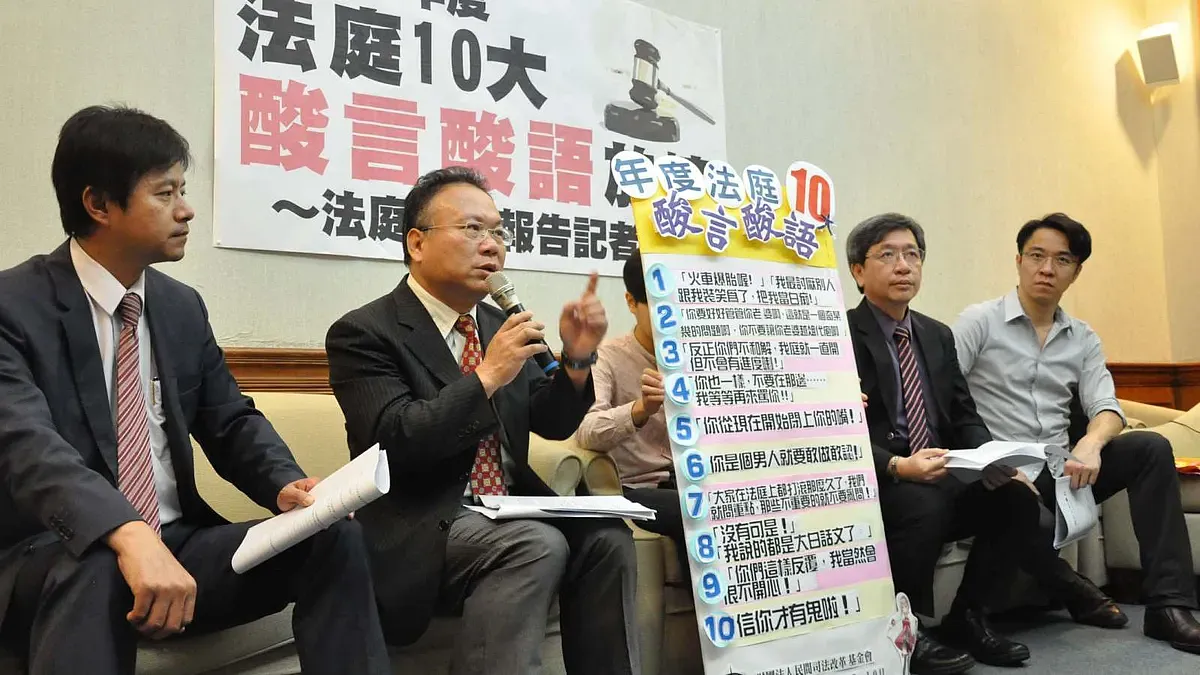
Unveiling the Top 10 Derogatory Courtroom Remarks of the Year: 2015 Court Observation Report Press Conference
Last edited: 2026-08-27
Since the Judicial Reform Foundation first published its court observation report in 1995, the quality of courtroom trials has improved slightly over the past 20 years. However, more than three years after the implementation of the Judges Act, "poor courtroom demeanor" remains the most heavily reported category by citizens and accounts for the highest number of individual evaluation requests. In response, the judicial sector has consistently lacked deep self-reflection, offering various excuses such as, "The judge's attitude is not very good because they are too serious," and "Although the judge's attitude is problematic, the judgment result is fine." This highlights that the mindset of "emphasizing substance over procedure" still permeates the minds of judges.
Starting this year, the Judicial Reform Foundation will use court observation as a method to identify incompetent judges and file for individual evaluations, hoping to strengthen supervision and enhance trial quality. This year, the Judicial Reform Foundation cooperated with the Taoyuan Bar Association, partner lawyers in Taichung, and partner lawyers in Kaohsiung to select 24 judges with poor evaluations or reputations, conduct 267 court observations, and compile the "2015 Court Observation Report." At the same time, individual evaluations were filed against 4 of these judges, and the annual top 10 courtroom sarcastic remarks ranking was selected.
Top 10 Courtroom Sarcastic Remarks of 2015
- The judge said: "Did the train blow a tire?", "I hate it most when people put on a fake smile and treat me like an idiot!"
- The judge said: "You need to keep your wife in line; this is a matter of *chi-mou-chi* [feeling], and you shouldn't let your wife overstep her authority."
- The judge told the parties: "Anyway, if you don't settle, I'll just keep holding hearings, but there will be no progress!"
- The judge told the defendant: "You too, don't just stand there... I'll come and scold you later."
- The judge impatiently reprimanded the defendant: "From now on, shut your mouth!"
- The judge (female) told the defendant: "If you are a man, you should dare to do it and own up to it!"
- The judge said: "Everyone has been rolling around in the courtroom for so long, let's ask about the key points and stop asking random, unimportant questions!"
- The judge said: "What I said is in plain, everyday language." The party said: "But..." The judge shouted loudly: "There are no buts!"
- The judge roared at the lawyers of both parties: "With you going back and forth like this, of course I will be very unhappy!"
- The judge told the defendant: "As if I'd believe you!"
2015 Court Observation Frequency Table
| Name of Court | Taoyuan District Court |
Taichung District Court | Taichung High Court | Kaohsiung District Court | Kaohsiung High Court | Total |
| Observed Judges | 5 | 9 | 1 | 5 | 4 | 24 |
| Observation Count | 82 | 93 | 13 | 51 | 28 | 267 |
| Individual Evaluations | 2 | 2 | - | - | - | 4 |
Most of the 24 judges on this year's observation list exhibited the following three common patterns:
-
Lacking emotional control and failing to maintain an impartial image:
For example, a judge roared at the lawyers of both parties: "With you going back and forth like this, of course I will be very unhappy!", or told the defendant: "As if I'd believe you!".
-
Abusing the power of litigation direction to coerce confessions, withdrawals, and settlements:
For example, a judge told the parties: "Anyway, if you don't settle, I'll just keep holding hearings, but there will be no progress!", "If you insist on not pleading guilty and want to hold more hearings, it amounts to wasting judicial resources, and I will consider your post-offense attitude to be poor, making it impossible to grant you leniency in sentencing!"
-
Prejudice, prejudgment, and presumption of guilt, denying parties the right to make statements:
For example, a judge (female) told the defendant: "If you are a man, you should dare to do it and own up to it!", and a judge said: "Whether you did it or not, you know in your heart and are just talking nonsense over there!"
"When trying cases, judges must faithfully uphold intrinsic independence and impartiality. Not only must they be convincingly impartial in substance, but their impartiality must also not be subject to external questioning." This is the standard set forth by the Judicial Yuan's Disciplinary Court—which holds the disciplinary power over judges and prosecutors—in Judgment No. 2 of the Disciplinary Cases of 2012. The reason for requesting individual evaluations for 4 judges selected from the 24 observed individuals in 2015 is that the frequency, circumstances, and degree of their aforementioned behaviors clearly lacked the basic requirements of rationality, objectivity, and neutrality that judges ought to possess during trials. If not properly supervised, this would cause severe damage to the public's trusted image of the court as holding neutral and impartial trials.
Using court observations to request individual evaluations can increase the strength of judicial supervision. The Judicial Reform Foundation will continue to conduct court observations and welcomes local bar associations and the public to jointly participate and cooperate. Finally, we put forward three demands:
- We call on the Judges and Prosecutors Evaluation Commissions to proactively conduct random general spot-checks on evaluated judges and prosecutors, and actively supervise incompetent ones.
- We call on the Judicial Yuan and the Ministry of Justice to conduct comprehensive evaluations in accordance with the provisions of the Judges Act, rewarding the excellent and weeding out the incompetent.
- The norms of the current Judges Act are overly restrictive. We call on the Judicial Yuan and the Ministry of Justice to face the fact that individual evaluations are ineffective, and not to obstruct the "NGO version" of the amendments to the Judges Act aimed at strengthening supervisory functions, so that the amendment bill can smoothly pass legislative readings in this session.
Appendix Download
Attendees
Chairman of Taoyuan Bar Association / Attorney Lin Shih-fang
Chairman of Judicial Reform Foundation / Attorney Lin Yung-sung
Standing Executive Committee Member of Judicial Reform Foundation / Attorney Lin Chih-chung
CEO of Judicial Reform Foundation / Attorney Kao Jung-chih
Press Contact
Judicial Reform Foundation / CEO Kao Jung-chih
This article is an AI-generated translation of the original Chinese text. In the event of any discrepancy, the Chinese version shall prevail.