
Triennial Evaluation Report on the Implementation of Individual Case Reviews Under the Judges Act
Last edited: 2026-08-27
Introduction—The Long and Arduous Road of Individual Case Evaluation
The individual case evaluation system under the Judges Act, implemented on January 6, 2012, established the Judges Evaluation Committee and the Prosecutors Evaluation Committee [1] (hereinafter referred to as the "JEC" and the "PEC"), which accept requests for individual case evaluations [2], deliberate on whether judges or prosecutors warrant disciplinary action, and resolve whether to refer them to the Control Yuan or the Personnel Review Committee [3].
The term of office for judges and prosecutors evaluation committee members is two years [4], with the first term running from January 2012 to January 2014. During its term, the first JEC deliberated on 12 evaluation request cases, resolving to refer 5 individuals to the Control Yuan for review, representing a referral rate of 41%; the first PEC deliberated on 22 evaluation request cases during its term, resolving to refer 8 individuals to the Control Yuan for review, representing a referral rate of 36%. These results were barely satisfactory.
In January 2015, having reached the halfway point of its term, the second JEC deliberated on 13 evaluation request cases, resolving to refer only 2 individuals to the Control Yuan for review, a referral rate of 15%; among the 17 evaluation request cases deliberated by the second PEC, only 1 case was resolved to be referred to the Control Yuan for review, leaving a startling referral rate of just 6%!
Appallingly dismal still seems insufficient to describe the performance of the second JEC and PEC to date. As the Judges Act reaches its third anniversary and the second JEC and PEC still have one year remaining in their terms, the JRF summarizes its work experience thus far, analyzes the factors hindering the individual case evaluation system from functioning effectively, and proposes directions for future reforms.
Overview of the Implementation of the Individual Case Evaluation System—Excessively High Dismissal Rate
The subjects regulated by the Judges Act are not limited to judges as strictly defined by text [5], but also include prosecutors. In terms of institutional design, these are handled respectively by the JEC established by the Judicial Yuan and the PEC established by the Ministry of Justice, and the composition of the committees also differs. Therefore, the following analysis of the implementation overview of the individual case evaluation system will observe and compare the execution effectiveness of both separately.
According to the Judges Act, sources of cases for the JEC and PEC include the Judicial Yuan and courts at all levels, the Ministry of Justice and prosecution offices at all levels, three or more joint-signing judges or prosecutors, bar associations, and legally permitted private organizations. Currently, the discovery of unfit judge and prosecutor cases in Taiwan is mainly achieved through the JRF accepting citizen petitions and submitting evaluation requests to the JEC and PEC. Particularly for prosecutor individual case evaluations, as high as 86% of cases originate from JRF complaints (see Tables 2-1 and 2-2).
Table 2-1 Statistics on Sources of Cases Accepted by the Judges Evaluation Committee (2012–2014)
| Requesting Agency | Total JEC Cases |
JRF | Judicial Yuan & Courts at All Levels | Bar Associations | Other Civil Organizations | Other |
| Number of Cases | 30 | 19 | 6 | 2 | 2 | 1 |
| Proportion (%) | 100% | 63% | 20% | 7% | 7% | 3% |
Table 2-2 Statistics on Sources of Cases Accepted by the Prosecutors Evaluation Committee (2012–2014)
| Requesting Agency | Total PEC Cases |
JRF | Ministry of Justice & Prosecution Offices at All Levels | Bar Associations | Other Civil Organizations | Other |
| Number of Cases | 44 | 38 | 4 | 2 | 0 | 0 |
| Proportion (%) | 100% | 86% | 9% | 5% | 0% | 0% |
Because Article 35, Paragraph 3 of the Judges Act restricts individuals from directly lodging complaints against judges and prosecutors with the evaluation committees, they must submit individual case evaluation requests to the evaluation committees through the standing or permitted applicants prescribed by the Judges Act. Accordingly, to understand the implementation status of the "Judges Act Individual Case Evaluation System," one cannot be satisfied merely with the statistical data of cases accepted by the evaluation committees; the number of cases accepted by the applicants must also be included in the observation. As a civil organization qualified to request individual case evaluations and the one that has submitted the most evaluation cases, the statistical data of internal petitions accepted by the JRF also serves as vital informational material for analyzing the implementation overview of the individual case evaluation system.
First, comparing the total number of citizen petition cases received by the JRF over the years, it can be found that cases where evaluation requests were submitted account for less than 20% of the total accepted cases (see Table 2-3).
Table 2-3 Execution Status of JRF Receiving Citizen Petitions for Judge and Prosecutor Individual Case Evaluations (2012–2014)
| Execution Status | Petitions for Judge Evaluation | Petitions for Prosecutor Evaluation | ||
| Number of Cases | Ratio | Number of Cases | Ratio | |
| Number of Citizen Petition Cases Accepted | 328 | 100% | 230 | 100% |
| Number of Individual Case Evaluation Request Cases | 19 | 6% | 38 | 16% |
| Number of Cases Decided Unable to Submit Individual Case Evaluation Requests | 234 | 71% | 140 | 61% |
| Number of Cases Under Administrative Processing [6] | 75 | 23% | 52 | 23% |
Next, analyzing the citizen complaints that did not mature into cases at the JRF—that is, the number of cases where a decision was made unable to submit individual case evaluation requests (see Figures 2-1 and 2-2)—"circumstances are not serious" is the primary reason determined by the JRF for being unable to assist. This demonstrates that the JRF, acting as an applicant, indeed shoulders the responsibilities of case gatekeeping and the most basic screening, as expected by legislators [7].
As for the second-ranking reason for failure to mature into cases, judge evaluation cases and prosecutor evaluation cases differ. For unsuccessful judge complaints, apart from "legal interpretation" which is barred by law from being complained about, "exceeded time limit" is the second most common situation. As for unsuccessful prosecutor complaints, "lack of case files" is the second most common situation.
What inference can be drawn as to why such a difference exists between the two? One possible explanation is that citizens usually wait until a judgment is finalized before coming to the JRF to complain about the judges of the prior instance, by which time the two-year limitation period stipulated by the Judges Act has often already been exceeded. On the other hand, citizens frequently complain about prosecutors shortly after obtaining a non-prosecution disposition, making it less prone to time-barring. However, citizens who obtain a non-prosecution disposition and fail to apply for adjudication in time will be unable to review the investigation files, often leaving the JRF unable to review due to a lack of evidence.
Figure 2-1: Statistics on Reasons for JRF Deciding Unable to Assist in Filing Judge Individual Case Evaluation
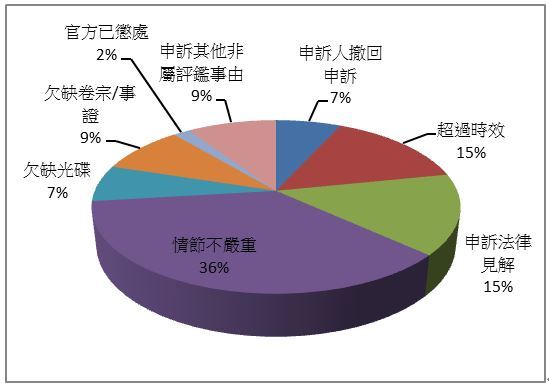
| Complainant Withdrew Complaint | Exceeded Time Limit | Complaint Concerning Legal Interpretation | Circumstances Not Serious | Lack of Disc | Lack of Case File Evidence | Officially Disciplined Already | Complaint Not Pertaining to Evaluation Grounds | Total |
| 16 cases | 35 cases | 35 cases | 85 cases | 16 cases | 21 cases | 4 cases | 22 cases | 234 cases |
Figure 2-2: Statistics on Reasons for JRF Deciding Unable to Assist in Filing Prosecutor Individual Case Evaluation
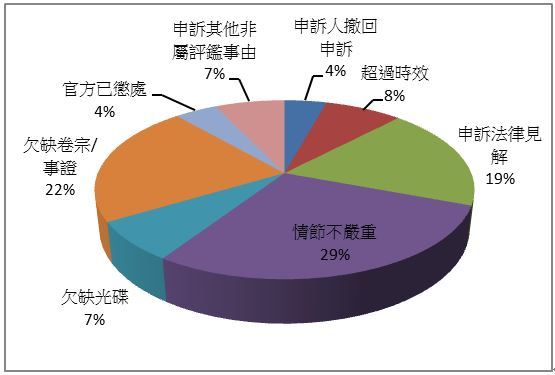
| Complainant Withdrew Complaint | Exceeded Time Limit | Complaint Concerning Legal Interpretation | Circumstances Not Serious | Lack of Disc | Lack of Case File Evidence | Officially Disciplined Already | Complaint Not Pertaining to Evaluation Grounds | Total |
| 6 cases | 11 cases | 26 cases | 40 cases | 10 cases | 31 cases | 6 cases | 10 cases | 140 cases |
However, even when citizens submit petitions within the statutory time limit, painstakingly gather the relevant case file materials involved, and have the JRF evaluate that the circumstances are serious, and subsequently labor to draft evaluation request documents and submit evaluation requests, the vast majority of cases are still ruthlessly rejected by the JEC and PEC. In particular, after the reorganization of the second evaluation committees in 2014, the proportion of cases referred to the Control Yuan dropped precipitously (see Figure 2-3). This raises the question: why do the evaluation committees (especially the Prosecutors Evaluation Committee) continuously reject the individual case evaluation requests painstakingly screened by the JRF?
Figure 2-3: Ratio of Evaluation Request Cases Referred to the Control Yuan by Evaluation Committees over the Years (2012–2014)
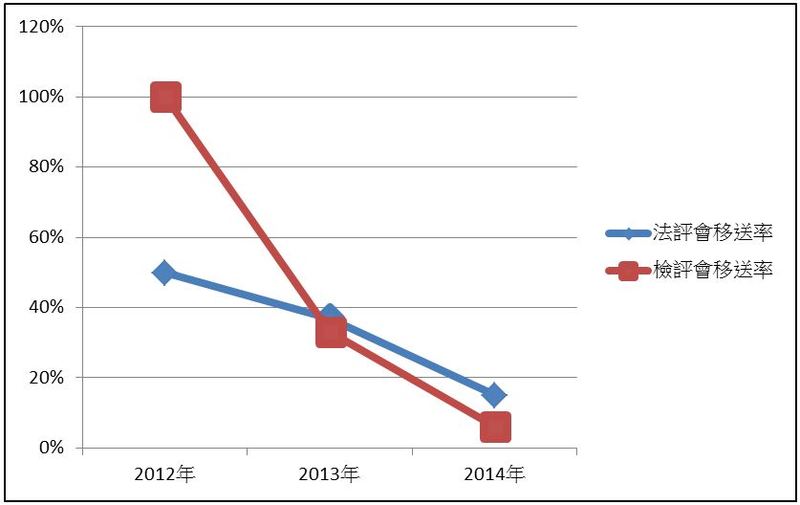
| Year | Judges Evaluation Committee | Prosecutors Evaluation Committee | ||
| No. Referred to Control Yuan / Cases Reviewed | Referral Ratio | No. Referred to Control Yuan / Cases Reviewed | Referral Ratio | |
| 2012 | 2 persons / 4 cases | 50% | 1 person / 1 case | 100% |
| 2013 | 3 persons / 8 cases | 37% | 8 persons / 21 cases | 38% |
| 2014 | 2 persons / 13 cases | 15% | 1 person / 17 cases | 6% |
Poor Interaction Mechanism Between the Evaluation Committees and the JRF
The Judges Act designs a set of "intermediary mechanisms" for individual case evaluation requests. The JRF and other statutory applicants serve dual functions: first, screening cases, and second, initiating the evaluation committees to engage in investigations against specific evaluated persons. Viewed from the perspective of applicants such as the JRF, requesting an evaluation is merely the process of persuading the evaluation committees to initiate their official powers. Accordingly, the question of "why the evaluation committees (especially the PEC) continually reject individual case evaluation requests painstakingly screened by the JRF" can be translated into "why evaluation request agencies such as the JRF are unable to persuade the evaluation committees?"
To persuade effectively, the key lies in exchanging correct information and engaging in well-intentioned, mutually trusting communication. Specific contents include knowing the defense content of the evaluated judge or prosecutor, listening to recordings, reviewing case files, attending meetings to express opinions, and sitting in on evaluation meetings. The importance of the right to procedural participation lies precisely herein. The provisions concerning procedural participation in the "Judges Act Individual Case Evaluation System" are found only in Article 41, Paragraph 5 of the Judges Act: "The Judges Evaluation Committee may conduct necessary investigations, or notify interested parties to appear and explain; investigation data obtained shall not, unless otherwise provided by laws and regulations, be provided to other agencies, organizations, individuals, or be made available for review or transcription.", and Article 9 of the Implementation Measures for Evaluation by the Judges Evaluation Committee: "The evaluated judge may request this Committee to review, transcribe, photocopy, or record documentary materials within the case files. However, in the event of any of the following circumstances, this Committee may restrict or refuse it: 1. Draft documents to be processed prior to the resolution of the individual case evaluation event. 2. Preparation or deliberation documents for the resolution of the individual case evaluation event. 3. Necessity to protect the legitimate rights and interests of a third party. 4. Other necessity for confidentiality pursuant to law or based on the public interest."
Regarding whether applicants may apply to review case files, both the JEC and PEC interpret applicants as "other agencies" excluded under Article 41, Paragraph 5 of the Judges Act, and combine this with the contrario sensu interpretation of Article 9 of the Implementation Measures for Evaluation by the Judges Evaluation Committee to deny applicants the right to apply for reviewing case files [8], thereby restricting channels for applicants like the JRF to obtain correct information.
Regarding well-intentioned and mutually trusting communication, during the term of the first JEC and PEC, not only did they both allow the JRF to attend meetings to express opinions and listen to audio recording discs, but the first JEC would also thoughtfully issue official documents during deliberations to ask the JRF whether it wished to supplement the scope or grounds of the evaluation request to serve as a reference for evaluation discussions. Similarly, the first PEC also passed a resolution to uniformly mail copies of the evaluated prosecutor's defense statement to the JRF for expression of opinion, facilitating reference during deliberation.
However, after the reorganization of the second evaluation committees, while less evident in the JEC, the interaction between the PEC and the JRF deteriorated progressively, showing increasing rejection of affording the JRF opportunities for procedural participation. Coupled with the principle that individual case evaluation meetings are non-public, it is tantamount to the JRF being able only to passively wait for the PEC to render an evaluation resolution after submitting the evaluation request form (see Tables 3-1 and 3-2). In other words, the current procedural participation rights of applicants are entirely pinned on the discretionary filling-in interpretations of Article 41, Paragraph 5 of the Judges Act by the evaluation committees, leaving people at a loss as to what to follow.
Table 3-1: Overview of JRF's Participation in Judge Evaluation Practice
| First JEC | Second JEC | |
| Cases Requested for Evaluation by JRF | 10 | 9 |
| Requested JRF to Attend Meeting to Express Opinions | 1 (101 Ping Tzu No. 1) | 1 (103 Ping Tzu No. 1) |
| Requested JRF to Review Recording Transcripts and Supplement Evaluation Request Grounds | 2 (102 Ping Tzu No. 4) | 1 (102 Ping Tzu No. 10) |
| Requested JRF to Attend Meeting to Listen to Recordings | 0 | 3 (103 Ping Tzu No. 1, 103 Ping Tzu No. 2, 103 Ping Tzu No. 4) |
Table 3-2 Overview of JRF's Participation in Prosecutor Evaluation Practice
| First PEC | Second PEC | |
| Cases Requested for Evaluation by JRF | 20 | 18 |
| Mailed Statement of Opinion of Evaluated Person, Requesting JRF to Express Opinions | 1 (102 Ping Tzu No. 5) | 0 |
| Requested JRF to Review Court Session Video Recordings and Express Opinions | 6 (102 Ping Tzu No. 9, 102 Ping Tzu No. 10, 102 Ping Tzu No. 11, 102 Ping Tzu No. 12, 102 Ping Tzu No. 14, 102 Ping Tzu No. 15) |
3 (102 Ping Tzu No. 21, 103 Ping Tzu No. 7, 103 Ping Tzu No. 9) |
| Requested JRF to Designate One Person to Attend and Observe Witnesses and Evaluated Person Expressing Opinions | 2 (102 Ping Tzu No. 16, 102 Ping Tzu No. 18) |
0 |
The increasingly hostile interaction between the PEC and the JRF has already been reflected in the results of individual case evaluation resolutions rendered by the PEC. Among them, the 9 cases dismissed on the grounds of "having exceeded the 2-year request period" best illustrate this situation. Most citizens are exhausted by the trial proceedings after being prosecuted, leaving them simply no time to consider filing a petition against a prosecutor. Therefore, Article 89, Paragraph 4, Subparagraph 1 of the Judges Act exceptionally allows the limitation period to be calculated starting from the finalization of the case when a prosecutor engages in extremely serious unfit behavior, serving as a solution for the excessively short 2-year time limit.
However, the PEC completely disregards this exceptional provision, universally considering evaluation requests in a decontextualized manner, adopting the strictest time calculation method, and showing not the slightest belief that reviewing methods for time calculation need to be relaxed. It also evidently shows no willingness to communicate procedurally or listen to statements of opinion with the JRF.
Currently, the problem of poor interaction between the evaluation committees and the JRF not only leads to a waste of case-review resources on both sides but also causes citizens to suffer the greatest disadvantage, which in turn disguisedly creates the current individual case evaluation status quo where "evaluating judges is relatively easy, while denouncing prosecutors is extremely difficult" (see Table 3-3).
Table 3-3 Listing of Cases Dismissed by the Second PEC Due to Exceeding the Two-Year Time Limit
| Case Number | Evaluated Person | Denouncing Organization | Grounds for Denunciation |
| 102 Prosecutor Evaluation Tzu No. 22 | Lin Tien-Lin | JRF | Prosecutor did not personally open court while handling major cases; all 11 investigation court sessions were investigated by a prosecutor investigator, and the contents of the non-prosecution disposition were riddled with errors. |
| 103 Prosecutor Evaluation Tzu No. 01 | Kuo Ch'i-Tung | JRF | Appealed to the Supreme Court without stating how the original judgment violated laws, yet lodged an abusive appeal. |
| 103 Prosecutor Evaluation Tzu No. 02 | Chang Ch'i-Pin | JRF | Appealed to the Supreme Court without stating how the original judgment violated laws, yet lodged an abusive appeal. |
| 103 Prosecutor Evaluation Tzu No. 03 | T'ien Ping-Lin | JRF | Appealed to the Supreme Court without stating how the original judgment violated laws, yet lodged an abusive appeal. |
| 103 Prosecutor Evaluation Tzu No. 04 | Ch'en Ming-Kuang | JRF | After declaring an appeal, completely failed to submit a statement of reasons for appeal. |
| 103 Prosecutor Evaluation Tzu No. 05 | Cheng Hsin-Hung | JRF | The offense of fraud is legally prohibited from being appealed to the third instance, yet appealed to the Supreme Court. |
| 103 Prosecutor Evaluation Tzu No. 06 | Tung Ho-Cun | JRF | Defendant was acquitted in the first and second instances, yet without knowing the provisions of Article 9 of the Implementation of Expedited Trial Act, abusively appealed to the Supreme Court. |
| 103 Prosecutor Evaluation Tzu No. 11 | Lin Che-Hui | JRF | Seriously violated non-disclosure of investigation, leaking state secrets. |
| 103 Prosecutor Evaluation Tzu No. 13 | Yang Ta-Chih | Taipei Bar Association | Investigated the case sloppily, and abusively prosecuted the defendant based on facts contradictory to the professional opinions of physicians. |
Conclusion—Amending the Law to Guarantee the Right to Participate in Individual Case Evaluation Proceedings
Summarizing the current status of individual case evaluation request work in its third anniversary, three urgent problems are identified: (1) excessively high dismissal rates by evaluation committees, (2) inability to obtain information on evaluation requests, and (3) poor communication with evaluation committees. Among them, the abrupt change in attitude of the second PEC is clearly related to the September 2013 political strife, following the JRF's request for an individual case evaluation of Prosecutor-General Huang Shih-Ming, which was resolved by the first PEC to be referred to the Control Yuan for investigation.
Before this, individual case evaluations were insignificant; after this, individual case evaluations became the focus of national attention and even the center of power struggles. Therefore, rumors of heavy-handed interference in the composition of the second PEC have been constant. Moreover, for a long time, the Ministry of Justice has allocated only one personnel department specialist to concurrently handle all business of the PEC, clearly intending to extremely passivate the functions of the PEC. In this regard, the JRF expresses solemn condemnation and demands that the Ministry of Justice at least match the Judicial Yuan by staffing sufficient and independent personnel to support the administrative work of the PEC. At the same time, any form of administrative black hand must no longer be allowed to interfere with individual case evaluation work.
Nevertheless, the fundamental solution still lies in amending the Judges Act to guarantee the right to participate in individual case evaluation proceedings and solve the current defects of incomplete regulations. The citizen-version draft amendment to the Judges Act has currently been proposed by 21 legislators, including Legislators Yu Mei-Nu and Liao Cheng-Ching. Its key amendments include extending the time limit for requesting individual case evaluations when facts under evaluation involve specific cases (Article 36), adjusting the composition of the Judges Evaluation Committee to increase external oversight colors (Articles 33 and 34), adding the right to procedural participation for requesting agencies or organizations and parties in evaluation proceedings (Article 41-1), stipulating that the evaluation committee has the official power for active investigation and dedicated personnel (Articles 35 and 41), and stipulating that parties, agents, and interested persons may request courts, prosecution offices, or other court recording custody agencies to deliver court recording discs on the grounds of requesting an evaluation (Article 41-2).
Currently, the citizen-version draft amendment to the Judges Act is under review in the Judiciary and Legal Committee of the Legislative Yuan. It only lacks a corresponding official version from the government to enter article-by-article substantive review. The JRF calls on the Judicial Yuan and the Ministry of Justice to promptly review current deficiencies and submit counter-proposals to the Legislative Yuan, and under no circumstances engage in administrative filibustering to delay the legislative process. It also expresses the hope that before the law is amended, the various judge and prosecutor evaluation committee members will actively and proactively operate the individual case evaluation system to enhance the strength of oversight and win public trust in the judiciary.
[1] See Article 30, Paragraph 1 and Article 89, Paragraph 1 of the Judges Act.
[2] See Article 35, Paragraph 1 of the Judges Act.
[3] See Article 39, Paragraph 1 of the Judges Act.
[4] See Article 34, Paragraph 1 of the Judges Act.
[5] Whether the Judges Act should uniformly apply to prosecutors has always been highly controversial. This controversy continues to this day.
[6] So-called under administrative processing: includes cases where the appeal case has not yet concluded, waiting for the complainant to supplement documents, waiting to confirm the complainant's willingness to appeal, and submitting cases to lawyers for review.
[7] Regarding the legislative purpose of restricting the qualifications of denouncers in the Judges Act, please refer to Shih-Ming Jiang, Legal Ethics, Angle Publishing.
[8] Referring to the JEC letter 103 Ping Tzu No. 8: "Pursuant to Article 41, Paragraph 5 of the Judges Act which provides: 'The Judges Evaluation Committee may conduct necessary investigations, or notify interested parties to appear and explain; investigation data obtained shall not, unless otherwise provided by laws and regulations, be provided to other agencies, organizations, individuals, or be made available for review or transcription.', and Article 9 of the Implementation Measures for Evaluation by the Judges Evaluation Committee which provides that the evaluated judge may request this Committee to review, transcribe, photocopy, or record documentary materials within the case files. Based on the above provisions, those who may apply to this Committee to review documentary materials within the case files do not include the requester of the individual case evaluation,..." In addition, although Article 15 of the Implementation Measures for Evaluation by the Judges Evaluation Committee provides that evaluation procedures regarding the investigation of facts and evidence, dates and periods, fees, and service shall, unless otherwise provided in these Measures, apply mutatis mutandis to the Administrative Procedure Act, because the scope of mutatis mutandis application does not extend to Section 7 on Information Disclosure, it cannot be interpreted as being able to invoke the Administrative Procedure Act as the legal basis for reviewing case files either.
This article is an AI-generated translation of the original Chinese text. In the event of any discrepancy, the Chinese version shall prevail.