
The Operating Space for Chinese Human Rights Lawyers is Being Further Constricted
Last edited: 2026-07-27
I can genuinely feel that the days of human rights lawyers in China are becoming harder by the day, the pressure is mounting daily, and our operating space is being constricted step by step. Over the past six months, a number of human rights lawyers in China have been arrested, such as Lawyer P'u Chih-ch'iang from Beijing, Lawyer Ch'ang Po-yang and Lawyer Chi Lai-sung from Henan, and Lawyer T'ang Ching-ling from Guangdong. These are lawyers who have been very active in public welfare, human rights cases, and social activism. Two events that took place in late August and early September clearly and unmistakably demonstrated this reality.
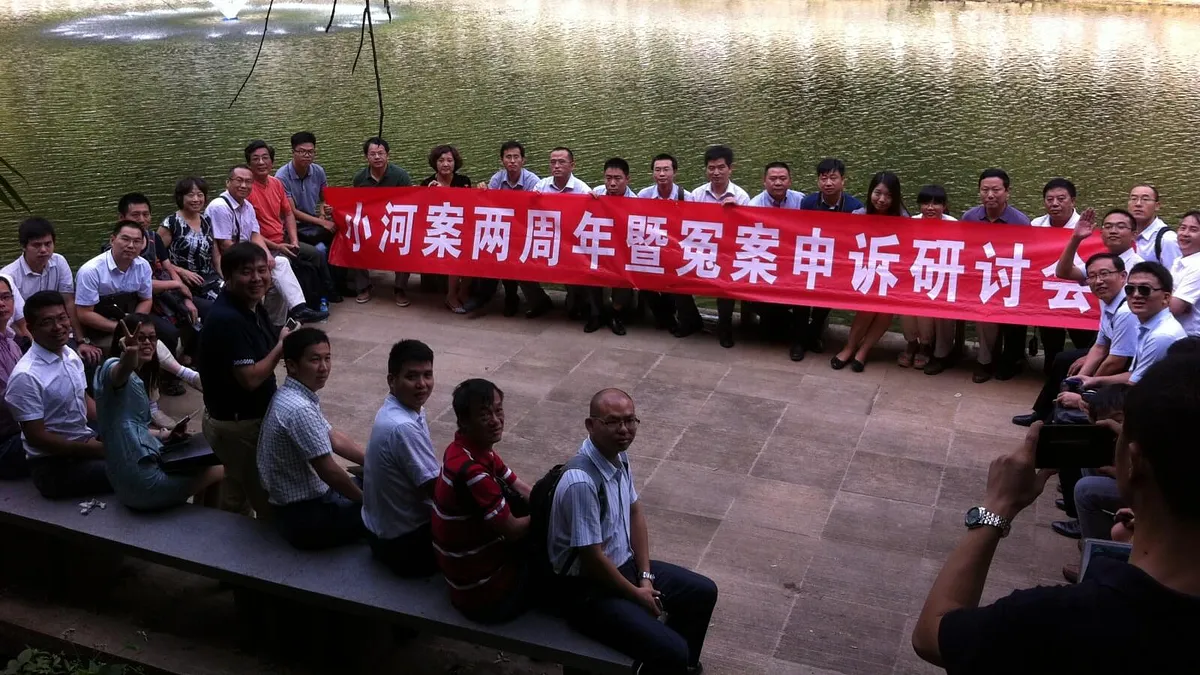
In late August, the "Seminar on the Second Anniversary of the Xiaohe Case and Appeal for Miscarriages of Justice," jointly organized by Lawyer Chou Tse, Lawyer Li Chin-hsing, and myself, was scheduled to be held in Kweiyang. The "Xiaohe Case" is a case that occurred in Kweiyang, Guizhou, where 57 people including Kweiyang entrepreneur Li Ch'ing-hung were accused of organizing, leading, and participating in mafia-style criminal organizations. Because the case involved the expansion of nationwide political campaigns modeled after the Chongqing crackdown on organized crime, local political struggles, the plundering of private enterprises by public power, the retaliatory arrests of multiple witnesses by the police and procuratorates, comprehensive violations of the Criminal Procedure Code (summarized by some lawyers as the epitome of illegal conduct by the police, procuratorates, and courts, violating nearly every procedural law provision possible), over a hundred lawyers participating in the defense, lawyers standing in solidarity to resist, the exposure of illegal acts by public security and judicial authorities, and a trial lasting over forty days that set a Chinese record, it became one of the most closely watched cases in China in 2012. In August 2013, the "Seminar on the First Anniversary of the Xiaohe Case and Effective Criminal Defense" was held in Kweiyang. Although the meeting faced some interference, it managed to complete its two-day scheduled agenda relatively smoothly.
However, this year was different. Every single conference attendee, from the moment they arrived in Kweiyang until their departure, regardless of where they went or what they did, was tracked point-to-point by multiple plainclothes police officers. Furthermore, this tracking was done without any attempt to hide it from us; it was blatant intimidation and harassment.
As for our conference, we successively booked accommodation and conference venues at four hotels, all of which unilaterally breached their contracts under the pretext that they could not host us. Among them, some hotels explicitly informed us that plainclothes police in Kweiyang had instructed them not to host us. With great difficulty, we found a fifth hotel. On the eve of the conference, just one day before it was set to begin, the water pipes in the reserved conference room mysteriously burst, leaving the entire venue submerged in a sea of water.
Having no other choice, nearly seventy attending lawyers (mostly active human rights lawyers) decided to visit Kweiyang's scenic Qianling Mountain Park and hold an open-air discussion. We were fortunate enough to find a small lakeside platform inside the packed park with only a single access pathway, and began our discussion there. However, shortly after we started, multiple individuals of unidentified origin, appearing to be hoodlums, came over to loudly shout and disrupt the meeting. Subsequently, numerous police officers—some in uniform without badges, and others with badges out of uniform—arrived, claiming that someone had reported us for holding an illegal assembly and demanding to inspect our ID cards. Naturally, we refused this illegal and unreasonable demand. Consequently, an even larger crowd of unidentified young men posing as hoodlums swarmed onto the platform (it was later discovered that most of them were plainclothes police). Afterwards, they made false accusations to passing citizens that we were "engaging in multi-level marketing" (which is an illegal criminal offense in China). Then, they began beating participating lawyers who were attempting to leave the platform and illegally detained the logistics staff member Hsiao Huang (who was taken to a local police station and illegally detained for 9 hours, and was released only after a collective hunger strike protest by 14 lawyers and dozens of lawyers demanding his release outside the police station). Subsequent statistics showed that multiple lawyers were beaten, injured, and had their personal property damaged. To escape the beatings and abduction, one lawyer leaped from the road into the lake to save himself. Fortunately, the lake was not deep, and he managed to wade back to the platform. The footage of him falling into the water made the pages of Hong Kong's Ming Pao the next day; that drenched appearance symbolized, to a certain extent, the current miserable plight of human rights lawyers in China.

Photo/Lawyer Liu Kai falling into the water

Photo/14 lawyers conducting a collective hunger strike protest
Despite suffering such a severe impact, our seminar later continued on that small platform for an entire afternoon, successfully completing the originally scheduled agenda.
On September 5, the hearing regarding the Beijing Municipal Bureau of Justice's proposed penalty of suspending Lawyer Ch'eng Hai's practice for one year was held. Prior to this, a statement of support drafted by me and co-signed by over two hundred lawyers and legal professionals was published online. The content of the statement pertains to the reasons behind the retaliatory punishment against Lawyer Ch'eng Hai and also reflects the current living environment of Chinese lawyers; therefore, it is transcribed in full below:
Joint Statement by Lawyers Regarding the Proposed Penalty Against Lawyer Ch'eng Hai by the Changping District Bureau of Justice, Beijing
On August 22, 2014, the Changping District Bureau of Justice of Beijing notified Lawyer Ch'eng Hai of its intention to impose an administrative penalty of suspending his practice for one year, on the grounds that Lawyer Ch'eng Hai disrupted courtroom order and interfered with the normal conduct of litigation proceedings while representing Mr. Ting Chia-hsi in court.
The case in which Mr. Ting Chia-hsi and others were accused of gathering a crowd to disrupt public order is a major case that has received widespread public attention. The relevant facts have long been presented in the public eye, and the following facts are clear:
- The criminal accusations against Mr. Ting Chia-hsi and others are entirely the persecution of citizens striving for legitimate rights by illegal public powers;
- The courts trying the case of Mr. Ting Chia-hsi and others (including but not limited to the Haidian District Court of Beijing) committed multiple procedural violations. For instance, they exercised illegal jurisdiction (illegally splitting a single case into multiple distinct cases and assigning them to courts at different levels), prohibited defense lawyers from copying crucial audio-visual data evidence, prosecutors from higher-level procuratorates posed as prosecutors from lower-level procuratorates to appear in court for public prosecution, and conducted disguised closed-door trials, failing to safeguard the litigation rights of defendants and defense counsel in accordance with the law;
- During the court proceedings, Lawyer Ch'eng Hai left the courtroom to report those perverting the law to legal supervisory agencies in order to fight for his proper and legitimate litigation rights.
Under these circumstances, the Changping District Bureau of Justice of Beijing actually intends to impose a one-year suspension of practice on Lawyer Ch'eng Hai under the pretext of disrupting courtroom order. Regarding this, we express our grave concern and state the following:
- When courtroom trial procedures are severely violated and lawyers, despite multiple efforts, remain powerless to prevent the continuation of these illegal procedures, leaving the courtroom to file a complaint with a legal supervisory agency is entirely the fulfillment of a lawyer's statutory duties. It is done to protect the legitimate rights and interests of clients, defend the correct implementation of the law, and uphold social fairness and justice.
- Given that atrocious incidents involving the varying degrees of deprivation and infringement upon the litigation rights of defendants and defense counsel have repeatedly occurred in courts across the country recently, how lawyers can effectively fulfill their statutory duties has become a serious issue. The Changping District Bureau of Justice's proposed penalty against Lawyer Ch'eng Hai will further exacerbate the disastrous situation where the litigation rights of clients and lawyers are stripped away and violated.
- Since 2014, Lawyer Wang Ch'u'an-p'ing in Guangdong has had his lawyer's practice license revoked, Lawyer Hsieh Yang in Hunan and Lawyer Ch'eng Wei-shan in Jiangsu have been unable to practice normally, and numerous other lawyers' practices have faced various forms of interference and pressure. We express our deep concern and serious protest regarding this.
- We urge the Changping District Bureau of Justice of Beijing to rescind its decision. Judicial administrative authorities should serve as institutions that safeguard lawyers' rights, rather than arbitrarily penalizing lawyers or degrading themselves into tools for lawbreakers to suppress lawyers.
- The primary meaning of ruling the country according to law is governing officials according to law. Only by giving full play to the role of lawyers can the abuse of power and the trampling of laws be effectively curbed; only when the role of lawyers is fully realized is it possible to build a nation under the rule of law.
Because the matter of Lawyer Ch'eng Hai facing punishment concerns the practice rights and safety of every human rights lawyer, everyone was deeply concerned and wished to attend the hearing as observers. On the one hand, this was to show solidarity with Lawyer Ch'eng Hai, and on the other hand, to understand the relevant disciplinary situation so as to have peace of mind should one ever face it personally. However, the Bureau of Justice located the hearing venue at a vineyard in the wilderness more than ten kilometers away from Changping in the suburbs of Beijing. Early in the morning, the gates were tightly shut and swarming with secret agents. Aside from Lawyer Ch'eng Hai and his two hearing agents who were allowed inside, more than a hundred people who arrived wishing to observe were all blocked outside and denied entry. Later on, according to Lawyer Ch'eng Hai, after the three of them went inside, they discovered that the hearing room was already packed with "seat-warmers" arranged by the authorities.
The lawyers and citizens who gathered outside the hearing venue unable to enter loudly chanted "Go, Ch'eng Hai!", and some raised banners supporting Lawyer Ch'eng Hai to take commemorative photos. Consequently, this drew a large contingent of police officers, who temporarily requisitioned several large public buses and even deployed a police helicopter to arrest the onlookers, under the pretext of so-called compulsory summons.
Later statistics showed that a total of 9 lawyers (including myself) regained our freedom after being illegally detained for 14 hours that day, while another 46 citizens regained freedom after being illegally detained for 24 hours. The so-called hearing became a trap set by the authorities. They claimed it was a public hearing, yet barred people from entering and arbitrarily made arrests. Under circumstances where the aspiring observer-lawyers (several of whom were Lawyer Ch'eng Hai's witnesses—though they were given no opportunity to testify for Lawyer Ch'eng Hai) and citizens had committed no violations of the law, police power was abused to carry out arrests and arbitrary illegal detentions.
Following our illegal detention, we 9 lawyers announced a hunger and thirst strike to protest the police brutality. Upon our release, we jointly filed a criminal complaint with the Beijing Municipal People's Procuratorate against the Chief of the Changping Public Security Bureau of Beijing and relevant police officers for the crime of illegal detention, demanding that their criminal liability be pursued. Although we knew there would be no response and no result, aside from this, there was nothing else we could do. By filing our complaint, we at least demonstrated to the abusers of power that we refuse to submit.
We refuse to submit, and citizens engage in civil disobedience. Although reality is cramped and oppressive, fighting for rights and fighting for democracy and the rule of law is our destiny, and we have no other choice.
This article is an AI-generated translation of the original Chinese text. In the event of any discrepancy, the Chinese version shall prevail.
