
Deadlock in the Central Plains
Last edited: 2026-07-27

As the autumn wind first rises and the wheat turns from green to gold, I head all the way south.
My destination this time is Zhengzhou in the Central Plains, to join a defense team of lawyers representing nine citizens detained on August 1 by the Zhengzhou Public Security Bureau on charges of "illegal assembly." These nine citizens were detained because they advocated for the right of nine previously detained citizens—currently held at the Zhengzhou No. 3 Detention Center (hereinafter the Zhengzhou No. 3 Detention Center)—to meet with their lawyers, a right illegally stripped from them by the Zhengzhou police.
In my previous article, "The Difficulty of Lawyer-Client Meetings in Mainland China," I mentioned the Zhengzhou case. Of the eleven people arrested in this case, two have been released on bail pending further investigation, while nine remain detained. More than two months have passed since their arrest; although dozens of lawyers have made dozens of requests for meetings, all have been turned away by the Zhengzhou police. The lawyers have fought back, filed complaints, lodged accusations, held "review meetings," and even jointly written a letter to the State Council, yet none of these efforts have secured the right to meet with their clients during the investigative stage.
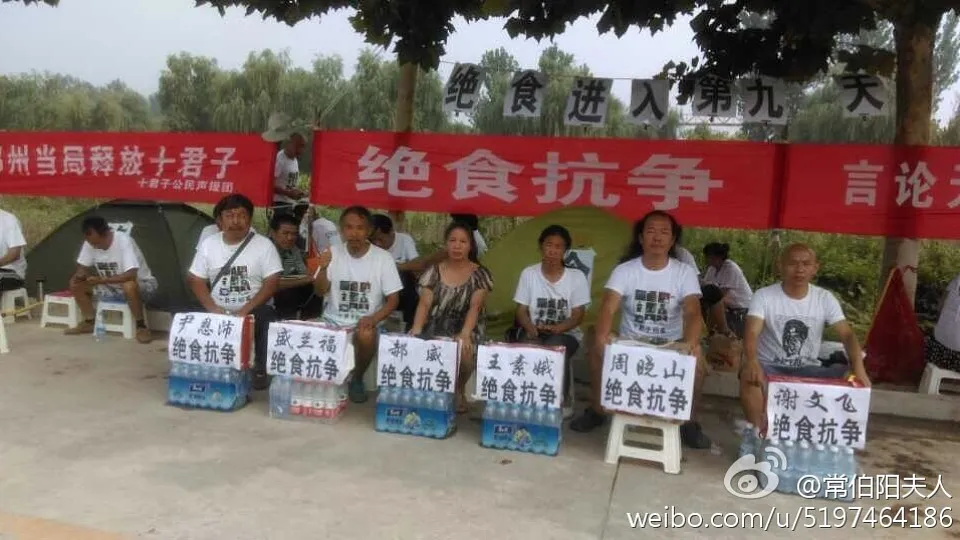
Among the nine individuals detained since their arrest in the Zhengzhou case, most are rights lawyers, activists, and dissidents. Their illegally stripped right to meet with lawyers has sparked nationwide attention due to their attorneys' advocacy. Starting July 3, dozens of citizens from across the country spontaneously gathered outside the Zhengzhou No. 3 Detention Center, where the Zhengzhou case "Ten Gentlemen" (Note 1) are held, to protest. They wore matching T-shirts printed with portraits of the "Ten Gentlemen," distributed flyers introducing them and their stories to passersby, and held banners and slogans such as: "Please let the Zhengzhou authorities arrest us under कटोcrime of the Zhengzhou Ten Gentlemen," "Would the nation collapse just because lawyers met Chang Po-yang and the other nine?", "The Zhengzhou Ten Gentlemen are innocent, we support you forever," "The Gentlemen are imprisoned for conscience, we hunger strike for the Gentlemen," "Democratic fighters in mainland China, in order to awaken the sleeping Chinese, are either imprisoned or on their way to prison," "Autocracy and despotism are the root of all evil in China," "When the law no longer protects justice, resistance becomes a universal obligation," and "Only through struggle is there change, freedom, and dignity." They began a relay hunger strike at the site on July 15. Throughout nearly a month of protests, photos of their on-site hunger strikes were widely circulated on the internet every day, generating massive repercussions both domestically and internationally and shaping into a major event.
The authorities evidently could not tolerate such on-site protests. On the afternoon of August 1 (Note 2), the Zhengzhou police used force to clear the site, forcibly summoning a total of over 40 protesting citizens to the Public Security Bureau. They subsequently announced the criminal detention of six individuals and the direct arrest of one, while also traveling to Wuxi, Jiangsu, to arrest two others. According to the police, the reason for these arrests was that these citizens had engaged in an "illegal assembly."
Since the citizens were detained (primarily) for fighting for the right to lawyer-client meetings, the lawyers naturally could not stand by and do nothing. Upon learning that the protesting citizens had been cleared out and arrested, some of us human rights lawyers discussed initiating legal assistance for them immediately. Thus, human rights lawyers began converging on Zhengzhou.
I rushed to the Zhengzhou No. 3 Detention Center on the afternoon of August 4, where I met nearly ten citizens who had been released following the forced clearance and summons over the past two days. They were heading to the Dahaolu Police Branch of the Zhengzhou Public Security Bureau—which had carried out the arrests and confiscated their banners and slogans—to retrieve their belongings. The citizens told me that the head of the branch told them the arrested protesting citizens had been locked inside the Zhengzhou No. 3 Detention Center. However, when the citizens went there that morning to inquire and prepare living expenses and clothing for the detained protesters, they were told there was no record of such people. Therefore, I decided to go to the Zhengzhou No. 3 Detention Center first to request a meeting with the detained citizens, check whether they were indeed detained there, and then determine our next steps. However, that afternoon, the result of my inquiry at the reception desk of the Zhengzhou No. 3 Detention Center was that the detention center's computer system showed no record of these citizens being held, leaving me unable to arrange a meeting.
On the morning of August 5, Lawyer Chang K'ai (张凯) from Shandong, who had taken an overnight train to Zhengzhou, joined me without rest at the Dahaolu Police Branch of the Zhengzhou Public Security Bureau. The two of us decided to first go to the branch to clarify the handling agency for the case, the types of coercive measures imposed on the detained citizens, their place of detention, whether they were being held under aliases or code names, and the details of the case. The three major difficulties of mainland public security organs—hard to get through the doors, harsh faces to look at, and hard to get things done—need not be mentioned. The police officer surnamed Li who received us checked and registered our lawyer certificates, law firm introduction letters, and powers of attorney. He told us that the branch was indeed the handling agency for this case, but no further details could be provided because the powers of attorney we held were signed by the principals themselves, yet those principals had already been detained and could not have issued powers of attorney after being locked up. We argued that the powers of attorney had been signed by the principals in advance, left with friends, and transferred to the lawyers by their entrusted friends after their arrest, which naturally made them valid. Moreover, the public security organ's review of a power of attorney should be limited to a formal review; meeting formal requirements presumes authenticity, and the lawyers should bear responsibility for its authenticity if any forgery is subsequently discovered. However, the officer insisted on first verifying that the powers of attorney were signed by the principals themselves before confirming our status as defenders. This is a routine tactic used by mainland public security agencies to harass lawyers in their practice; we have seen it too many times. Left with no other choice, our response was: Fine, go ahead and verify it, we will sit right here and wait for you to do so.
After sitting and waiting for half a month—correction, half an hour—the receiving officer came out and explicitly told us that the individuals were indeed detained at the Zhengzhou No. 3 Detention Center and that we could go meet them (meetings are actually handled by the detention center specifically responsible for holding detainees, which has nothing to do with the handling agency, though both belong to the public security system and maintain close ties).
Our purpose in going to the public security branch was simply to have the handling agency officially confirm that the individuals were locked up in the Zhengzhou No. 3 Detention Center. Upon receiving a formal reply from this officer, we decided to go to the detention center to request a meeting. When we arrived, the detention center's computer system surprisingly showed records this time. However, the detention center told us that we could not meet with them right now because the handling unit needed to conduct continuous interrogations, and the detention center would arrange it within 48 hours in accordance with the law, telling us to return for a meeting on the morning of the 7th. Another 48 hours! I cannot even say that the detention center's actions are illegal, because the Criminal Procedure Law stipulates: "Where a lawyer requests to meet [with a detainee], arrangements shall be made promptly, and no later than 48 hours." What could we do? We could only sit and wait dryly.
In the afternoon, we accompanied Beijing lawyer Chu Hsiaot'ing (朱孝顶) to the Zhengzhou No. 3 Detention Center to meet with Chia Ling-min (贾灵敏), one of the Ten Gentlemen (Chia was framed and imprisoned by the local Zhengzhou government for popularizing legal knowledge among evicted residents; her case has now been transferred for prosecution review, making meetings permissible). We saw nearly 30 citizens wearing matching T-shirts printed with portraits of the Ten Gentlemen return to the gates of the Zhengzhou No. 3 Detention Center, forming lines, holding slogans, unfurling banners, and continuing their protest. They even deliberately lined up to show the detention center police officers as they got off work and left through the main gate on the shuttle bus. Four days after being cleared out on August 1, the citizens returned to the protest site with dauntless courage, unyielding resolve of not fearing imprisonment, and a proud sense of honor in entering prison!
Several prominent commentators made such remarks regarding the citizens' return to the protest site and the Zhengzhou protests: "This may well become a watershed moment in Chinese history, because the citizens raised clear political demands, launching the prologue to mainland street movements with unyielding courage under a harsh political environment."
Inside the Zhengzhou No. 3 Detention Center, the Ten Gentlemen are still locked up; outside the detention center, nine more citizens who protested to defend the rights of the Ten Gentlemen have been locked inside as well; and even more citizens are rushing from all over the country to the Zhengzhou protest site.
The Ten Gentlemen will have 20 defense lawyers; the nine citizens will also have 18 defense lawyers. A battle to defend human rights and the rule of law has already begun in Zhengzhou. I feel deeply honored to be a part of it.
This truly is a deadlocked Central Plains. Will Zhengzhou become the Beautiful Island (Formosa) of the mainland?
Written in Zhengzhou on August 5, 2014
Notes:
- An honorable designation used by outsiders for those detained in this case. 12 people were actually arrested, 2 released on bail, leaving 10 still detained.
- August 1 was a Friday. This timing was carefully chosen because Friday afternoon sees a decline in public media attention, minimizing the public opinion fallout from a violent clearance. Furthermore, the following two days are the weekend, making it impossible for lawyers to promptly provide legal assistance—though even if lawyers went, the police would not allow them to have a smooth and timely meeting. The Chinese Criminal Procedure Law stipulates a 48-hour clause: "Where a lawyer requests to meet, arrangements shall be made promptly, and no later than 48 hours"—forcing lawyers to wait dryly for over 40 hours before a meeting is arranged.
This article is an AI-generated translation of the original Chinese text. In the event of any discrepancy, the Chinese version shall prevail.