
The Difficulty of Lawyer-Client Meetings in mainland China
Last edited: 2026-07-27
With over 95% of criminal suspects in mainland China being detained, the difficulty for lawyers to meet with their detained clients has long been one of the most prominent issues in mainland Chinese criminal defense. In recent years, with the development of the legal system and legislative progress, the difficulty of lawyer-client meetings in ordinary cases has improved to a certain extent. However, in many "special" cases, the problem of meeting difficulties still stands out prominently.
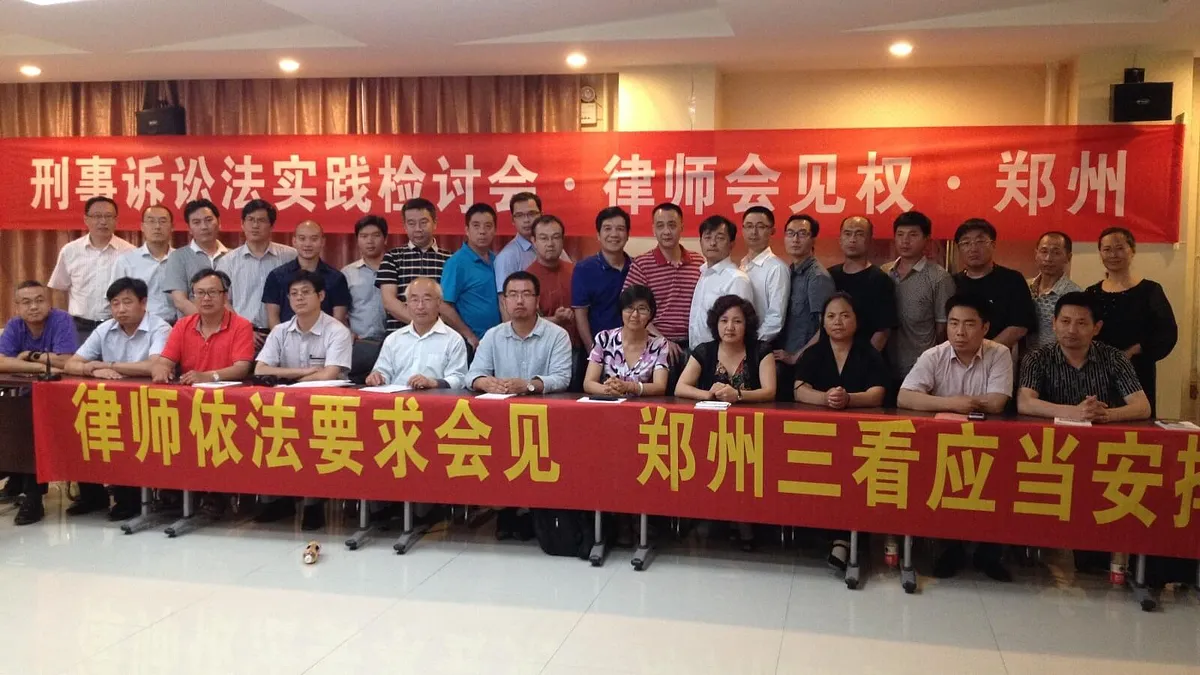
On June 5, 2014, more than thirty lawyers from all over the country held a meeting in Zhengzhou City, Henan Province, entitled "A Review of Criminal Procedure Law Practice: The Right to Lawyer-Client Meetings" (I was one of the organizers). Calling it a "review meeting" rather than a "seminar" was a first in mainland China, both officially and among civil society. This is because officially, authorities believe they are forever great, glorious, and correct, and do not think anything needs reviewing; among civil society, it was previously generally thought that when problems arose in the implementation of the law, it was the fault of legislators and law enforcers, and civil society had neither the obligation nor the right to review them.
The reason such a meeting was held in Zhengzhou was because a very serious, large-scale incident violating the rights of clients and lawyers to meet occurred there. In late May, more than ten people—including Ch'ang Po-yang (常伯陽) and Chi Lai-sung (姬來松), Zhengzhou human rights lawyers long engaged in public interest litigation; Chieh Yu (石玉), a journalist who exposes corruption; Yu Shih-wen (于世文) and Ch'en Wei (陳衛), pro-democracy figures; Ms. Chia Ling-min (賈靈敏), who has long provided civic legal education on a voluntary basis to evicted residents across the country (and is herself a victim of forced eviction); alongside other citizens—were criminally detained by the Zhengzhou public security authorities. The alleged charge given to them was "gathering a crowd to disrupt order in a public place." However, according to reports, the real reason for their detention was that on the third day of the Lunar New Year this year, they had gone to the hometown of former Chinese Communist Party General Secretary Chao Tzu-yang (趙紫陽) by the Yellow River in Hua County, Henan Province, to hold a memorial event commemorating those who died in relation to the "June Fourth" incident. Meanwhile, Chia Ling-min was detained because she had long been educating evicted persons across the country on the law and encouraging them to fight for their legal rights and interests according to the law, causing her to be viewed as a troublemaker by some local governments.
After being criminally detained, these individuals were all locked up in the Zhengzhou No. 3 Detention Center. Using the excuse that meetings required permission from the handling case agency, the detention center refused all lawyer-client meetings for the clients in this case, rejecting meeting requests from a total of six batches comprising dozens of lawyers.
The new mainland Criminal Procedure Law, which came into effect on January 1, 2013, stipulates that lawyers holding their attorney certificate, a power of attorney, and a law firm certificate may go to the detention center to request a meeting with their client, and the detention center shall arrange it promptly, no later than 48 hours. Meanwhile, the Criminal Procedure Law stipulates that for three categories of cases involving "endangering state security, terrorist activities, and major bribery," meetings during the investigative stage require permission from the case-handling agency.
According to this legal provision, the suspects in the Zhengzhou case were detained under the charge of "gathering a crowd to disrupt public places," which does not fall under the statutory circumstances requiring permission from the case-handling agency for a meeting. However, the case-handling agency arbitrarily expanded the interpretation of the three categories of cases, asserting that although these detainees were charged with ordinary offenses, they had already "endangered state security"; therefore, meetings required permission, and thus lawyer-client meetings were refused.
The same situation occurred in Beijing. In early May, the Beijing Municipal Public Security Bureau criminally detained five publicly renowned figures under the charge of "picking quarrels and provoking trouble": lawyer P'u Chih-chiang (浦志強), Professor Hsü Yu-yü (徐友漁), Professor Hao Chien (郝建), Elder Hu Shih-ken (胡石根), and Ms. Liu Ti (劉荻), because they attended a "June Fourth 25th Anniversary Symposium" held in a private home. "Picking quarrels and provoking trouble" is also an ordinary charge and does not belong to the circumstances requiring permission from the case-handling agency for meetings. Nevertheless, after allowing the five individuals' defense lawyers to meet once, the Beijing No. 1 Detention Center repeatedly rejected meeting requests from multiple lawyers for a period lasting over a month. (Note 1)
Why did this situation arise? What compels public security detention centers to violate the explicit provisions of the Criminal Procedure Law, to blatantly trample on the law and basic human rights, and to bar detained persons from meeting with lawyers?
This must begin with the update in the mainland government's tactics for cracking down on dissidents over the past two years. Unlike the continuous methods used for many years in the past, the mainland government has shifted the charges used to suppress dissidents from routine offenses involving "state security"—such as "(inciting) subversion of state power"—to ordinary charges. Examples from last year include the "gathering a crowd to disrupt public order" charge in the New Citizens' Movement series of cases represented by Hsü Chih-yung (許志永); and the "picking quarrels and provoking trouble" charge in the cases of P'u Chih-chiang, Hsü Yu-yü and others, the Zhengzhou case series, and the Guangzhou case series.
I believe this demonstrates the mainland authorities' intention to create the impression that "there are no political prisoners in China." A piece of news confirmed this judgment of mine: Chinese Foreign Ministry spokesperson Hung Lei (洪磊) stated on June 3: "In China, there are only lawbreakers; there are no dissidents."
However, no matter what the charge is, it cannot conceal the authorities' substance of cracking down on dissidents.
At the same time, with the development of internet communication technology, mainland lawyers have gradually given rise to political defense. Defense lawyers no longer approach politically sensitive cases with caution and trepidation; instead, they point directly to the core facts of political persecution and utilize self-media to widely disseminate and boldly expose such political persecution. This has placed the authorities' crackdown operations in a very passive position. This point was fully demonstrated in the New Citizens' Movement series of cases involving Hsü Chih-yung and others.
One of the authorities' countermeasures against this has been to forbid lawyers from meeting detained dissidents—especially when a case has just occurred and has the highest communicative timeliness. If lawyers cannot see their clients, they naturally cannot carry out timely exposure and dissemination. Yet according to the provisions of the Criminal Procedure Law, the only cases where lawyer meetings can be restricted are the three categories of cases mentioned earlier. This places the authorities in a dilemma: they must suppress dissidents, but they do not want to prosecute them under political case charges, meaning they must use ordinary charges. In that case, lawyers would be able to meet clients; once they meet, lawyers will expose and disseminate information, thereby substantiating the fact of political persecution by the authorities. Therefore, to sever this cycle, they strike at the point of lawyer-client meetings, determined to cut off the foundation of lawyers' political defense: forbidding meetings.
There is another reason for banning lawyer meetings: case-handling agencies often sever the detained person's contact with the outside world while exerting intense psychological pressure on them, forcing the detainee to submit and compromise. Last year, the Beijing No. 3 Detention Center used the pretext of "fixing water pipes" to bar all lawyers in the New Citizens' Movement cases from meeting their detained clients for more than twenty days, while intensively interrogating the detainees day and night. As a result, one key detainee confessed to the authorities—becoming the only person to confess among nearly twenty defendants in the New Citizens' Movement cases.
Therefore, in mainland China today—just as human society has entered the second decade of the 21st century and in a China that boasts of being a rule-of-law state—human rights incidents in which detained persons are forcibly stripped of their right to meet with lawyers have occurred on a massive scale.
There are also other cases, such as Falun Gong cases, which do not belong to the three categories of cases requiring meeting permits. However, because of their special nature, the rights of clients and lawyers to meet are frequently subjected to various restrictions and deprivations.
As for meetings regarding the three categories of cases that do require permission from the case-handling agency, legally prescribed permitted meetings are almost equivalent to denied meetings.
In a normal rule-of-law environment, the right to a defense should be the core of criminal proceedings, and a lawyer meeting with their client is the foundation of the right to a defense. In the current criminal justice environment of the mainland, lawyers are frequently unable to meet their clients. It is hard to imagine what effective defense work a lawyer can carry out if they cannot even meet their client.
Yet this is the current reality of criminal defense in the mainland.

Note:
- On June 5, among the five arrested individuals, apart from lawyer P'u Chih-chiang, the other four had been released on "bail pending trial."
This article is an AI-generated translation of the original Chinese text. In the event of any discrepancy, the Chinese version shall prevail.