
A Hunger Strike Diary in Chien-San-Chiang
Last edited: 2026-07-27
Chien-San-Chiang is a geographical location situated within Fuchin City, Jiamusi City, Heilongjiang Province, on the Chinese mainland, where the Heilongjiang, Songhua, and Wusuri Rivers converge. It is the northeasternmost point of mainland China, bordering Russia, and is referred to by Chinese people as the 'Great Northern Wilderness'. Administratively, Chien-San-Chiang belongs to the agricultural reclamation system, which operates independently from local government, maintaining its own agricultural production and self-run administration, with its public security, procuratorate, and courts operating separately from local authorities as an independent kingdom.

At around 7:30 AM on March 21, 2014, four lawyers—Chiang T'ai-yung, T'ang Chi-t'ien, Wang Ch'eng, and Chang Chün-chieh (among whom Chiang T'ai-yung, T'ang Chi-t'ien, and Wang Ch'eng had all faced suppression by judicial administrative authorities due to their human rights defense activities, resulting in revoked licenses or an inability to practice normally)—along with multiple citizens, were detained by local police at the Chien-San-Chiang Farm. The reason was that on the afternoon of the previous day, March 20, the four lawyers, together with relatives of their clients, went to the Chien-San-Chiang 'Ch'ing-Lung-Shan Legal Education Base' (in reality a black jail) to demand that the base release several law-abiding citizens illegally detained therein, most of whom were Falun Gong practitioners and petitioners.
On March 23, citizens from all over the country rushed to Chien-San-Chiang to inquire about how the local police station would handle the four lawyers and multiple citizens, only to be told that T'ang Chi-t'ien and the other three lawyers had been subjected to 15 days of administrative detention under the charge of 'using an evil cult to undermine society.' Chiang T'ai-yung, Wang Ch'eng, and Chang Chün-chieh were also subjected to administrative detention, and all four were locked up in the Ch'hsing Detention Center of the Chien-San-Chiang Agricultural Reclamation Administration Public Security Bureau. As soon as this news spread, the legal community was filled with righteous indignation. The charge of 'using an evil cult to undermine society' was precisely the accusation leveled against the clients whom T'ang Chi-t'ien and the other three lawyers were assisting. Now, this very charge was directly slapped onto the lawyers themselves. By such logic, defense lawyers would commit the same crime as the persons they defend—what utter absurdity!
On the morning of March 24, Beijing lawyer Hu Gui-yun, Hubei lawyer Zhang Ke-ke, and Hunan lawyer Cai Ying arrived at the Ch'hsing Detention Center in Chien-San-Chiang, holding lawful credentials and demanding to meet with the detained lawyers. They were rejected by the Ch'hsing Detention Center under the pretext that it needed to report to leadership and respond within 12 hours (though in reality no response was ever given). According to the mainland State Council's administrative regulation, the 'Regulations on Detention Houses,' and the mainland Ministry of Public Security's 'Implementation Measures for the Regulations on Detention Houses,' detention houses shall guarantee the detained person's right to meetings, and lawyers' meetings shall not be subject to restrictions on time and frequency. Under these two aforementioned laws, detention houses presented with lawful credentials by lawyers requesting a meeting shall arrange it immediately, and the law provides no exceptional circumstances where meetings are not permitted. Not only did the detention house fail to arrange a meeting, but the head of its superior institution, the Ch'hsing Public Security Precinct, revealed an intention to possibly convert the detention of the four lawyers into criminal detention (i.e., turning a public order case into a more serious criminal case) when receiving the lawyers who requested the meeting. Upon seeing this news, Attorney Li Jin-xing and I, who were on a business trip in Liaoning, discussed the matter and concluded that the local police in Chien-San-Chiang were simply lawless, and we had to do something to prevent the situation from deteriorating. We thus changed our original itinerary and headed to Chien-San-Chiang.
On the afternoon of March 25, Attorney Li Jin-xing from Shandong, Attorney Xi Xiang-dong, Attorney Chiang Yuan-min from Shenzhen, Attorney Ge Wen-xiu from Guangzhou, Attorney Hu Gui-yun, and I went to the Ch'hsing Detention Center once again holding lawful credentials to request a meeting. Before setting out, each of us had written our own authorization power of attorney so that once we were arrested, it would be convenient for subsequent lawyers to come and defend us. Two kilometers away from the intersection leading to the Ch'hsing Detention Center, police had set up a cordon to inspect passing vehicles. When we reached the entrance of the detention house, we found the scene bizarre and treated as if facing a formidable enemy: multiple police cars were parked on the side, along with several unidentified vehicles surrounding the entrance. We could see roughly seventy or eighty plainclothes personnel surrounding us, looking fierce and full of hostility toward us.
We prepared to enter the detention house to request a meeting with the detained lawyers, but lo and behold, the gates of the detention house were tightly shut and would not be opened for us at all. Only after we repeatedly shouted that lawyers were demanding a meeting did a person wearing police uniform come out. Upon our demand, he showed his identification; he was the director of the detention house. The director checked our lawyer credentials, told us to hand over our meeting paperwork to him, and turned around saying he needed to report to leadership and told us to wait. We demanded that the detention house arrange the meeting immediately; otherwise, it would be a violation of the law. However, the director ignored us, turned around and briskly walked away, not even letting us inside the gate, leaving us to wait in the March cold wind of the Northeast.
During our wait, multiple plainclothes personnel provoked us without reason. From inside the detention house, a plainclothes person also held a video camera filming us. One plainclothes person told Attorney Li Jin-xing that he would find some local thugs to finish Attorney Li Jin-xing off. Attorney Li Jin-xing immediately dialed 110 to report the crime to the police. Ten minutes later, 110 police officers arrived at the scene, holding law enforcement recorders and filming us lawyers the entire time, while failing to film the person who issued a death threat to the lawyers. When Attorney Li Jin-xing demanded that the police handle the threatener in accordance with the law, the police instead said there was no need to investigate as everyone knew who it was, and then they left. Later, when that threatener came down again to provoke us, we noticed that his belt was engraved with a police emblem.
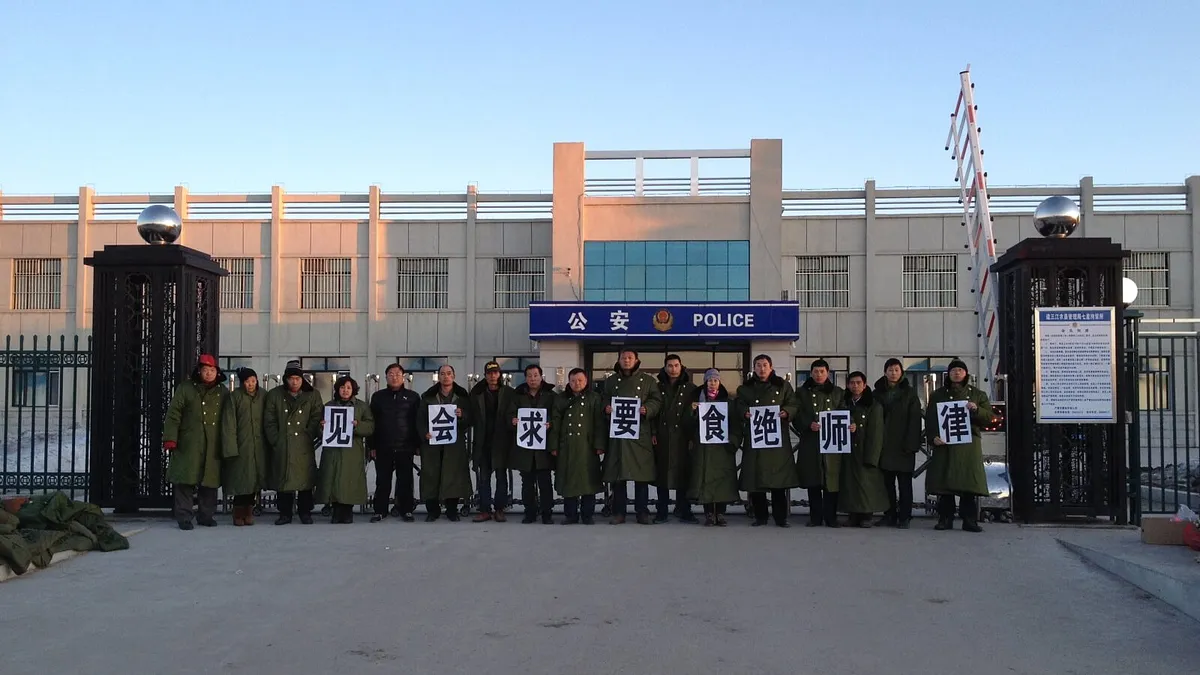
Given that we repeatedly shouted demands for the detention house to immediately arrange a lawyer meeting in accordance with the law, yet the detention house gave no response and refused to make arrangements, Attorney Li Jin-xing and I announced the start of a hunger strike protest at 14:00, beginning a sit-in hunger strike at the detention house entrance. During this time, more than twenty citizens who rushed over from all over the country came to the scene to watch and show support.


When the off-duty hours of the afternoon of the 25th arrived, the detention house still had not arranged our meeting, so we decided not to leave the detention house by even a single step, spending the night in the open air outside the detention house. At night, citizens fetched us hot water and brought us cotton-padded overcoats, hats, quilts, and cotton shoes. In the Northeast, it gets dark exceptionally early. At night, the temperature dropped below zero. The next morning, we discovered a thin layer of ice on the ditch outside the detention house gate. Every hour, we shouted toward the detention house: 'Arrange in accordance with the law for lawyers to meet T'ang Chi-t'ien, to meet Chiang T'ai-yung, to meet Wang Ch'eng, and to meet Chang Chün-chieh. The detention house must guarantee the detained person's right to meetings. Refusing to arrange lawyer meetings is illegal. Police officers, do not trample upon the law and human rights.' That night, citizens also began shouting in unison outside the detention house walls the names of the four lawyers (according to Attorney Chang Chün-chieh, who had already been released, he could hear his name being shouted from the outside while inside, and he was moved to tears of gratitude several times).
At noon on the 26th, when our hunger strike reached nearly 24 hours or so, the head of the Ch'hsing Public Security Precinct came outside the detention house gates, demanding public registration of the lawyers and citizens present at the scene. This was rejected by us; we raised that only one matter needed to be resolved right now: immediately arrange lawyer meetings in accordance with the law. To this lawful demand of ours, the precinct head paid no heed; instead, he announced that the entire road section in front of the detention house gate would be placed under martial law (this was once again a serious violation of the law, as according to the 'Martial Law,' martial law must be decided by the State Council and proclaimed by the Premier of the State Council).
Shortly after the precinct head left, citizens who came in from the outside told us that cordons had been set up at the outer intersections, with multiple police officers stationed on guard to check ID cards of incoming persons and forbid food and water from being brought in. The ban on bringing in food targeted the citizens and other lawyers steadfastly holding their ground at the scene, while the ban on bringing in water was aimed primarily at the hunger-striking lawyers. Upon hearing that bringing in water was prohibited, a wave of grief and indignation rose from the bottom of my heart: when people are conducting a hunger strike protest for a right that is thoroughly lawful and extremely justified, imposing martial law on the site and forbidding water from being brought in is a bottom line that no civilized government or civilized humanity could ever accept.
The Ch'hsing Detention House is located in the wilderness, surrounded by vast farmland and a few farmhouses. Citizen friends went to find some hot water for us at kind-hearted farming households, and found hot dumplings for the other lawyers and citizens who were not on hunger strike (later, we heard that local police wielded their power arbitrarily, imposing fines ranging from 5,000 to 20,000 yuan on each farming household that provided us with water or food—alas).
Late at night on the 26th, a total of over ten citizens and lawyers who had returned from the scene to hotels to sleep were summoned to the police station by police. After other lawyers and citizens rushed over to negotiate, they were all released. Rumors circulated that night that the police station intended to forcibly clear the site; we continued to sleep, waiting for the police station to come and arrest us.
On the 27th, the sun rose as usual, warming those who had been frozen during the bitter night. Waking up in the morning, there was no site clearance, but we heard that last night, Harbin citizen Ch'ih Chin-ch'un, who had delivered sleeping bags to us lawyers, had been made to disappear (we later learned he was detained by the police). The detention house continued its illegal failure to arrange lawyer meetings, we continued our hunger strike protest, and every interval we shouted demands for the detention house to arrange meetings in accordance with the law, while citizens also shouted the names of the four lawyers at regular intervals. By this time, the Chien-San-Chiang incident had already become a public event, and we were right at the center of the storm. We continued our sit-in and hunger strike, feeling very hungry at one point, but soon the hunger passed and we could no longer feel it.
At 14:00 on the 27th, our hunger strike protest reached 48 hours. The right of lawyers to meet detained persons, explicitly provided by law, still could not be realized. We watched with our own eyes as the law was trampled upon by public power institutions, watching lawyers humiliated time and again by unlawful public power. At this moment, Attorney Li Jin-xing experienced unbearable stomach pain, and we decided to halt the hunger strike and withdraw from the scene.
Just as we withdrew from the scene, we received a phone call from Attorney Chang Chün-chieh, who had been released from the detention house at 4:00 AM that day. He informed us that after being released from the detention house by the Chien-San-Chiang police, he was escorted onto a plane, and that he had suffered torture by local police, with his lower back beaten to the point where he still could not stand upright (subsequent examination showed three lumbar transverse processes with four fractures, constituting minor injury). He also informed us that the other three detained lawyers had all suffered varying degrees of torture. Only then did we understand why the Chien-San-Chiang police preferred to break the law in front of the national public rather than arrange lawyer meetings—it turned out they were afraid their savage atrocities of torturing the four lawyers would be exposed.
Because Attorney Li Jin-xing and I had other cases to handle, we left Chien-San-Chiang on the evening of the 27th. On the following night, relay lawyers who arrived later—Beijing lawyer Wang Ch'üan-chang, Shenzhen lawyer Wang Sheng-sheng, and Shandong lawyer Fu Yong-gang—encountered a forced clearance. All lawyers and citizens were illegally summoned for 24 hours with black hoods and hands bound behind their backs with adhesive tape. Attorney Wang Sheng-sheng 'had the honor' of becoming the first female lawyer on the mainland to be fitted with a black hood, while Attorney Wang Ch'üan-chang was grabbed by his hair and forcefully slammed against a wall by police, and was repeatedly punched in the head by multiple police officers for a prolonged period. Apart from three lawyers and some citizens who were released after 24 hours, over a dozen more citizens were forcibly disappeared.
Chien-San-Chiang momentarily became a place of violence and terror. Dozens of police officers guarded the city entrance roads, checking ID cards one by one, using unmarked vehicles to tail the lawyers and citizens heading there, and conducting close-range tailing and surveillance at any time. However, Chinese lawyers have backbone and are not afraid. On April 2, Hunan lawyer Hsieh Yang, Beijing lawyer Wang Hsing, and Ch'en Chien-kang arrived at Chien-San-Chiang, demanding to meet the detained lawyers and filing accusations regarding the illegal acts of the Chien-San-Chiang police.
The matter has not yet ended. Legal scholars have already summarized: 'The Chien-San-Chiang incident is extremely grave and highly egregious; it has already become one of the landmark anti-legal and anti-constitutional events of 2014.'
According to the 15-day limit of detention punishment, barring unforeseen circumstances, on April 6, the three lawyers Chiang T'ai-yung, T'ang Chi-t'ien, and Wang Ch'eng will walk out of the detention house. I look forward to embracing them.
Postscript
On the morning of April 6, 2014, the three lawyers T'ang Chi-t'ien, Chiang T'ai-yung, and Wang Ch'eng were released from the detention house by local police and sent directly to different airports to be escorted onto flights. At the same time, a total of over ten other lawyers and citizens who went to Chien-San-Chiang to welcome the three lawyers were subjected to illegal summons, restricting their personal freedom for five to six hours. The local police did not want the three lawyers to enjoy a hero's welcome. However, over a dozen lawyers and citizens welcomed the returning three lawyers with flowers and applause at the Beijing airport. All three lawyers stated that they had suffered severe torture.

This article is an AI-generated translation of the original Chinese text. In the event of any discrepancy, the Chinese version shall prevail.