
Recent Events at Beijing No. 3 Detention Center
Last edited: 2026-08-28
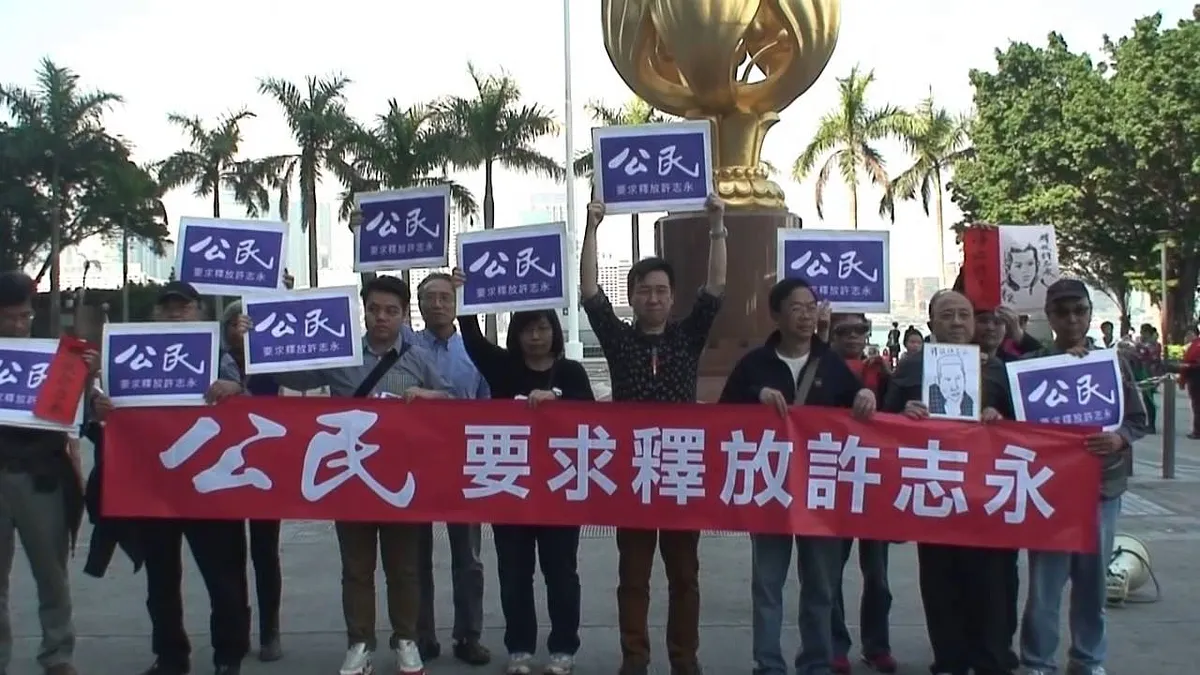
Photo Source / Citizens demanding the immediate release of Xu Zhiyong
Beijing's Third Detention Center, located at No. 5 Tuangui Road, Daxing District in the southern suburbs of Beijing, is currently holding more than ten citizens, including Xu Zhiyong, Wang Gongquan, Ding Jiaxi, Zhao Changqing, and Song Ze, who were imprisoned for promoting the "New Citizens' Movement," "public disclosure of officials' assets," and "equal education rights." The charges brought against them allege that they are suspected of "assembling a crowd to disrupt order in public places" and "illegal assembly." Since April 2012, this batch of cases has occurred successively. Following the concentrated detention of these citizens at Beijing's Third Detention Center (hereinafter referred to as the Third Detention Center), during the process in which lawyers intervened to defend these citizens, circumstances emerged that differed markedly from other ordinary cases.
First: Screening of Defense Counsel Qualifications
When defense lawyers requested to meet with the detained individuals, the detention center did not make prompt arrangements for the meetings. Instead, the investigating authorities first screened the qualifications of the defense counsel. Several defense lawyers were rejected from serving as defense counsel for the relevant defendants on the pretext that they were "involved in the case" or through other excuses. Among these instances, following Xu Zhiyong's criminal detention, Shandong lawyer Liu Weiguo went to the Third Detention Center on the second day requesting a meeting, but was rejected by the investigating authorities on the grounds that lawyer Liu Weiguo was involved in Xu Zhiyong's case. Lawyer Liu Weiguo fought forcefully on legal grounds, and many citizens gathered to observe. As a result, lawyer Liu Weiguo himself and numerous onlookers were taken to the police station by Third Detention Center police officers and held in custody. Lawyer Liu Weiguo was not released until the early hours of the following day, whereupon he was immediately taken back to Shandong by local Shandong "Guobao" (Note 1) who rushed to Beijing. Shanghai lawyer Si Weijiang accepted a retainer from Xu Zhiyong's wife and went to request a meeting with Xu Zhiyong, but was refused meeting arrangements by the investigating authorities on the grounds that lawyer Si Weijiang had previously served as defense counsel for Hou Xin, a suspect in a related case. In fact, lawyer Si Weijiang had merely prepared to serve as Hou Xin's defense counsel; Hou Xin's relatives had once retained lawyer Si Weijiang, and lawyer Si Weijiang entrusted other lawyers to deliver the power of attorney and notice signed by Hou Xin's relatives to the investigating authorities, but Hou Xin's relatives subsequently revoked the retainer of lawyer Si Weijiang. Lawyer Si Weijiang had never even met Hou Xin, and Hou Xin also explicitly stated that she herself had not retained lawyer Si Weijiang as her defense counsel. Yet the investigating authorities still refused to allow lawyer Si Weijiang to serve as Xu Zhiyong's defense counsel. Lawyer Si Weijiang is currently suing the investigating authorities in court over the unlawful deprivation of defense rights; after several twists and turns, the court accepted the case, which has not yet gone to trial. Beijing lawyer Guo Haiyue was retained by Song Ze's older sister to act as Song Ze's defense counsel and went to the Third Detention Center requesting a meeting, but the investigating authorities refused to allow him to serve as defense counsel on the grounds that lawyer Guo Haiyue had "participated in New Citizens dinner gatherings and was involved in the case" (I replaced lawyer Guo to serve as Song Ze's defense lawyer after lawyer Guo Haiyue was rejected).
Second: Special "Directional Services" for "Scheduled Meetings" Imposed Exclusively on Defense Lawyers in This Batch of Cases
Pursuant to the provisions of the Criminal Procedure Code, when lawyers request a meeting, arrangements shall be made promptly, at the latest within forty-eight hours. The Third Detention Center informed these lawyers that they were practicing the "Mass Line" campaign advocated by the Central Committee of the Communist Party of China, and "to facilitate lawyer meetings," they launched a "scheduled meeting service," meaning that telephone reservations must be made before each meeting, and the Third Detention Center would arrange meeting times according to the reservations before scheduling the actual meeting. If no reservation was made, no meeting would be arranged even if the lawyer appeared in person at the detention center. I witnessed Beijing lawyer Zhou Ze being refused a meeting by the Third Detention Center on the grounds of not having a prior reservation. In other words, this "service" is mandatory, and these defense lawyers have no right to opt out of this "service." Meanwhile, I personally witnessed numerous defense lawyers handling ordinary cases having direct meetings at the Third Detention Center without any prior reservation.
Third: Unlawful Prohibition of Photographing, Audio Recording, and Video Recording During Meetings
Several departments, including the Beijing Municipal Public Security Bureau, the People's Procuratorate, and the Bureau of Justice, issued a joint regulation regarding lawyer meetings, which provides that photographing, audio recording, and video recording of the meeting may be conducted upon obtaining the consent of the person being met. This regulation is posted on the wall of the lawyer meeting room at the Third Detention Center. At the outset of these cases, the Third Detention Center adhered to this regulation, and defense lawyers were able to take photographs and make recordings. Later, because a video of Xu Zhiyong inside the detention center was posted online, drawing immense attention from the international community and domestic public, the Third Detention Center ceased enforcing the aforementioned regulation and no longer permitted defense lawyers to take photos, audio recordings, or video recordings. On November 26, 2013, when Beijing lawyer Cheng Hai made an audio recording while meeting with Ding Jiaxi, the meeting was suspended by Third Detention Center police officers, who seized the recording equipment. Lawyer Cheng Hai argued forcefully on the basis of the aforementioned Beijing regulation, but the police claimed that lawyer Cheng Hai violated meeting regulations because the recording was not consented to by the detainee Ding Jiaxi. Lawyer Cheng Hai immediately asked Ding Jiaxi on the spot whether he consented to audio recording the meeting, and Ding Jiaxi stated his consent. When lawyer Cheng Hai demanded the resumption of the meeting and the return of the equipment, a clash occurred with the police; the police forcibly dragged and assaulted lawyer Cheng Hai, unlawfully detaining him for more than four hours. On November 27, I went to the Third Detention Center to meet with Song Ze. At the conclusion of the meeting, with Song Ze's consent, I requested to take a photograph of Song Ze to preserve relevant evidence, but the police refused. When I argued forcefully based on the regulation posted on the wall, the police shifted their excuse: "Taking photographs will capture the equipment of our detention center, so you are not allowed to photograph." During the dispute, the police confiscated my lawyer's practice certificate, alleging that I had violated meeting regulations. I stated that I had not violated any regulation. The police then remarked that I had posted online stating that the Third Detention Center refused lawyer meetings under the pretext of water pipe repairs, and had also published a post the previous day stating that lawyer Cheng Hai was dragged and assaulted by Third Detention Center police, demanding that I explain myself before they would return my lawyer's certificate. I stated that everything I posted online was factual, that refusing to arrange lawyer meetings on the grounds of pipe repairs was a serious legal violation, and that lawyer Cheng Hai's clothing and shoes were torn up by their assaults, which I personally witnessed outside the gate of the Third Detention Center when lawyer Cheng Hai emerged yesterday. After arguing for more than ten minutes, the police finally returned my lawyer's practice certificate to me, but I consequently missed my flight to attend a court hearing out of town.
Fourth: Halting All Lawyer Meetings for 25 Days Under the Pretext of Water Pipe Repairs and Renovations
On October 29, Beijing lawyer Lin Qilei made an appointment for a meeting the following day. When he arrived at the Third Detention Center the next day prepared for the meeting, he was informed that "the water pipes in the lawyer meeting room are deteriorating and undergoing emergency repairs, making it impossible to arrange meetings." On November 4, I called to make an appointment for a meeting and was similarly refused on the same grounds. On November 11, I went directly to the Third Detention Center to request a meeting, yet was still informed that emergency water pipe repairs were underway and no meeting could be arranged. I filed a complaint with the Supervisory Corps of the Beijing Municipal Public Security Bureau, which informed me that the lawyer meeting room at the Third Detention Center was undergoing maintenance due to safety concerns, making it temporarily impossible to arrange lawyer meetings. I immediately filed a complaint with the First Branch of the Beijing Municipal People's Procuratorate, demanding that the procuratorial organ fulfill its legal supervision responsibilities and order the Third Detention Center to immediately rectify its unlawful conduct of refusing lawyer meetings. In the "Legal Opinion Requesting Immediate Rectification of Unlawful Acts by Beijing's Third Detention Center in Refusing to Arrange Lawyer Meetings" submitted to the First Branch of the Beijing Municipal People's Procuratorate, I pointed out that the grounds presented by Beijing's Third Detention Center and its superior body, the Beijing Municipal Public Security Bureau (Supervisory Corps), for not being able to arrange lawyer meetings were completely untenable. First, failing to arrange lawyer meetings directly violates explicit provisions of the Criminal Procedure Code. Paragraph 2 of Article 37 of the Criminal Procedure Code provides: "Where a defense lawyer, presenting their lawyer's practice certificate, proof of law firm affiliation, and a power of attorney or legal aid letter, requests to meet with a detained criminal suspect or defendant, the detention center shall arrange the meeting promptly, and at the latest within forty-eight hours." This provision is crystal clear without any ambiguity; failing to arrange a lawyer meeting promptly, or exceeding forty-eight hours without arranging a meeting, constitutes an illegal act regardless of the reason or pretext. Refusing to arrange any lawyer meetings for an extended period under the pretext of emergency water pipe repairs constitutes an even graver legal violation. Second, the claim that "meetings cannot be arranged due to emergency water pipe repairs" defies both reason and logic. First of all, taking more than ten days without completing repairs on the water pipes of a lawyer meeting room makes one wonder what kind of engineering project this is, or whether such a project even exists at all. Furthermore, why could the water pipe repairs not be scheduled during non-working hours? In addition, even if there were a rush to complete the project, meetings could well proceed alongside the construction work. Fourth, why could alternative locations (such as preliminary investigation rooms) not be arranged for meetings? After suspending meetings for 25 days, the Third Detention Center resumed scheduling meetings starting November 25.
On November 27, I met with Song Ze. Combining this with the circumstances other defense lawyers encountered when meeting their clients, my personal assessment is that the failure to arrange lawyer meetings for these detained citizens for nearly a month (which also prevented suspects in other ordinary cases from obtaining meetings) was not without design; "repairing water pipes and conducting emergency repairs due to safety risks" was merely a pretext.
This article is an AI-generated translation of the original Chinese text. In the event of any discrepancy, the Chinese version shall prevail.