
Introduction to the Chinese Human Rights Lawyers Service Group
Last edited: 2026-08-28
Photo Source / Human Rights in China (HRIC)
On September 12, 2013, prominent Chinese investor Wang Kung-chüan was criminally detained by Beijing police on suspicion of "gathering a crowd to disrupt public order." This incident sparked massive reactions across the Chinese internet. Mr. Wang is a businessman with an independent personality who refuses to collude with bureaucrats, and he is one of the rare successful merchants in China actively engaged in social justice. He personally participated in and supported the public interest organization "Open Constitution Initiative" (whose head, Hsü Chih-yung, was criminally detained on July 16, 2013, under the same charge). He has dedicated himself to paying attention to and supporting vulnerable social groups, advocating for equal educational rights, and promoting the New Citizens' Movement centered on the values of "Freedom, Justice, and Love." Yet, such a person was arrested as a criminal suspect, shocking, despairing, and angering countless individuals.
According to incomplete statistics since the beginning of this year, more than 37 citizens nationwide have been arrested for engaging in social justice causes such as demanding public disclosure of officials' assets, promoting educational equality, and popularizing the ideas of the New Citizens' Movement. Various signs indicate that this is a centrally coordinated, strictly organized crackdown—a comprehensive suppression of citizens' lawful exercise of their Constitutional rights (with asset disclosure corresponding to the right to supervise state functionaries, educational equality to the right to equality before the law, and the New Citizens' ideals to political and free speech rights).
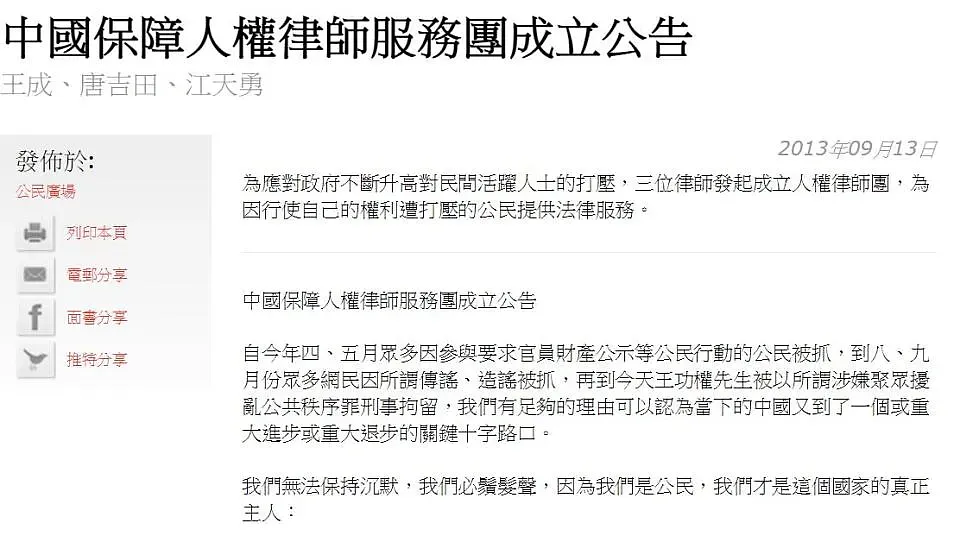
Under this situation, first, Chang Hsüeh-chung, a teacher at East China University of Political Science and Law in Shanghai (currently suspended from teaching), issued an open letter on September 7, 2013, to all Chinese legal professionals titled "Uphold the Rule of Law and Resolutely Resist Judicial Persecution." In the letter, he publicly called out the Beijing Municipal Public Security Bureau Chief (who concurrently serves as Vice Minister of Public Security), suspected of being the mastermind behind this round of crackdown, demanding an immediate halt to the suppression and persecution of citizens. Thereafter, on the second day following Mr. Wang Kung-chüan's arrest, lawyers Wang Cheng from Hangzhou, T'ang Chi-t'u, and Chiang T'ien-yung from Beijing initiated and established the "Chinese Human Rights Lawyers Service Group" (all three lawyers were previously persecuted by authorities and unable to practice normally: T'ang Chi-t'u's license was revoked in 2010, Chiang T'ien-yung's license was denied renewal, and Wang Cheng was ordered by the Hangzhou Justice Bureau to have his former law firm terminate his employment contract, effectively forcing all law firms in Hangzhou to refuse to take him in). The three lawyers wrote in the announcement for the establishment of the service group: "From cracking down on citizen movements, to cracking down on so-called online rumors, and down to today's criminal detention of Mr. Wang Kung-chüan, this series of actions has triggered massive criticism and universal opposition from civil society and the internet community; yet the relevant institutions have not only shown no intention of stopping, but have instead intensified and escalated step by step. Given the severity of the issue, this year numerous outstanding citizens have been arrested for exercising their civil rights, and the legal community has successively formed multiple case-specific lawyer teams. However, judging from today's criminal detention of Mr. Wang Kung-chüan, similar incidents will continue to occur, and organizing lawyer teams merely for individual cases is insufficient to respond; to better serve society, protect civil rights, and advance the nation's rule of law construction, we believe it is necessary to initiate and establish a human rights lawyers service group within the legal community. The specific matters of the service group are: 1. Its primary work is to provide legal services for citizens detained and tried for exercising their civil rights, including but not limited to legal consultation, criminal defense, appeals, accusations, etc.; 2. All Chinese lawyers are free to join and withdraw from the service group, and colleagues from the legal circle are cordially invited to participate; 3. The service group is not an organization, but a method of connection and collaboration established among human rights lawyers based on the recognition of basic values such as freedom, equality, democracy, constitutionalism, rule of law, and human rights. All lawyers participating in the service group enjoy equal status."
Within half a month after the establishment announcement was issued, the number of participants exceeded one hundred. This somewhat exceeded my expectations because, in the current mainland, the term "human rights" is viewed to a certain extent as a taboo by certain power authorities, causing many people to avoid it out of fear. When I published the latest roster of 113 service group members on my Weibo, a respected teacher and mentor of mine wrote to me, saying that while they admired our bravery, they also urged us to protect ourselves well, noting that the name "Human Rights Lawyers Service Group" might be too sensitive and that focusing on specific cases might be safer.
I am very grateful for my mentor's care and reminder. In fact, legally speaking, the words "human rights" are not sensitive at all; Article 33, Paragraph 3 of the Constitution explicitly stipulates that "The State respects and guarantees human rights," and Article 2 of the Criminal Procedure Law lists "respecting and guaranteeing human rights" among the tasks of the Criminal Procedure Law. Moreover, in practice, the Chinese government has constantly engaged in efforts to improve human rights and has achieved great success. However, the issue of human rights itself is very complex, especially in mainland China. Therefore, my mentor's thoughts and reminder actually represent the psychological state of a large segment of the population.
Following the establishment of the Human Rights Lawyers Service Group, because the service group is not an organization and lacks a deliberative body, its current primary working method is to issue joint statements by service group lawyers on major legal events. Within half a month of its establishment, it successively issued statements on three major legal events.
The first was the case of Yang Hui, a junior high school student in Changchia-chuan County, Gansu Province, who was criminally detained by public security authorities for posting online. Service group lawyers issued a statement at the earliest opportunity: "According to published materials, junior high student Yang Hui does not constitute any illegal offense or crime, and thus criminally detaining Yang Hui under the crime of picking quarrels and provoking trouble is erroneous. The judicial interpretation recently issued by the Supreme People's Court and the Supreme People's Procuratorate, titled *Provisions on Several Issues Concerning the Application of Law in the Handling of Criminal Cases Such as Defamation Implemented Through Information Networks* (Note 1), cannot be used to handle this case, as this interpretation directly violates the provisions of the Constitution and the Legislation Law, making its ultra vires interpretation naturally void; public security departments must adhere to the principle of freedom of speech and the principle of legality (nullum crimen, nulla poena sine praevia lege poenali) when dealing with cases of speech-related crimes."
The second was regarding the case of Shenyang vendor Hsia Chün-feng, who stabbed a urban management officer (chengguan) to death, and whose death sentence was approved and executed immediately on September 25 (Note 2). Service group lawyers issued a statement: "Protesting the Supreme People's Court's approval and immediate execution of a death sentence in a case with doubtful evidence and procedural violations; demanding the Supreme People's Court publish the death penalty review opinion for Hsia Chün-feng's case; demanding the Supreme People's Court reform the death penalty review procedure, remove its mystified colors, and implement the principle of judicial transparency."
The third was regarding the second-instance judgment result of the Wang Shu-chin case (Note 3), which is linked to the Nieh Shu-bin case. Service group lawyers issued a statement: "In view of various signs showing that relevant institutions in Hebei Province intend to factually deny Wang Shu-chin's involvement in the Nieh Shu-bin case through coordinating the two cases, and legally block appeals in the Nieh Shu-bin case, we strongly condemn the Hebei Provincial Higher People's Court; we demand that the Supreme People's Court, when reviewing Wang Shu-chin's death sentence, focus its review on the factual aspects related to the Nieh Shu-bin case; we demand that the Supreme People's Court personally re-examine the Nieh Shu-bin case rather than delegating it back to the Hebei Provincial Higher People's Court, which served as the court of final instance for the Nieh Shu-bin case; we remind the Supreme People's Court and courts at all levels that if judicial judgments degenerate into provocations against the public's ordinary sense of justice not built upon fair procedures, it will be a disaster for China's judiciary."
The service group has gathered the most active group of "rights-defense lawyers" in mainland China today, while also attracting more lawyers to participate in the rule of law cause of safeguarding human rights. Therefore, worriers have claimed this proactively provides authorities with a blacklist; malicious actors have claimed online that arresting people according to the list would bring peace to China; and admirers have praised the service group roster as a roll of honor.
The service group has not really done much yet. Personally speaking, honor is of no concern to me, nor do I fear any blacklist. Born in this era, to do a little bit of what is within one's power and hope to contribute to social progress—if there are risks, let them come.
Notes
- *Provisions of the Supreme People's Court and the Supreme People's Procuratorate on Several Issues Concerning the Application of Law in the Handling of Criminal Cases Such as Defamation Implemented Through Information Networks*, issued on September 6, 2013, and implemented on September 10. Its main content stipulates that defamatory content published online reaching over 5,000 actual clicks or 500 forwards constitutes the crime of defamation; using information networks to hurl abuses or intimidate others under egregious circumstances, disrupting social order, constitutes the crime of picking quarrels and provoking trouble, etc. Critics believe this interpretation defines internet order as real social order in the sense of criminal law, violating the principle of legality and constituting an ultra vires interpretation, and is thus invalid.
- In my article titled *One Detained, Hundreds on the Road: Those Sisters, Wives, and Mothers Toiling on the Path of Redressing Grievances*—published in *Judicial Reform* Issue No. 95—I wrote about the story of Chang Ching, wife of Hsia Chün-feng, seeking grievance redress and survival for her husband. Unfortunately, the ending turned out this way. The same article also recounted the story of Nieh Shu-bin's mother seeking grievance redress for her son; now, it appears that the path of grievance redress is also about to be blocked.
- In 1995, Nieh Shu-bin was sentenced in the final instance by the Hebei Provincial Higher People's Court for the rape and murder of a person surnamed K'ang, and was executed that same year. In 2003, after Wang Shu-chin was arrested in another case, he voluntarily confessed that he had raped and murdered K'ang. The Intermediate People's Court of Handan, Hebei Province, refused to recognize his rape and murder of K'ang, sentencing Wang to death with immediate execution based on two other rape and murder cases. Wang refused to accept this and appealed on the grounds that his rape and murder of K'ang was not recognized. After the case was dragged out for nine years, the Hebei Provincial Higher People's Court held a second-instance trial, which featured an extremely rare scene: the appellant stated "I killed the person," the prosecuting prosecutor stated "He did not kill the person," and the defense counsel stated "He (the appellant) killed the person." On September 27, the Hebei Provincial Higher People's Court delivered its final judgment rejecting Wang's appeal and upholding the original judgment.
This article is an AI-generated translation of the original Chinese text. In the event of any discrepancy, the Chinese version shall prevail.