
Citizen Participation in Trials "From the Bottom Up": The Selection, Rights, and Obligations of Japan's Saibanin
Last edited: 2026-08-28
‱ Originally published in Judicial Reform Magazine, No. 83
Introduction
In response to public criticism of "dinosaur judges" and public pressure, the Judicial Yuan is currently drafting a potential system for public participation in trials in Taiwan. It is understood that the "people's lay participation" system currently planned by the competent authorities involves selecting people's representatives through a certain method to serve as "lay observers" who participate throughout the first-instance proceedings in specific major criminal cases. Furthermore, to avoid unconstitutional concerns of infringing upon judges' "independent trials," the authorities emphasize that professional judges should dominate the trial and retain the final decision-making power, describing the design concept as: "Observe the court trial from start to finish; let the people speak up on right and wrong" (Note 1). However, under the Judicial Yuan's planned lay participation system, representatives of the people sitting high on the judgment bench are merely "sitting quietly and watching" without judging, or they participate in verdict deliberations sitting on the side of decision-making yet "speaking without effect and deliberating without deciding." Such a planned design for lay participation is unprecedented worldwide, functioning akin to "watching a play from the sidelines" or "barking at a moving train," which merely dampens public interest and makes public participation in trials dull and unappealing.
In a modern democratic state governed by rule of law, judicial relief is the last line of defense for social justice. Criminal trials cannot violate the democratic mechanisms of "public participation" and "the people's opinions." On May 21, 2009, after ten years of planning and grinding through differences, Japan officially implemented the Saibanin (Lay Assessor) system for public participation in criminal trials. Specifically, Japan's new system of public participation in criminal trials involves six lay assessors selected from the general public participating alongside three professional judges in the trial proceedings to jointly determine the guilt or innocence of the defendant and the severity of the punishment. This establishes the "public opinion foundation" for criminal justice, builds the legitimacy of state power in prosecuting criminal defendants, and fosters the general public's awareness of self-determination and responsibility as the "governing subject" (Note 2). This article explains the qualifications, rights, and obligations of selecting lay assessors in Japan to facilitate the analysis of social costs and public burdens, providing a comparative reference for Taiwan's future judicial reform decision-making.
Qualifications and Conditions for Lay Assessors
Japanese lay assessors are randomly selected from ordinary citizens aged 20 and over who possess the right to vote for members of the House of Representatives. Regarding the appropriateness of the lower age limit for lay assessors, considerations of social experience or life experience might suggest requiring someone "slightly older" than the voter qualification. Conversely, if the emphasis is on a broader representation that reflects diverse opinions, raising the lower age limit may be unnecessary. Japan's policy choice seems to lean toward the latter consideration (Note 3). However, the premise is that they must not possess the following "disqualifying conditions": (1) failing to meet the disqualifying criteria of having been sentenced to imprisonment or having failed to complete compulsory education, or having physical or mental disabilities; (2) not belonging to political appointees, judicial, prosecutorial, or police civil servants, or individuals engaged in legal work such as attorneys, and those detained or arrested for crimes punishable by imprisonment or heavier, falling under "professional status prohibitions"; and (3) having no connections or involvements with the defendant, victims, or other case-related matters, or grounds that raise concerns of "unfairness" in the trial (Note 4). In other words, lay assessors are "laypeople" who are not legal experts, directly participating in the state power of judicial adjudication as part-time, non-permanent state public servants. Therefore, those lacking the qualifications for appointment as state public servants or those deemed inappropriate to participate in trials are prohibited. Additionally, considering the intent of establishing lay assessors to diversely reflect the conscience and capabilities of citizens, or based on the democratic politics of the separation of powers, legal professionals and members of parliament are deemed unsuitable to serve as lay assessors (Note 5).
Furthermore, although the planning of the citizen participation system expects that ordinary citizens can cooperate and participate, to avoid placing an excessive burden on the general public, the design of the lay assessor system also stipulates that individuals who do not meet the aforementioned disqualifying conditions may apply to "decline serving" as a lay assessor based on their personal circumstances (Note 6). Examples include persons over 70 years of age, local government assembly members (limited to session periods), students during class periods, those who have served as lay assessors or prosecution review committee members within a certain period, or those who appeared in court as alternate lay assessors (though those who decline are not limited hereto), as well as unavoidable reasons (severe illness or injury making court appearance difficult, caring for and raising cohabiting family members, risk of major damage if important work matters are not handled personally, social customs such as weddings and funerals), or other reasons stipulated by laws and regulations (Note 7).
Selection Procedure for Lay Assessors
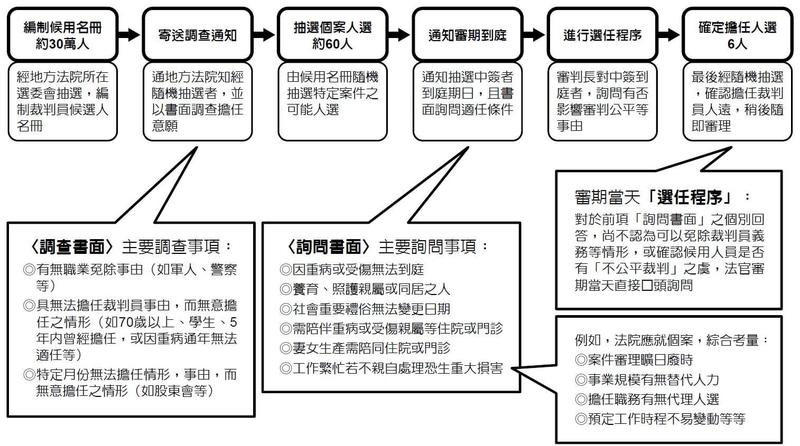
The selection procedure for Japanese lay assessors begins with district courts estimating the possible demand for prospective lay assessor candidates for the following year based on the types and quantities of criminal cases previously received, and allocating a specific quota to the jurisdictions of townships, cities, and administrative districts according to a certain ratio. (1) The election commissions within the respective administrative districts receiving the aforementioned notice "randomly select" a corresponding quota from eligible voters and compile a "prospective lay assessor roster," which is sent back to the district court. The district court considers the aforementioned "disqualifying conditions" and "professional status prohibitions," confirms the existence of candidates and their voting qualifications, eliminates candidates who do not meet the regulatory requirements, completes the "prospective lay assessor roster," and issues notifications. (2) Once the "first trial date" for a case applying the lay assessor system is fixed, the district court "randomly selects" individual "lay assessor candidates" for the specific case from the prospective lay assessor roster and simultaneously notifies them of the date for the "lay assessor selection procedure." (3) During the "lay assessor selection procedure," through direct questioning of the "lay assessor candidates," individuals meeting the "disqualifying conditions," "professional status prohibitions," or "unfitness" criteria are ruled by the court ex officio or upon the request of the prosecutor and defense to be "excluded" from candidacy, and persons to serve as "lay assessors" (and "alternate lay assessors") for the case are then "randomly selected" (Note 8).
In other words, the selection procedure for Japanese lay assessors requires a three-stage process of "random selection": first by the election commission from the voter registry, then by the district court from the "prospective lay assessor roster" compiled by the election commission, and finally through the "random selection" conducted during the lay assessor selection procedure on the first trial date (Note 9). Furthermore, prior to the lay assessor selection procedure, the court may prepare a written questionnaire to inquire of the lay assessor candidates to determine their fitness to serve as lay assessors. Meanwhile, to enable the parties to obtain material to judge whether the lay assessor candidates are appropriate—such as their relationship to the case—the presiding judge must deliver a roster containing the names of the lay assessor candidates to the prosecutor and defense counsel two days prior to the lay assessor selection procedure. Moreover, before the relevant procedures begin on the day of the lay assessor selection procedure, the copies of the answers submitted by the lay assessor candidates mentioned above shall be made available for the prosecutor and defense counsel to inspect.
The convening of the lay assessor selection procedure requires the attendance of judges, court clerks, and defense counsel. When the court deems it necessary, the defendant may also be required to appear, but the lay assessor selection procedure is conducted in private (Note 10). At the same time, the prosecutor or defense counsel may use the results of the answers to relevant inquiries to circle and designate candidates whose lay assessor candidate qualifications should be excluded. Furthermore, the prosecutor and defense counsel may each apply to exclude up to four lay assessor candidates from serving as lay assessors "without stating reasons" (Note 11).
Rights and Obligations of Lay Assessors
Selected lay assessors (or alternate lay assessors) must faithfully and fairly perform their duties in compliance with laws and regulations, and must not engage in conduct that harms the fairness of trials and judicial credibility, nor engage in conduct that endangers the evaluation of a lay assessor's status. After being informed by the court of their rights, obligations, and other matters, they have the obligation to "take an oath," and they also bear the obligation to "appear in court" on trial dates requiring the participation of lay assessors. Furthermore, lay assessors have the obligation to attend deliberations and "express opinions," the obligation to "comply" with the court's interpretation of laws and regulations, and the obligation to "appear in court" on the date of the verdict announcement. Violations of these obligations constitute "grounds for dismissal" of the lay assessor and may be subject to a fine of up to 100,000 yen (Note 12).
Furthermore, current and former lay assessors and alternate lay assessors bear the "obligation of confidentiality" not to disclose the course of deliberations, deliberation opinions, the number of opinions, and other matters known through their duties as lay assessors. Violation of this obligation constitutes "grounds for dismissal" of the lay assessor and is subject to criminal penalties. This confidentiality obligation is indispensable for ensuring the freedom of expression and communication of opinions during the deliberation process, protecting the privacy and reputation of case-related persons, and safeguarding the public credibility of judicial trials. At the same time, explicitly stipulating the content and boundaries of this obligation not only reduces the burden of external speech and statements on the lay assessors themselves, but also prevents defendants and other litigation participants from inquiring and probing into responsibilities, or from unnecessary contact and probing driven by competitive media reporting, thereby serving a regulatory role in protecting the safety and rights of lay assessors (Note 13). In other words, the scope and limits of a lay assessor's confidentiality obligation are as follows (Note 14):
| Scope of Confidentiality Obligation | Secrecy of Deliberations | The discussion process of the verdict conclusion |
| Deliberation opinions and contents of lay assessors or judges; the number of persons supporting or opposing an opinion, etc. | ||
| The number of persons forming the majority opinion of the verdict | ||
| Secrets learned outside of deliberation duties | Privacy of case-related persons such as victims, and the names of lay assessors | |
| Scope Outside Confidentiality Obligation | Facts witnessed and heard in the courtroom on the trial date | Contents of witness examinations |
| Contents of the verdict |
Conclusion
As the French thinker Alexis de Tocqueville noted in his immortal masterpiece Democracy in America: "To look upon the jury as a mere judicial institution is to take a very narrow view of it... The jury is, above all, a political institution, and it must be regarded in this light in order to be properly understood." Today, in Taiwanese society, the concept of the people as "bosses of the country" is frequently invoked. From presidents and legislators down to local government heads and representatives, popular sovereignty and the election of the capable are taken for granted. However, judicial trial procedures have yet to incorporate the opinions and judgments of the people, and verdict deliberations are not authorized or endorsed by public opinion. Although "people's lay participation" drills a hole to let light into the trial's dark room, it still erects a barrier of a "democratic restricted zone," leaving the alienation between the people and the judiciary unchanged.
However, the design of a citizen participation system should not be a unilateral top-down judgment by the competent authorities on whether the people can share state power and handle trial expertise. The success or failure of citizen participation depends on whether ordinary citizens, from the bottom up, have the right to guarantee a fair and adequate assessment of justice and whether they share the democratic awareness of jointly punishing wrongdoers. As Japan promoted the most significant judicial reform since its Meiji Restoration, it recognized that even if it is merely an individual monologue, if it comes from the voice of inner justice, the judicial trial must listen intently. This is an individual's irreplaceable moral conviction of life, while simultaneously connecting to the fundamental logic of human dignity under the Constitution. In other words, the key to the citizen participation system is: "The judiciary belongs to us, and we participate from start to finish; we judge together, and we all bear the responsibility."
- Cf. The written explanation provided by the staff unit, "Introduction to the People's Lay Participation System Under Conception by the Judicial Yuan," at the "First Meeting of the Deliberation Committee on the People's Lay Participation System" held by the Judicial Yuan on January 12, 2010.
- For related explanations, see also Lin Yü-shun, "The Enlightenment of Japan's 'Saibanin System'—Trials Cannot Evade Public Opinion," Judicial Reform, No. 74, Dec. 2009, pp. 25 et seq.
- Ikeda Osamu, Commentary on the Saibanin Act—Legislative Background and Challenges, Kobundo, July 2005, p. 45.
- Cf. Articles 14, 15, and 17 of Japan's "Act on Criminal Trials Participated in by Saibanin" (Act No. 63 of 2004).
- Supreme Court of Japan, Saibanin System Navigation (Revised Edition), June 2009, p. 12.
- Regarding the strictness, leniency, criteria, or regulatory application of this article's "grounds for declining" by ordinary citizens, some argue that it involves the key positioning of the lay assessor system and should be handled with caution; this viewpoint is well worth noting. Ikeda Osamu, Commentary on the Saibanin Act—Legislative Background and Challenges, Kobundo, July 2005, pp. 50–54.
- Cf. Article 16 of Japan's "Act on Criminal Trials Participated in by Saibanin." During the writing of this article, my father passed away. While in mourning, I considered declining the JRF's invitation to present a paper at the seminar on "Public Participation in the Judiciary" and attendance at meetings for the Judicial Yuan's "Feasibility Evaluation Committee for the People's Lay Participation System," among other tasks. However, thank you, father Lin Cheng-hsiung—I have inherited your "courage"! We did not perform many Buddhist chants or sutra recitations, but I believe you would agree that I did not "decline." This is because Taiwan's judiciary is encountering a historical turning point.
- Main provisions include Article 14 of Japan's "Act on Criminal Trials Participated in by Saibanin" on professional status prohibitions (excluding restrictions under the Public Offices Election Act or criminal procedure recusal provisions), and Articles 32 to 40 on selection procedures.
- Kamiya Sayako, Sawa Yasuomi, The World's Lay Assessors, Nihon Hyoronsha, June 2009, p. 232.
- Mitsui Makoto, Sakamaki Tadashi, Introduction to Criminal Procedure Law (4th ed.), Yuhikaku, 2006, p. 208.
- Article 36, Paragraph 1 of the "Act on Criminal Trials Participated in by Saibanin": "The public prosecutor and the defendant may each apply, up to four persons, for a ruling not to select a lay assessor candidate without stating reasons."
- Main provisions include Articles 41 and 83 of Japan's "Act on Criminal Trials Participated in by Saibanin."
- Ikeda Osamu, Commentary on the Saibanin Act—Legislative Background and Challenges, Kobundo, July 2005, pp. 82, 84.
- Main provisions include Article 9 of Japan's "Act on Criminal Trials Participated in by Saibanin": "A lay assessor shall faithfully and fairly perform his/her duties in compliance with laws and regulations." "A lay assessor shall not leak secrets concerning the contents of deliberations prescribed in Article 70, Paragraph 1 and other secrets known in the course of his/her duties." "A lay assessor shall not engage in conduct that may impair the trust in fair trials." "A lay assessor shall not engage in conduct that damages the public credibility of his/her duties." See also Supreme Court of Japan, Saibanin System Navigation (Revised Edition), June 2009, p. 17.
This article is an AI-generated translation of the original Chinese text. In the event of any discrepancy, the Chinese version shall prevail.