
Standing Against State Injustice: Attorney Kuo Te-tien on the Frontlines of Rights Defense and Legal Advocacy
Last edited: 2026-08-28
"These workers are either aging or passing away." Recalling his initial encounter with public interest cases, Attorney Kuo Te-tien shared the case of the closed-factory workers: "If they are old, they are left all alone. Just imagine—it is an extremely cruel thing for an elderly person to face litigation." With over five hundred clients and more than three hundred cases, "and for those who passed away, inheritance comes into play; their children, or even grandchildren, have to inherit their debts. Many completely unrelated individuals were dragged into this litigation as defendants. You would wonder what on earth happened to this country to actually spend over NT$20 million suing these people?"
Attorney Kuo Te-tien, whose research field is public law, believed that "studying public law should at least be put into practical application. What we study is where the state violates the law and whether it administers according to the law. Therefore, we cultivate a concept: is the state permitted to act in this manner?" Consequently, Attorney Kuo resolutely threw himself into this public interest litigation case, marking his debut.
"Actually, I joined in the later stages; many lawyers before me had laid a lot of groundwork. When I first saw this case, I realized that public interest cases are actually not quite what we imagined. It is not simply that a client is very pitiful and comes to you saying: 'Counselor, can you help me? I don't have money, could you waive my fee or make it cheaper?'"
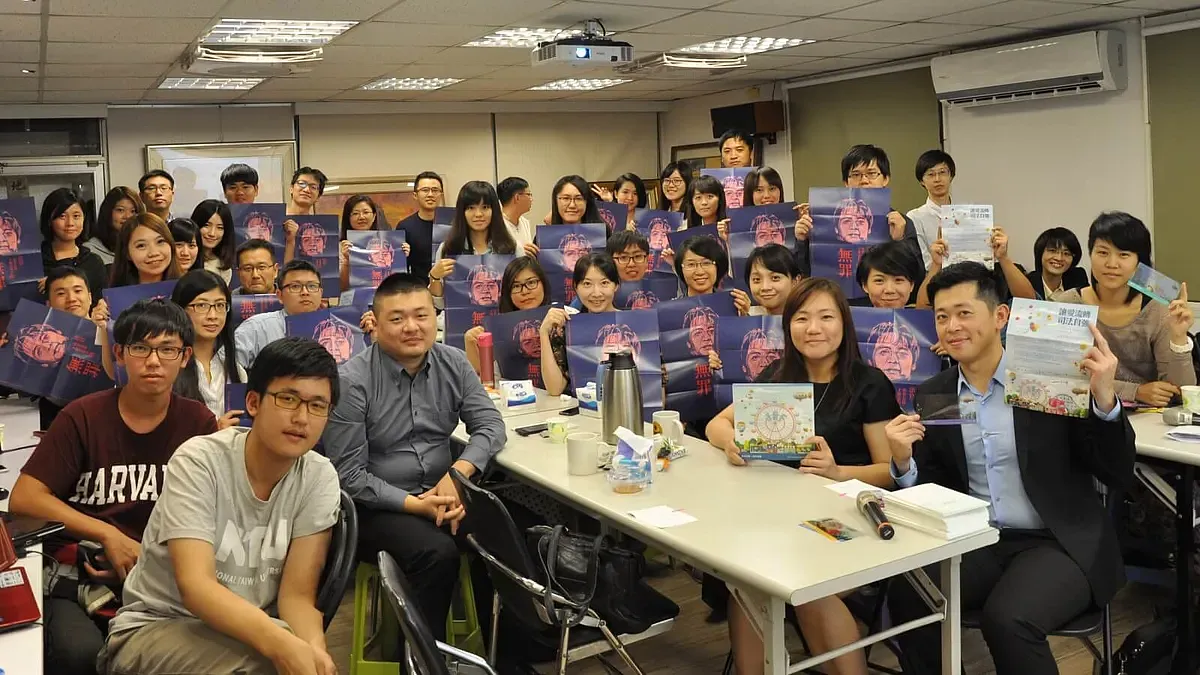
Having never encountered public interest cases before, participating in public interest litigation for the first time meant handling a very large-scale litigation. Basically, it could also be called a class action, except that when we talked about class actions in the past, it was many people suing one person; now it was the state suing many people. This can also be considered a class action, and the terrifying part was the immense waste of judicial resources. While volunteer lawyers devoted themselves, the Judicial Reform Foundation and the Legal Aid Foundation also supported a great deal of administrative work, and some lawyers even stepped onto the battlefield themselves. What impressed me the most was that many lawyers, even if they did not study public law, stood up because they abhorred the injustices committed by this country, calling on everyone to do this together.
Joining the closed-factory workers' case in the later stage was because many people specializing in public law were needed later on. "I remember at that time, Executive Director Kao Jung-chih of the Judicial Reform Foundation raised the insight during the legal defense team's discussion: 'This is a public law case!' At that time, no one else had thought of it as a public law case. In the beginning, everyone was fighting civil litigation; anyway, there was a fifteen-year extinctive prescription, and if the prescription had not expired, the money had to be repaid." Later, everyone began researching whether this was a public law case. The statute of limitations for public law claims is five years, meaning the state's right of claim against the people had already been extinguished. There were many lawsuits across the country being fought in district courts, and some had even been appealed to the high court. Later, the litigation strategy shifted; lawyers began arguing in district courts that these were public law cases and requested judges to rule to transfer them to the administrative divisions. Out of a hundred cases, there will always be one success; there really was a judge willing to adopt this, and the Taoyuan District Court was the first.
At that time, many scholars were invited to discuss, hold symposiums, and give many lectures; professors from various law schools all stepped forward to write numerous articles. In fact, the state's protection of the fundamental rights of the people at least encompasses the concept of social rights; the state must even undertake the duty to provide assistance when the people are in distress. If the state is at fault, it is even more obligated to lift the people up. It is actually about the concept of social compensation: if there are structural problems in the state system, the state should lend a helping hand to the people.
The Council of Labor Affairs at the time did not supervise whether employers paid pensions for these closed-factory workers. In the past, the factory contribution rate was very low; these workers were very pitiful, and when the factories ran away, you actually couldn't get any money—looking into it later, it was the Council of Labor Affairs' lack of proper supervision, and supervising employer contributions was the obligation of the Council of Labor Affairs. Grand Justice Hsu Tzong-li advocated such a view at that time. In fact, this was also a strategy: to provide judges with something to serve as a legal basis. Sometimes district court judges find it difficult to act because the statutory provisions are not formulated that way, and deriving some social compensation theory out of thin air from a constitutional provision is a very difficult task. Therefore, it had to be paired with academic discourse; if judges read it and found it substantive and well-reasoned, they could perform a very simple act: ruling to transfer the case. Once a ruling of transfer was made, others would follow. Some judges considered them civil cases and rendered judgments directly; some judges—especially younger judges who possessed a better grasp of fundamental rights concepts—were more willing to do such things, namely accepting this discourse. Subsequently, several cases were successively ruled to be transferred to the Taipei High Administrative Court.
We also noticed that if the cases truly entered the High Administrative Court, the issue of the extinction of the right of claim under public law might be applied. At that time, we were discussing assigning three lawyers to one client, who had to speak their minds freely in court, talking about how detestable this country was or using the extinctive prescription to counter it. On the day of the court session, the Council of Labor Affairs dispatched a legal affairs director, who ended up being besieged by more than a dozen lawyers. The scene that day was very extraordinary; the judge also allowed the lawyers to speak freely and recorded all contents into the trial transcript.
In the closed-factory workers' case, due to the dedication of numerous lawyers, a judge of the Taipei High Administrative Court was finally willing to accept the argument and rendered a judgment recognizing the issue of extinctive prescription. However, such reasoning implies that if the prescription had not been extinguished, the issue of repaying the money would remain. Yet, under social compensation, there is no issue of repaying money at all. I was very amazed by such an outcome, that today we could actually share the fruit of success with everyone. This shows that if a single lawyer had handled this case alone, they would certainly have been exhausted to death; in the beginning, the legal defense team consisted of only five lawyers, but think about it: this was a public interest case.
If you are going for an internship, you can actually think carefully about how to approach these matters. From my experience, during the trainee lawyer stage, one must thoroughly learn how to handle all types of cases. After completing the internship, you consider whether to be an employed associate or establish your own practice. If you wish to handle public interest cases as an employed lawyer, you must communicate well with your employer. Attorney Chiu Hsien-chih interned at Attorney Lo Ping-cheng's law firm and handled many public interest cases. Being an employee brings pressure; if you want to do it, you should try to communicate. Another approach is to establish an independent practice on your own, where you have to think about how to balance regular work with public interest work. We engage in public interest cases only when we have the surplus capacity. Returning to the situation of ordinary people, you must have an income, and within your feasible range, engage in the public interest. I myself decided to start my own practice immediately. In fact, we still have a lot to learn after completing an internship, but right after my internship, I immediately practiced independently. At the same time, I was also teaching at cram schools, so the income was decent, though that era has passed. However, if you are interested, you can try part-time work, except that legal cases might offer a higher return on investment. At that time, the goal I set for myself was to take on at least one public interest case a year.
You will find that lawyers can actually collaborate with many social movement groups. The most frequent situations involve cases under the Assembly and Parade Act. In regular fee-charging cases, you rarely receive Assembly and Parade Act cases, because those who take to the streets are basically not wealthy people. In assembly and parade cases, prosecutors in practice tend to consider the person holding the microphone as the ringleader, but the court does not determine it that way; it looks at whether the person directed the crowd. After our involvement in the closed-factory case, many public interest lawyers would approach you asking if you wanted to take on public interest cases. I believe that as long as there is willingness, you will definitely receive public interest cases; you can treat it as training—training in how to communicate with a victim, or how we communicate with these clients in this environment.
Everyone knows that we have the Habeas Corpus Act. If foreigners come to engage in assemblies and parades, as long as it diverges from their purpose of coming to Taiwan, they will be apprehended, and the National Immigration Agency can seamlessly deport them. (The deportation case of the South Korean Hydis closed-factory workers.) What was very peculiar was that at that time, they were apprehended by the Zhongzheng First Police Precinct, but their statements were recorded in Sanxia. The seamless transition meant that the police immediately issued a administrative fine, and subsequently, the National Immigration Agency could deport them immediately. The National Immigration Agency usually would not think of sending them to court for temporary detention. But we found it absurd, because these people did not violate the Social Order Maintenance Act, and isn't assembly and parade a fundamental right? Why didn't they have the right to express their opinions? Later, we lawyers learned that a shareholders' meeting was to be held the next day, and the South Korean workers intended to go protest at the shareholders' meeting; we anticipated that the police would use the same tactic, following the identical pattern to deport them in the afternoon. So we devised a method to break through it—the Habeas Corpus Act—to compel their release. At that time, the lawyers had already drafted the petition for habeas corpus. When those eight workers were sent back, we thought, "Good heavens, those eight people had no idea what to do, and were just pushed along onto the airplane and flown away." As a government, you ought to consider what they need. If you are a country founded on human rights, you ought to consider what they need. In this case, even the judge could not see where the South Korean workers violated the law. Fundamentally, this was not a lawful arrest, and they should have been released.
If you are a public interest lawyer, you must face and handle such situations through legal means. If you wish to engage in public interest work in the future, do not demand too much—just take on one case a year, and think about how I can change this society and this country. Regarding your imagination of the public interest, sometimes you might feel, "What does this have to do with me?" You certainly do not have to care about their feelings or their outcome, but you have to think that we are all people living on this land; what they encounter, I might also encounter in the future.
I think the closed-factory workers' case is an excellent case. Regarding public interest cases, when you look for an internship mentor, if you are interested, you can consider lawyers who have an interest in public interest cases. It is never too late, and what you earn is the transformation of this society.
This article is an AI-generated translation of the original Chinese text. In the event of any discrepancy, the Chinese version shall prevail.