
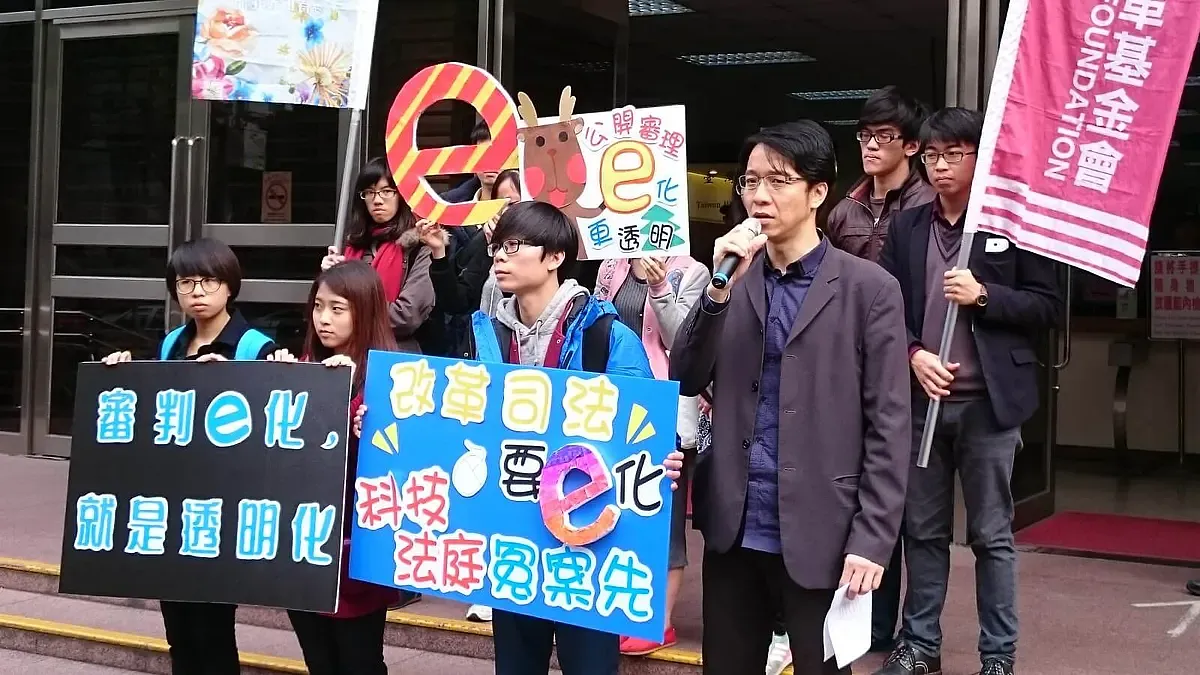
Trial e-Digitization Means Transparency: Press Conference Urging the Prompt Establishment of a Tech-Enabled Courtroom for the Hsuch Tzu-chiang Case
Last edited: 2026-08-28
The Judicial Yuan has actively promoted the establishment of digital and tech-enabled courtrooms, allocating an annual budget of NT$20 million across four fiscal years starting in 2012 (except for 2013, which had NT$15 million). These tech-enabled courtrooms are implemented in phases to allow observing citizens to personally experience transparent trials through electronic equipment assistance, thereby enhancing public trust in the judiciary.
History has shown that in the widely watched "Tom Bear Throat-Slitting Case," the second instance adopted tech-enabled courtroom proceedings, which not only helped observing citizens and reporters understand the case but also made the prosecution and defense arguments easier to focus, aiding in the clarification of facts. Conversely, the Hsuch Tzu-chiang Case, which commands equal societal attention, involves high complexity and strong controversy, yet to this day is still conducted only through traditional methods.
For the citizens and media reporters who care about this case and attend the hearings, it is simply impossible to fully grasp the crux of the issue. Furthermore, because the trial process and content lack transparency and focus, they easily devolve into mere shouting matches where proceedings become a mere formality. Consequently, regardless of the outcome, it easily invites doubts of unfair trial and makes it even harder to elevate public trust in the judiciary.
Therefore, based on the following reasons, we sincerely urge the judges presiding over this case to begin establishing the digitization of case files and evidence, in order to realize a tech-enabled courtroom and assist in focusing and clarifying the disputed points and facts of this case.
-
Tech-enabled courtrooms are concrete and feasible, representing a major judicial reform policy in recent years:
To promote tech-enabled courtrooms, the Judicial Yuan budgets funds every fiscal year. The NT$20 million budgeted for next year has already passed preliminary review in the Legislative Yuan. Through the establishment and practical operation by courts such as the Taiwan High Court Tainan Branch, Taitung District Court, and New Taipei District Court, there are no longer any technical bottlenecks or difficulties.
-
Realizing legal education and elevating public trust in the judiciary:
Promoting legal education has been a long-standing policy goal. Meanwhile, to make the public "feel" the judiciary, traditional courtroom litigation methods must inevitably undergo reform. By introducing tech-enabled courtrooms and presenting evidence right in the courtroom, the trial process is made transparent, thereby enhancing public understanding and trust in the judiciary.
-
The Hsuch Tzu-chiang Case is a socially prominent case, and its factual and legal disputes are both complex and controversial. Through a more transparent, tech-enabled courtroom that presents evidence on the spot, facts can be clarified and public trust in the judiciary can be enhanced:
The Hsuch Tzu-chiang Case occurred in 1995 and is now undergoing its ninth retrial. During this period, it has experienced a final judgment in the third instance, a constitutional interpretation of unconstitutionality by the Grand Justices, and the initiation of a retrial. Throughout the 19-year litigation process, the testimony of a co-defendant has been the primary basis for conviction, while substantive evidence has been extremely lacking, making it difficult to convince the general public.
To enable observing citizens and the media to better understand this case, utilizing tech-enabled courtroom proceedings brooks no delay. The Hsuch Tzu-chiang Case is a socially prominent case commanding high attention from all sectors. Only through the concrete implementation of court e-digitization—allowing observing citizens to understand more fully and making the trial process more transparent and focused—can we simultaneously foster the credibility of litigation procedures and meet the basic requirements of a fair trial.
To enable observing citizens and the media to better understand this case, utilizing tech-enabled courtroom proceedings brooks no delay. The Hsuch Tzu-chiang Case is a socially prominent case commanding high attention from all sectors. Only through the concrete implementation of court e-digitization—allowing observing citizens to understand more fully and making the trial process more transparent and focused—can we simultaneously foster the credibility of litigation procedures and meet the basic requirements of a fair trial.
We express our affirmation of the Judicial Yuan's investment of massive resources in establishing tech-enabled courtrooms. Conducting trials in tech-enabled courtrooms will surely yield twice the result with half the effort in elevating judicial trust. Therefore, we simultaneously call upon courts at all levels to prioritize major socially prominent cases as primary considerations for implementing tech-enabled courtrooms.
Press Contacts
Kao Jung-chih, Attorney-at-Law, Executive Director, Judicial Reform Foundation 02-25231178
This article is an AI-generated translation of the original Chinese text. In the event of any discrepancy, the Chinese version shall prevail.