
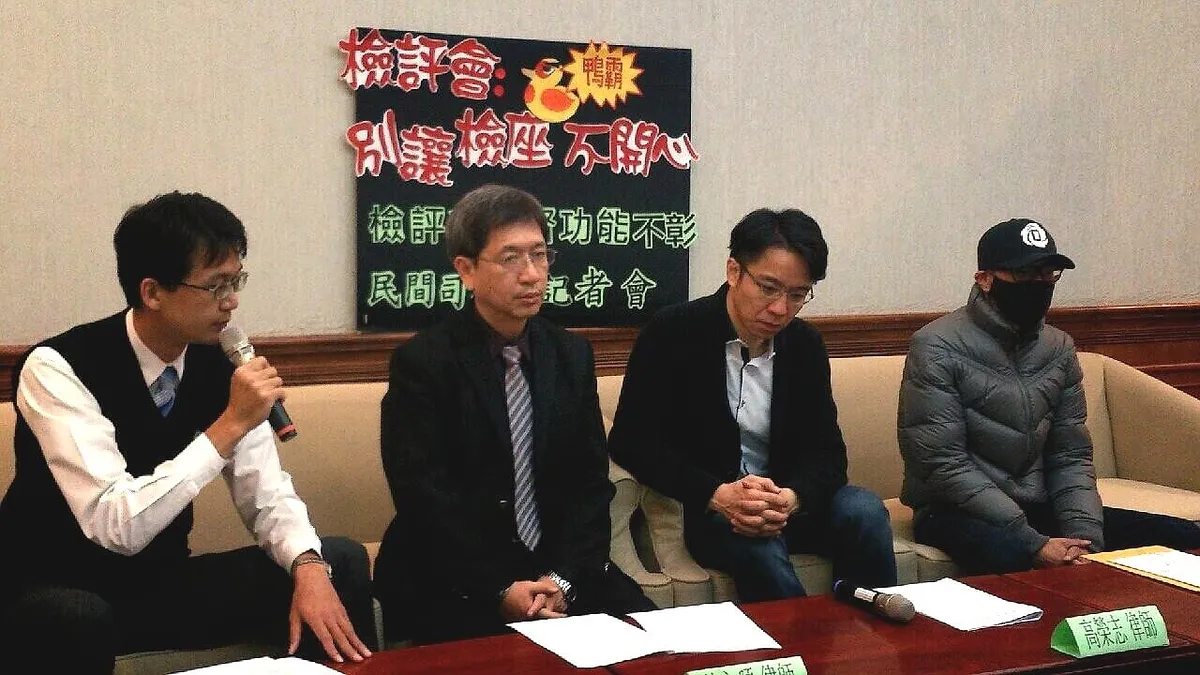
The Prosecutor Evaluation Commission: Keeping Prosecutors Happy!~Press Conference on the Ineffective Supervisory Function of the Prosecutor Evaluation Commission
Last edited: 2026-08-28
In the early morning of June 30, 2014, amidst torrential rain, Mr. A was driving home when he collided with Ms. B, who suddenly rushed out. Following the accident, Ms. B voluntarily contacted Mr. A, expressing her intention to negotiate a settlement. Witnessed by a friend of Mr. A, Ms. B and Mr. A executed a settlement agreement at the hospital, stipulating that no civil or criminal lawsuits would be filed against Mr. A, and she accepted a settlement amount of NT$66,000. Unexpectedly, after Ms. B was discharged from the hospital, Mr. A received a phone call from a police officer informing him that Ms. B had filed a criminal complaint for negligent injury and requiring him to report to the police station to make a statement, leaving him baffled and bewildered.
The case concerning Mr. A's suspected negligent injury was handled by prosecutor Chien Tai-yü (簡泰宇) of the Taiwan Taoyuan District Prosecutors Office. In the investigative hearing, Ms. B stated that the settlement agreement was signed while she was unconscious and that she had not reached an agreement with Mr. A. Prosecutor Chien Tai-yü struck a "righteous" pose during the hearing, adopted Ms. B's one-sided statement, and arbitrarily concluded that the settlement between Mr. A and Ms. B was invalid. He coercively demanded on the spot that Mr. A take back the NT$66,000 settlement amount and subsequently indicted Mr. A. His overbearing remarks and conduct during the hearing are listed in the table below:
| After the Investigative Hearing Commenced | ||
|---|---|---|
| 02:31 | Defendant | Ms. B was the one who voluntarily brought up the settlement afterwards. Yes. |
| 02:39 | Prosecutor | I told you before, whether to settle or not is a civil matter, I don't care! What I am handling is whether you are criminally negligent or not! |
| Before the Investigative Hearing Concluded | ||
| 20:01 | Prosecutor | The prosecutor instructs the complainant to return the NT$66,000 originally delivered by the defendant. |
| 20:13 | Defendant | Prosecutor, may I ask if this isn't related to civil law then? |
| 20:18 | Prosecutor | Civil, civil law is inherently separate from criminal law! You might be acquitted criminally while still having to pay compensation civilly; this is very common! |
| 20:26 | Defendant | Must I accept that money? |
| 20:29 | Prosecutor | That money is yours! You can still give it to her, or if you don't want it now, you want to waive it, then otherwise shall we help you donate it? |
| 20:35 | Defendant | Because there was a settlement at the time. |
| 20:38 | Prosecutor | You simply did not settle! At that time, she filed a written statement afterward, meaning that she was in a coma on her hospital bed at the time, so she believes she did not settle! In this situation, I am telling you! The court will not consider that you have settled! Nor will I consider that you have settled, because if there were a settlement, it would mean the court feels you are bullying the victim! In this situation, it will not be considered a settlement! Now this money is yours, if you do not accept it, if you don't accept it, waive it! |
Article 60 of the Court Organization Act stipulates that the scope of a prosecutor's authority is limited to: "conducting investigations, instituting public prosecutions, assisting in public prosecutions, assisting private prosecutions, assuming private prosecutions, and directing the execution of criminal judgments." Whether a settlement agreement between a complainant and a defendant is valid is purely a dispute over private rights between the two parties and does not affect the determination of whether the state may prosecute the defendant. In this case, Prosecutor Chien T'ai-yü clearly had no authority to determine that the settlement was invalid, let alone coerce Mr. A into taking back the settlement amount or threaten that if he did not take it back, the prosecutor could treat it as waived or help donate it. Prosecutor Chien's aforementioned actions clearly overstepped his statutory investigative authority. Consequently, the JRF requested an individual case evaluation pursuant to Article 95, subparagraph 2 and Article 89, paragraph 4, subparagraph 2 of the Judges Act (please refer to Attachment 2).
On October 27, 2014, the Prosecutor Evaluation Commission issued Decision No. 12 of the 103rd Year (103), dismissing the request on the grounds that Prosecutor Chien T'ai-yü did not improperly interfere in the private rights relationship of the parties involved (please refer to Attachment 3). However, the Commission failed to directly address the issue of overstepping authority; instead, it made excuses for the prosecutor by stating that he "did not fully understand whether the complainant and the defendant had reached a settlement and the distinction between civil and criminal legal relations, leading him to repeatedly mention whether there was a settlement and the settlement money," and that "the person evaluated was not found to have engaged in the aforementioned acts of improperly interfering in the private rights relationship of the parties, thereby affecting the sentencing of the subsequent presiding judge and seriously infringing upon Mr. A's rights to receive a suspended sentence or a reduced sentence." In reality, Mr. A was very clear about the distinction between civil and criminal matters; in the recording, Mr. A also questioned, "isn't this related to civil law then?" challenging the prosecutor's lack of authority to force the return of the settlement money, yet this was deliberately ignored by the prosecutor. Furthermore, the prosecutor's act of forcing the revocation of the settlement resulted in the subsequent court judgments explicitly stating: "...the defendant denies the offense and has yet to reach a settlement with the complainant and compensate for the losses...", thereby depriving Mr. A of his right to a sentence reduction! The reasoning behind the Commission's decision is clearly merely an excuse to shield the prosecutor.
This year, the 2nd Prosecutor Evaluation Commission issued 18 evaluation decisions, with 16 requests being unfounded—a dismissal rate as high as 89%. Experiences like Mr. A's are viewed by the Commission as trivial matters that require neither review nor sanction. Such an attitude by the Commission surely pleases prosecutors, but leaves ordinary citizens to suffer from prosecutorial abuse of power and bullying. Such a Prosecutor Evaluation Commission has deviated from the purpose of establishing the individual case evaluation system under the Judges Act, losing its function to supervise and check prosecutors. This Monday (the 8th), the Judiciary and Organic Laws and Statutes Committee of the Legislative Yuan reviewed the civil society version of the draft amendments to the Judges Act. The Judicial Yuan and the Ministry of Justice opposed all reform demands raised by civil society, resulting in the bills being shelved and legislation remaining indefinitely delayed. This Foundation hereby calls upon legislators to heed public sentiment, promptly deliberate the civil society version of the draft Judges Act, and reform the flaws in the current individual case evaluation system.
Attachments
- Verbatim transcript of the investigative procedure recording disc, Taiwan Taoyuan District Prosecutors Office, 102-Nien-Chen-Tzu No. 2289, March 14, 2013
- Taiwan Association for Human Rights / Taiwan Judicial Reform Foundation Request for Individual Case Evaluation of Prosecutor Chien Tai-yü
- Prosecutor Evaluation Commission Evaluation Decision No. 12 of the 103rd Year (103)
This article is an AI-generated translation of the original Chinese text. In the event of any discrepancy, the Chinese version shall prevail.
