
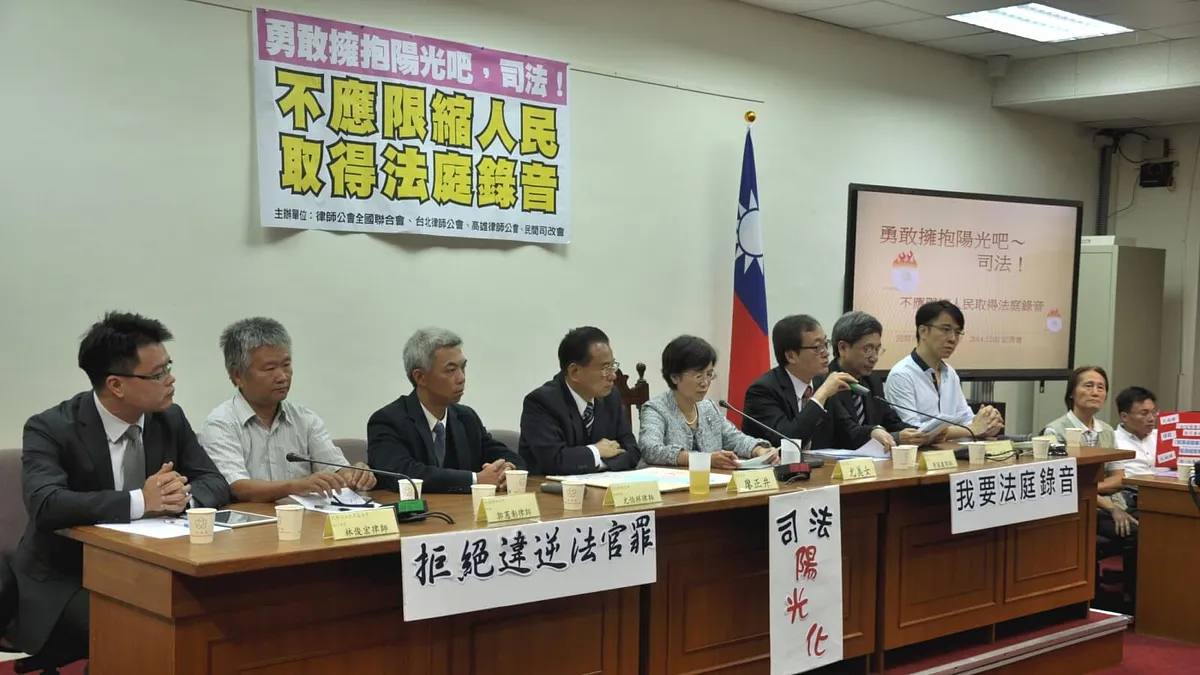
Embrace the Sunshine, Judiciary! ~ Press Conference on Opposing the Restriction of People's Access to Court Recordings
Last edited: 2026-08-28
(Court recording starts at 1 minute and 12 seconds of the video)
The aforementioned case was finally processed by the Judges Evaluation Commission as 103-Yuan-Tzu No. 11. Although the violation of processing procedures reached a serious degree, it was deemed that there was no need for disciplinary action, so it was referred to the Personnel Review Committee of the Judicial Yuan for handling. The Personnel Review Committee later resolved to issue a verbal order prompting the judge to pay attention.
On October 25, 2013, the Judicial Yuan arbitrarily promulgated the "Regulations Governing Court Recordings and Their Utilization and Preservation," causing a public uproar. In addition to the Taiwan Bar Association and various local bar associations expressing solemn opposition, over a thousand lawyers also signed a petition protesting that this move would cause the open trial system to retrogress by 200 years, disregard people's right of litigation, leave the quality of judgments without supervision, and infringe upon lawyers' rights to defense and litigation agency. Are we going back to the era of secret trials?
According to the statistical data of the Judicial Yuan, after the "Regulations Governing Court Recordings and Their Utilization and Preservation" took effect, from January to August of this year, the proportion of courts rejecting citizens' applications for the delivery of court recording discs was as high as 85.54%, and even civil cases refused to deliver recording discs. However, facing the voices of protest, the Judicial Yuan not only turned a deaf ear but also "upped the ante." On November 20 of this year, it countersigned with the Executive Yuan and forcefully passed the partial amendment draft of the Court Organization Act (hereinafter referred to as the Judicial Yuan's Draft). Although it seemingly incorporated the suggestions of the Taiwan Bar Association on the amendment of the Court Organization Act, there is still a risk that some provisions infringe upon the people's right to constitutional litigation, and therefore amendments and adjustments remain necessary.
Facing the aforementioned controversy, instead of seeking a solution, the government explicitly stipulated in the draft: If the content of the court recording involves the privacy of the parties, intervenors, or third parties, the court may refuse to permit or restrict the delivery of the content (Article 90-1 of the draft amendment). It also added a criminal penalty for violating the use of court recordings, which is imprisonment for up to 3 months or detention or a fine (Article 90-4 of the draft amendment). Furthermore, the crime of contempt of court was also revised to increase the penalty to imprisonment for up to 1 year, detention, or a fine of up to NT$90,000 (Article 95 of the draft amendment; the old law was imprisonment for 3 months and a fine of up to NT$3,000).
We believe that the people's right to request the delivery of court recordings is the implementation of the court's "open and transparent" litigation procedure and the principle of fair trial, in order to safeguard the people's right of litigation guaranteed by Article 16 of the Constitution. Therefore, the problems with the Judicial Yuan's draft lie in:
-
Under the guise of protecting the right to privacy and business secrets, it actually infringes upon the people's right of litigation, erodes the open trial system, and violates the lawyers' right to defense/litigation agency
Regardless of whether a case is tried publicly or non-publicly, since the matters are stated or exposed in court, there is no longer any privacy or possibility of constituting secrets for the parties and participants in court activities. Such a basis should not be used to restrict the right to request the delivery of court recordings and thereby erode the constitutionally guaranteed right of litigation. Moreover, whether something constitutes privacy or a business secret—and thus whether recording discs can be delivered—is entirely up to the court to decide, with no clarity or consistency in scope whatsoever.
The Judicial Yuan's draft restricts the acquisition of recordings of court activities, reducing the openness and transparency of court activities, which runs counter to the principle that trials should be conducted openly. At the same time, anyone with litigation experience deeply realizes the seriousness of flaws in the preparation of court transcripts in practice. Restricting parties from obtaining court recordings will obviously plunge them into greater danger, make erroneous transcripts even harder to discover, and infringe upon the parties' and lawyers' right to inspect files.
-
Inability to Supervise the Quality of Trials
Just like Mr. Wang, a party who attended this press conference, whose father is over 80 years old and has a physical or mental disability, was deceived and induced by the judge to withdraw the lawsuit during the court session. If he cannot apply for court recording discs and must rely solely on the court transcript, it is simply impossible to provide evidence, and the truth will eventually sink into oblivion and go unnoticed. (For details, please refer to Attachment 1) This case highlights that once the application for court recording discs is restricted, it will lead to the dilemma of being unable to supervise the quality of trials. If the Judicial Yuan's draft is passed, judges will find it easier to evade supervision and evaluation, and the Judicial Yuan's repeated declarations of eliminating incompetent judges will once again be reduced to empty slogans.
-
Intent to Punish Those Who "Disobey" Judges' Orders with Criminal Penalties
In addition to restricting requests for court recording discs, the Judicial Yuan's draft further adds criminal penalties to deal with those who illegally use court recording discs. However, the current Criminal Code or Personal Data Protection Act can already handle related acts such as interfering with secrets or spreading others' personal data to infringe upon privacy, making this redundant and cumbersome. What is even more worrisome is that the draft arbitrarily increases the criminal penalty for the "crime of contempt of court." The amendment explanation for this article cites hackneyed reasons such as "ensuring the smooth progress of litigation procedures, maintaining the dignity and authority of the court, and establishing judicial authority," without explaining at all what difficulties exist in the current regulations or the reasons for the necessity of increasing penalties. It ignores the principle of criminal law as ultima ratio, and that the establishment of judicial authority can never be achieved solely through heavy penalties. Instead, it highlights that judicial elites still harbor an authoritarian mentality of dealing with those who are "disobedient" and "defy judges" through criminal penalties, and judicial authority is likely to be completely destroyed as a result.
In fact, civil society has long proposed alternative countermeasures regarding court recordings. These include the partial amendment draft of the Court Organization Act by the Taiwan Bar Association and the draft Act of Audio and Video Records of Litigation by the JRF. The former was proposed by Legislator Wu Yi-chen (吳宜臻), and the latter was jointly proposed by legislators including Yu Mei-yu (尤美女) and Liao Cheng-ching (廖正井) (for details, please refer to Attachment 2). The contents and legislative strategies of the different civil society versions may vary, but they share the same opposition to the Judicial Yuan's restriction on people's access to court recordings and the subsequent increase in penalties. They even more resolutely oppose casually restricting the people's constitutionally guaranteed right of litigation under the pretext of the "Personal Data Protection Act" or the right to privacy.
Therefore, we urge all citizens and legislators, regardless of party affiliation, not only to reject the Judicial Yuan's draft which infringes upon the basic rights of the people, but also to further formulate laws that "sunshine the judiciary." We also call on the judiciary: Embrace the sunshine courageously! This is the only foolproof way for the judiciary to win the trust of the people!
Attachments
- Case Brief - The Case of the Taiwan High Court Judge Coercing and Inducing an Elderly Plaintiff to Withdraw a Lawsuit
- Comparison Table between the Civil Version of the "Act of Audio and Video Records of Litigation" (Proposed by Legislators Yu Mei-yu and Liao Cheng-ching) vs. the Judicial Yuan's Version of the "Court Organization Act"
Attendees
Victim / Mr. Wang Chih-hua (王治華)
Legislator / Yu Mei-yu (尤美女)
Legislator / Liao Cheng-ching (廖正井)
Chairman of the Taiwan Bar Association / Attorney Li Chia-ching (李家慶)
Managing Director of the Taipei Bar Association / Attorney Yu Po-hsiang (尤伯祥)
Director of the Kaohsiung Bar Association / Attorney Kuo Hsien-chang (郭憲彰)
Standing Director of the Judicial Reform Foundation / Attorney Lin Yung-sung (林永頌), Executive Committee Member Attorney Lin Chun-hung (林俊宏), CEO Attorney Kao Jung-chih (高榮志)
Press Contacts
CEO of the Judicial Reform Foundation / Attorney Kao Jung-chih (高榮志) 02-25231178
Legislative Assistant of Legislator Yu Mei-yu's Congressional Office / Chu Wan-lin (朱琬琳) 02-2358-8112
This article is an AI-generated translation of the original Chinese text. In the event of any discrepancy, the Chinese version shall prevail.