
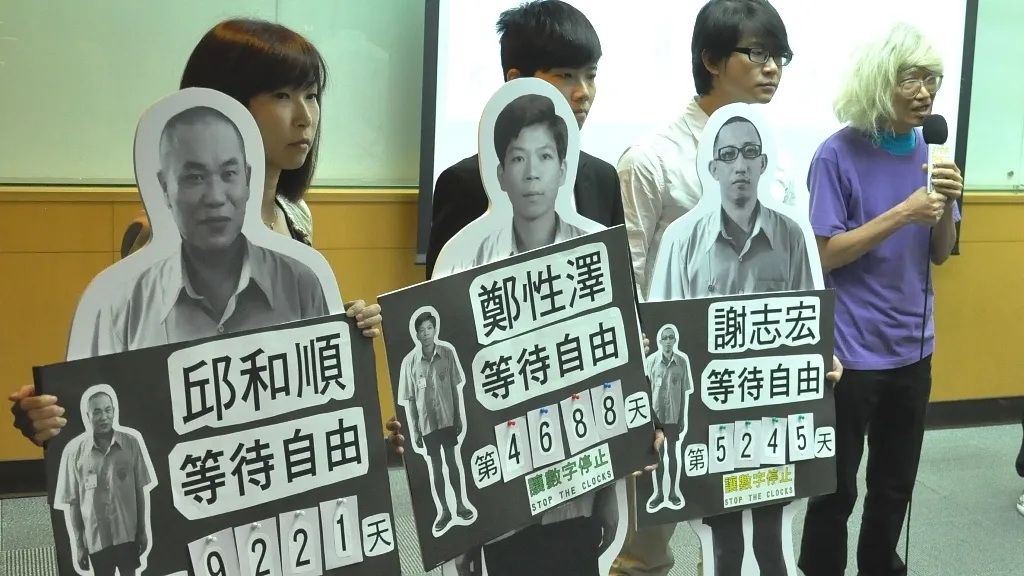
Stop the Numbers: Premiere and Press Conference for the Advocacy Short Films on Chiou Ho-shun, Hsieh Chih-hung, and Cheng Hsing-tze
Last edited: 2026-08-28
4,170 days is the time we spent locked up in the detention center due to a wrongful imprisonment.
4,527 days, 9,602 days, and 5,073 days
are the days Cheng Hsing-tze, Chiou Ho-shun, and Hsieh Chih-hung have been locked up in detention centers because of wrongful convictions.
And this number continues to grow.
Let us work together to: Stop the Numbers
~ Su Chien-ho, Liu Bing-lang, Chuang Lin-xun ~
On the morning of November 7, 2014, the Taiwan Alliance to End the Death Penalty, the Taiwan Association for Innocence, the Judicial Reform Foundation, and the Taiwan Association for Human Rights held a press conference and premiere for "Stop the Numbers," three advocacy short films concerning Chiou Ho-shun, Hsieh Chih-hung, and Cheng Hsing-tze, at the National Taiwan University Alumni Club.
How the Project Took Shape
Because of a murder case they did not participate in, between 1991 and 2003, Chien-ho, Ping-lang, and Lin-hsun spent over 4,000 anxious nights in detention centers wondering whether tomorrow would ever come, unable to speak up for themselves. Three life-sized cardboard cutouts served as their proxies until they were finally acquitted on August 31, 2012, becoming free individuals truly able to speak for themselves and for others.
TAEDP Executive Director Lin Hsin-yi stated that the idea to film these three documentaries came from renowned film critic Li Yu-ying-wu-chun ("Quail"). "When discussing the abolition of the death penalty with Li Yu-ying-wu-chun last year, he mentioned that he had footage of advocacy groups holding press conferences with life-sized cutouts of the Su Case trio, and offered it to TAEDP to use however we pleased. This gave me some visual concepts and ideas. Chien-ho, Ping-lang, and Lin-hsun have come out; they are no longer cardboard cutouts. But Hsieh Chih-hung, Chiou Ho-shun, and Cheng Hsing-tze are still in detention centers. They cannot speak for themselves. Who can speak for them?" Li Yu-ying-wu-chun would also attend the press conference to show support for the three men.
Li Chia-huai, who served as the assistant director for the Hsueh Case documentary *Island Etudes 3: The Taste of Freedom*, also assisted TAEDP and TAI in 2013 in filming the documentary *I Am Innocent: Cheng Hsing-tze*. The film used animation to portray the absurdity of the case as presented in the judgment, receiving widespread acclaim. "When I was asked whether I was willing to film these three short pieces, I agreed immediately without a second thought." Although he and fellow director Huang Wei-cheng still had heavy workloads at the time, "Just thinking that if Chien-ho, Ping-lang, and Lin-hsun had not been successfully vindicated, and Taiwan continued carrying out executions today, it would be an unimaginable outcome." "Taiwanese society as a whole remains indifferent to wrongful convictions, and Xiao Wei-ge and I hoped to use our humble visual power to make things clearer."
Who Are They?
Chiou Ho-shun was accused in 1988 of involvement in the murders of Lu Cheng and Ko Hung-yu-lan. Aside from a confession extracted through torture, there is no evidence to prove Chiu's guilt, nor could his alibi be disproven. The fingerprints and handwriting found on the ransom note in the Lu Cheng case did not match the defendants in this case. Relevant physical evidence showed that the true perpetrators of both murders were someone else. Although the police officers who engaged in illegal torture back then were definitively convicted in 1998, Chiou Ho-shun was nonetheless sentenced to death in 2011 after being detained for a staggering 23 years, and currently faces the imminent danger of execution.
Hsieh Chih-hung was implicated in a 2000 double-homicide in Kueijen Township, Tainan. Police seized the murder weapon and the victim's cell phone from Kuo Chun-wei's home. No fingerprints were tested on the weapon, and neither Hsieh Chih-hung's clothing nor his scooter tested positive for the victims' blood. There is no scientific evidence whatsoever indicating that Hsieh Chih-hung committed murder. Hsieh had confessed to the crime at the police station, but denied it once outside police surveillance, stating that he had been subjected to police torture. To verify whether torture had indeed occurred, the court requested an examination of the police interrogation audio recordings, only to discover that the audio tapes had been lost. Nevertheless, the court relied on the confession tainted by suspicions of torture and sentenced Hsieh Chih-hung to death in 2011. Hsieh currently faces the imminent danger of execution.
Cheng Hsing-tze was implicated in a 2002 KTV shooting in Fengyuan, Taichung. A police officer tragically lost his life during the raid. Cheng Hsing-tze cracked under police torture and confessed. There is no scientific evidence proving Cheng Hsing-tze committed murder. No fingerprints of Cheng were found on the murder weapon. Eyewitnesses also testified that Cheng did not shoot at the police. Cheng showed clear signs of having been tortured, and his confession contradicted physical evidence in multiple aspects, yet the court still sentenced Cheng Hsing-tze to death in 2006. He currently faces the imminent danger of execution.
Chiou Ho-shun, Hsieh Chih-hung, and Cheng Hsing-tze have all been wrongfully imprisoned due to different cases. Who can speak for them? Initiated by TAEDP, TAI, the Judicial Reform Foundation, and TAHR, the "Stop The Numbers" advocacy campaign filmed Judicial Reform Foundation volunteer Lü Pei-kuei, TAI Executive Director Attorney Lo Shih-hsiang, and TAEDP Legal Affairs Director Miao Poma each spending a day carrying life-sized cutouts of Chiou Ho-shun, Hsieh Chih-hung, and Cheng Hsing-tze, which were edited into advocacy short films.
Becoming the Protagonists
When initially considering the protagonists for the three short films, lawyers from the defense teams were ruled out first. Because the advocacy groups wanted to demonstrate that it is not only lawyers who can rescue individual cases, or rather, that wrongful conviction rescue requires the participation of all kinds of people!
The protagonist of *9602, Stop the Numbers*, Judicial Reform Foundation volunteer Lü Pei-kuei, was unable to attend the scene due to school midterm exams, so Judicial Reform Foundation Deputy Executive Director Chen Yü-fan expressed her sentiments on her behalf: "What kind of justice allows an innocent person to spend nearly half their life in prison? What kind of justice makes it impossible for a person to even achieve these tiny wishes? We hope the justice system will squarely face its errors soon and return Chiou Ho-shun his innocence."
r
Taiwan Association for Innocence Executive Director Lo Shih-hsiang is the protagonist of *5073, Stop the Numbers*. He stated, "If today were June 27, 2000, I wish I could tip off Hsieh Chih-hung; how I wish I had been the lawyer accompanying him during the interrogation. None of those confessed words were spoken by Hsieh Chih-hung, yet the confession transcript stayed with Hsieh for 11 years until he was sentenced to death. There is no other physical evidence in the entire case to prove Hsieh Chih-hung committed the crime. When will the sky of his 19-year-old youth clear up?"
TAEDP Legal Affairs Director Miao Poma, who participated in filming *4527, Stop the Numbers*, said, "Cheng Hsing-tze is a victim of a death row wrongful conviction, having spent 12 years on death row, enduring over 4,000 anxious nights wondering if tomorrow would come. Cheng Hsing-tze was once scoundrel scorned by all, but he harbors no hatred for fate or society; he even sincerely blesses everyone outside the iron bars, genuinely caring for every suffering and sorrowful life. I hope Cheng Hsing-tze's sentiments will draw more people's attention to the wrongfully suffering souls behind the iron bars."
Over the course of a day of filming, carrying life-sized cutouts 24 hours a day was an unforgettable experience for them. Many people curiously asked who these figures were; some looked on coldly and apathetically, while others were filled with righteous indignation upon hearing their stories.
We Invite You to Join Us as Protagonists in Wrongful Conviction Rescue
A single day may not achieve major changes, but what about the day of 10 people, 100 people, or 10,000 people? Or 1 hour from 10,000 people, or 10 minutes from 100,000 people? How immense of a force would this gather? TAEDP, TAI, the Judicial Reform Foundation, and TAHR jointly invite you to become a protagonist in wrongful conviction rescue through the following steps:
- After understanding the stories of the three men (please refer to the aforementioned case blogs or dedicated pages), you are welcome to record a ten-second selfie short film.
- In the short video, please face the camera and state: first, the reason for your support; second, who you are; and third, which individual you support. (For example: Oppose confessions extracted through torture as evidence, I am Wang Hsiao-ming, I support Chiou Ho-shun).
- Please upload the video to Facebook and use the hashtag for Chiou Ho-shun (#ChiuHoShun), Cheng Hsing-tze (#ChengHsingTze), or Hsieh Chih-hung (#HsiehChihHung) so more people can see it.
- The campaign runs until December 31. After collecting the videos, we will proceed with further compilation and creative integration.
TAHR Executive Secretary Yen Szu-yü concluded by stating, "Having walked through the Chiang Kuo-ching and Su Chien-ho triad cases, these should not be treated as fading past events. Judicial arrogance continues to produce new tragedies. We hope to stop these horrifying numbers, exonerate the wrongful convictions of Hsieh Chih-hung, Chiou Ho-shun, and Cheng Hsing-tze, and let these scars become the final documentary."
This article is an AI-generated translation of the original Chinese text. In the event of any discrepancy, the Chinese version shall prevail.