
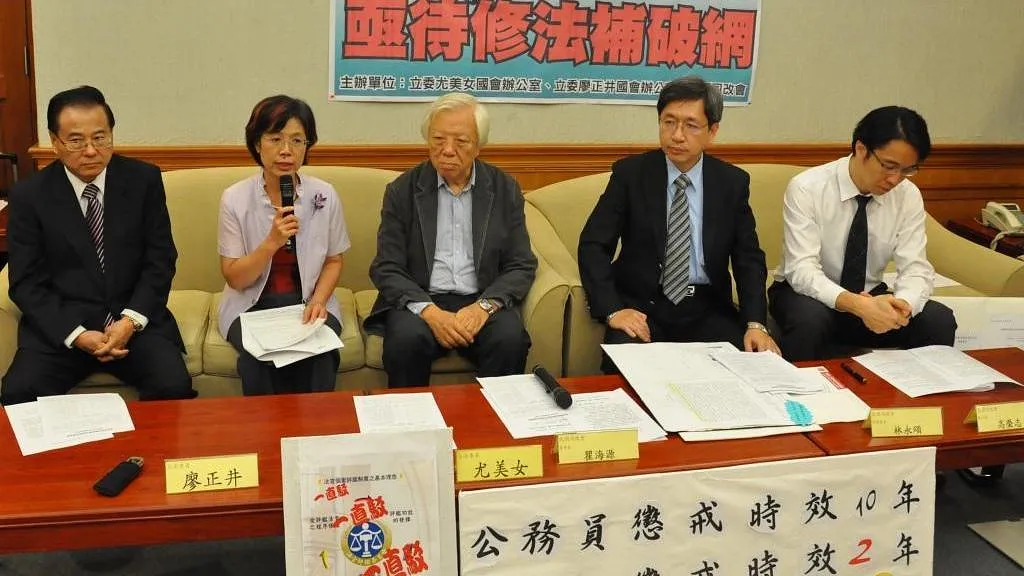
Difficulties in Evaluating Judges and Prosecutors Call for Urgent Amendments to Fix Loopholes: Press Conference on Strengthening Individual Case Evaluations Under the Judges Act
Last edited: 2026-08-28
The individual case evaluation system under the Judges Act has been in effect since January 6, 2012, approaching nearly three years to date. Since the formation of the 2nd term of the Prosecutors Evaluation Committee in January this year, a total of 16 evaluation decisions have been rendered, with only 2 cases established and referred to the Control Yuan for investigation, representing an establishment rate of 12.5%. Among the 14 unestablished cases, as many as 9 were dismissed on the grounds of "exceeding the two-year request period."
In Case 5 of the table below, the appeal brief submitted by Taiwan High Prosecutors Office prosecutor Chen Ming-kuang was less than half an A4 page in total length (see Appendix 1), showing an unparalleled level of negligence and dereliction of duty.
In Case 7 of the table below, Taiwan High Prosecutors Office prosecutor Tung Ho-tsun (see Appendix 2), despite the defendant having been acquitted in both the first and second instances, did not mention a single word regarding any provisions of the Criminal Speedy Trial Act in the appeal brief submitted to the Supreme Court, evidently demonstrating complete ignorance of statutory changes and gravely infringing upon the defendant's right to a speedy trial.
Table of Cases Dismissed by the Second Prosecutor Evaluation Commission Due to Expiration of the Two-Year Statute of Limitations
| Case Number | Person Evaluated | Reporting Organization | Grounds for Reporting |
|---|---|---|---|
| 102 Prosecutor Evaluation No. 22 | Lin Tien-lin | JRF | The prosecutor handling a major case failed to personally preside over the hearings; all 11 investigative hearings were conducted by a prosecutor's investigator, and the written non-prosecution disposition was riddled with errors. |
| 103 Prosecutor Evaluation No. 01 | Kuo Chi-tung | JRF | Appealed to the Supreme Court without specifying how the original judgment violated the law, thereby filing a frivolous appeal. |
| 103 Prosecutor Evaluation No. 02 | Chang Chi-pin | JRF | Appealed to the Supreme Court without specifying how the original judgment violated the law, thereby filing a frivolous appeal. |
| 103 Prosecutor Evaluation No. 03 | Tien Ping-lin | JRF | Appealed to the Supreme Court without specifying how the original judgment violated the law, thereby filing a frivolous appeal. |
| 103 Prosecutor Evaluation No. 04 | Chen Ming-kuang | JRF | After declaring an appeal, completely failed to submit an appellate brief. (See Appendix 1) |
| 103 Prosecutor Evaluation No. 05 | Cheng Hsin-hung | JRF | Appealed a crime of fraud to the Supreme Court despite the legal prohibition against appealing such cases to the third instance. |
| 103 Prosecutor Evaluation No. 06 | Tung Ho-tsun | JRF | Despite the defendant being acquitted in the first and second instances, ignorantly appealed to the Supreme Court in violation of Article 9 of the Criminal Speedy Trial Act. (See Appendix 2) |
| 103 Prosecutor Evaluation No. 11 | Lin Che-hui | JRF | Severely violated the principle of non-publicity of investigations and leaked state secrets. |
| 103 Prosecutor Evaluation No. 13 | Yang Ta-chih | Taipei Bar Association | Conducted a perfunctory investigation and frivolously prosecuted the defendant based on facts contradicting professional medical opinions. |
The absurdity of these cases and the inability to penalize the prosecutors stem from Article 36 of the Judges Act, which stipulates that requests for individual case evaluations must be "made within two years," with the limitation period beginning from the completion of the case by the handling prosecutor. In other words, an evaluation request must be filed within two years of the prosecutor prosecuting the case. The problem is that prosecution is followed by protracted trials; while proceedings are ongoing, how could ordinary citizens dare to request an evaluation of a prosecutor? By the time the case reaches final determination, the statute of limitations for reporting the prosecutor has usually expired. Although Article 89, Paragraph 4, Subparagraph 1 of the Judges Act contains a special provision allowing the two-year period to be calculated from the final determination of the case, the Prosecutor Evaluation Commission has applied an "extraordinarily strict interpretation" to this provision, rendering it entirely unusable for any case. If legal amendments are not made to resolve the problem of excessively short limitation periods, individual case evaluations of prosecutors will lose most of their functionality. This also indirectly creates the unfair phenomenon where "evaluating judges is relatively easy, while reporting prosecutors is extremely difficult"!
The 2nd Judges Evaluation Commission is no better: out of 7 evaluation cases currently reviewed, only 1 was accepted and referred to the Control Yuan for investigation, an acceptance rate of 14.2%. Among the 6 unaccepted cases, as many as 4 were dismissed on the grounds of "no necessity for disciplinary action or non-serious circumstances." As shown in Case 4 of the table below, Taiwan High Court Judge Tseng Shu-hua failed to inform a defendant apprehended under a warrant that other co-defendants had their sentences reduced upon appeal, and instead made conditional non-detention an exchange for the defendant withdrawing their appeal, thereby reducing her own caseload. For such a serious dereliction of duty and "betrayal of justice," the Judges Evaluation Commission still deemed that there was "no necessity for disciplinary action." This shows that the culture of officials shielding one another remains severe, and legal amendments should be made to reduce the number of official-appointed members while increasing external members.
Table of Cases Dismissed by the Second Judges Evaluation Commission Due to No Necessity for Disciplinary Action or Non-Serious Circumstances
| Case Number | Person Evaluated | Reporting Organization | Grounds for Reporting |
|---|---|---|---|
| 102 Judge Evaluation No. 09 | Li Chia-hui | JRF | Neglected to notify the defendant's defense counsel to appear at the trial date and instead appointed a public defender. |
| 102 Judge Evaluation No. 11 | Lü Cheng-yeh | JRF | Poor courtroom demeanor and improperly induced the defendant to plead guilty. |
| 103 Judge Evaluation No. 03 | Tsai Hui-ju | Association of Greater China Magistrates | Conducted perfunctory trial proceedings and issued a judgment containing erroneous descriptions and copy-pasted text from unrelated cases. |
| 103 Judge Evaluation No. 04 | Tseng Shu-hua | JRF | Conditioned the non-detention of a defendant apprehended under an arrest warrant on the withdrawal of their appeal. The defendant predictably fled again, making it impossible to enforce the prison sentence. (See Appendix 3) |
To resolve the numerous problems arising after the implementation of the Judges Act, a civil society version of the draft amendments to the Judges Act has been proposed by Legislator Yu Mei-nu, Legislator Liao Cheng-ching, and 21 other legislators, and has been referred to the Judiciary and Organic Laws and Statutes Committee for review (See Appendix 4). The draft aims to resolve issues such as (1) evaluation request limitation periods being obviously too short, (2) individual parties and reporting evaluation organizations lacking participatory rights in the evaluation procedure, resulting in insufficient due process, (3) the evaluation commission lacking the power of proactive investigation, and (4) the external oversight nature of decision-making procedures being inadequate, thereby strengthening the individual case evaluation system under the Judges Act.

Legislator Yu Mei-nu further explained that the purpose of the individual case evaluation system is to weed out incompetent judges and prosecutors, which will also enhance overall public trust in the judiciary. "A single fly spoils the whole pot of soup"; failing to weed out bad judges or prosecutors means public trust in the judiciary will remain tainted by bad impressions, which is unfair to hardworking and dedicated good judges and prosecutors. Therefore, the Judicial Yuan and the Ministry of Justice should not resist the amendments to the Judges Act; instead, they should actively promote them as a means to enhance overall judicial quality.
Today, JRF presented two cases where prosecutors at the High Prosecutors Office enjoy a "free ride," which precisely illustrates how Article 36 of the Judges Act imposes an excessively short limitation period along with an unreasonable starting point—where "case completion" is interpreted in practice as "leaving the hands of the person evaluated." Given the reality that litigation is often time-consuming, a case can easily take three to five years from initiation to final determination. One must ask: which party would be willing to rashly request an evaluation while the case is still pending? Even if the case has left the hands of that judge or prosecutor, parties remain fearful that immediate evaluation requests will lead to unfavorable outcomes for their cases.
In fact, issues concerning prosecutors' frivolous prosecutions, appeals, or non-prosecutions have gradually gained attention in recent years. From late 2011 to June 2012, JRF held four press conferences, and the Ministry of Justice responded each time by stating that "if the handling prosecutor is indeed found to have been negligent, disciplinary action will be taken based on the circumstances in accordance with the 'Standards for Reward and Punishment of Personnel in Prosecutorial Agencies' under the Ministry." Furthermore, on December 26, 2013, October 9, 2013, and March 17, 2014, the Legislative Yuan's Judiciary and Organic Laws and Statutes Committee successively passed several proposals by Legislator Yu Mei-nu, requiring the Ministry of Justice to categorize situations of prosecutorial abuse or negligence (for instance: prosecutors merely citing the informant's brief without stating their own opinions, resulting in dismissal by the court, or prosecutors ignoring/disregarding the amendment and implementation of the Criminal Speedy Trial Act and still filing appeals in unappealable cases, thereby burdening defendants with litigation), establish criteria for judgment, and set up specific accountability or performance management mechanisms. However, more than a year has passed, and what has been the Ministry of Justice's actual course of action? We see absolutely nothing.
Furthermore, the evaluation commissions are currently established under the Judicial Yuan or the Ministry of Justice, and their composition and setup diverge significantly from the "external independent oversight mechanism" anticipated by the public. The staff of the Prosecutor Evaluation Commission are even personnel from the Ministry of Justice. When facing external oversight, the competent authorities brush off criticism under the pretext that "evaluation commissions exercise their powers independently," thereby implicitly rejecting oversight. With such a crippled institutional design, it is no wonder public doubts regarding the impartiality and independence of the evaluation commissions can never be dispelled.
On February 21 this year, after the spring festival, President Ma Ying-jeou held a dialogue with legislators, the Judicial Yuan, and judicial reform organizations, and publicly stated that the "judge and prosecutor evaluation system" was legislated with the initial approach of "first having it, then making it better." After two years of implementation, "we cannot forget to pursue 'better' just because we 'have' it." He urged the Judicial Yuan to study whether targeted amendments could be made before the completion of the system's third year of implementation by consulting opinions from all sectors, thereby showing the public the government's sincerity in reform. To this end, the Judicial Reform Foundation calls upon the Judicial Yuan to carry out this policy and promptly submit its amendment proposals to the Legislative Yuan so that legislators can deliberate them as soon as possible. If the amendments can be passed during this session, the individual case evaluation system can fulfill the functions it ought to perform. Legislators Yu Mei-nu and Liao Cheng-ching also pledged their full support for the revision of the evaluation system under the Judges Act.
Appendices
- Appeal Brief by Prosecutor Chen Ming-kuang
- Supreme Court Judgment in Prosecutor Tung Ho-tsun's Appeal Case
- Illustration of Judge Tseng Shu-hua's Case Handling
- Draft Amendments to Certain Articles of the Judges Act
Attendees
Legislator Yu Mei-nu, Legislator Liao Cheng-ching
Judge Lin Chia-hsien, Assigned to the Department of Judicial Administration
Specialist Huang Shu-yuan, Department of Prosecutorial Affairs, Ministry of Justice
Professor Chü Hai-yüan, Chairman, Judicial Reform Foundation
Attorney Lin Yung-sung, Standing Board Director, Judicial Reform Foundation
Attorney Kao Jung-chih, CEO, Judicial Reform Foundation
Press Contacts
Attorney Kao Jung-chih, CEO, Judicial Reform Foundation 02-25231178
Chu Wan-lin, Legislative Assistant to Legislator Yu Mei-nu's Congressional Office 02-2358-8112
This article is an AI-generated translation of the original Chinese text. In the event of any discrepancy, the Chinese version shall prevail.