
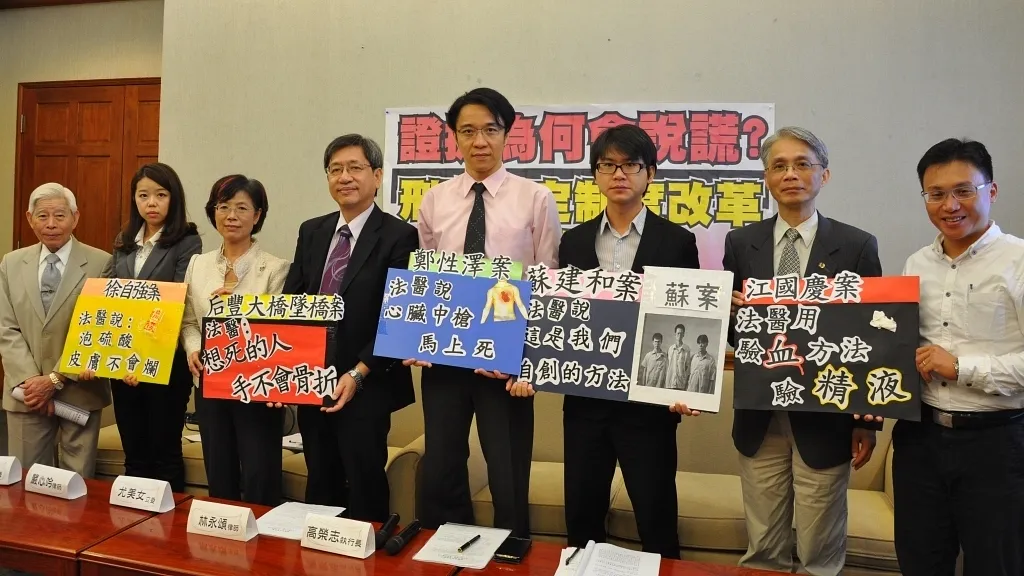
Why Do Evidences Lie? Reforming Forensic Appraisal Systems and Holding Negligent Personnel Accountable — Press Conference on Criminal Forensic System Reform
Last edited: 2026-08-28
In 2004, an erroneous fingerprint identification by the U.S. Federal Bureau of Investigation (FBI) in the Madrid bombing case led to the wrongful detention of an individual for two weeks. The U.S. government promptly established a special task force within the Department of Justice to investigate. Subsequently, the FBI apologized, discontinued the hiring of external experts, and took four measures regarding its internal examiners: (1) immediately suspending their forensic casework, (2) reviewing all forensic cases they had previously conducted, (3) administering proficiency testing, and (4) conducting re-education. Meanwhile, the U.S. government also paid US$2 million in compensation to the wrongfully accused, innocent defendant.
In recent years, several wrongful convictions involving glaring forensic errors have occurred in Taiwan; yet not a single errant forensic agency or examiner has faced review, nor have any improvement measures been put forward. Today, the Judicial Reform Foundation and the Taiwan Innocence Project jointly release five cases, demanding accountability:
Chiang Kuo-ching Case DNA Identification Errors: Pu Chang-en, Chao Chi-hsiang, Keng Liang-tsai, Fang Chung-min, Li Wei-hua, Hsiao Kai-pin.
Professor Li Chun-i of National Taiwan University's Department of Forensic Medicine pointed out that a review of the wrongful death case of Chiang Kuo-ching revealed numerous fatal errors in scientific evidence. At the time, the Investigation Bureau of the Ministry of Justice used a "blood" test reagent to test whether a bloodstain contained "semen," which was an obvious error. Testing for semen and testing for blood require different reagents; using a blood test reagent on blood naturally yielded a "positive reaction," and Chiang Kuo-ching was inexplicably wronged in this manner. Furthermore, although the Investigation Bureau determined that the DNA matched Chiang Kuo-ching, subsequent findings proved that the sample was of a different profile from that of Chiang Kuo-ching. Now that it has been proven that Chiang Kuo-ching was wrongfully convicted, the polygraph test conducted by the Investigation Bureau at the time was also highly problematic. However, instead of reviewing these numerous lapses, the Investigation Bureau of the Ministry of Justice filed civil and criminal lawsuits against Professor Li for publishing articles reviewing the case. Professor Li Chun-i stated that pseudo-scientific evidence causes profound harm to the judiciary, yet the authorities refuse to confront it, leaving the public with no choice but to fend for themselves and pray that they will not be wrongfully convicted.
Hsü Chien-ho Case Bone Identification Errors: Hsiao Kai-ping, Shao Yao-hua, Jao Yu-tung, Chen Ming-hung, Sun Chia-tung, Fang Chung-min

Taking the erroneous forensic examination of the Hsü Chien-ho trio as an example, Judicial Reform Foundation Executive Secretary Hsiao I-min pointed out that the Institute of Forensic Medicine of the Ministry of Justice had serious flaws in identifying the number of murder weapons based on the angles of knife marks on the skeletal remains. Examiners found knife mark angles of 0 degrees, 20 degrees, and 40 degrees on the bones and rationalized their findings to conclude that there were at least three different types of bladed weapons, implying that there was more than one perpetrator. However, it has been proven that the same weapon, due to variations in force and angle, can produce different skeletal notches. The angle of a knife mark is fundamentally unrelated to the type of blade. Most egregiously, the "knife mark angle comparison method" employed by the Institute of Forensic Medicine of the Ministry of Justice was a "novel theory" seen nowhere else in the world, with no comparable scientific research whatsoever. Hsiao I-min stated that because of this flawed forensic report, it took the court 12 years after the retrial of the Hsü case to finally uncover the truth. Ultimately, the court explicitly ruled that the skeletal identification by the Institute of Forensic Medicine of the Ministry of Justice lacked admissible evidentiary capacity. Nevertheless, this erroneous appraisal has still not been reviewed, and the personnel involved have received no disciplinary punishment.
Hsu Tzu-chiang Case Wound Photograph Forensic Identification Errors: Hsiao Kai-ping

Legislator Yu Mei-nu concluded: She has already demanded in the Legislative Yuan that relevant ministries and agencies study the establishment of a national-level independent forensic center, and that forensic units should not be subordinate to investigative agencies to avoid compromising their independence and neutrality. However, across past proposals, the relevant authorities have presented no concrete measures, even responding that there is no such need. The numerous wrongful convictions serve as clear proof; reconstructing the forensic appraisal system to make appraisals more fair, objective, and neutral has become the public expectation. Legislator Yu Mei-nu called on the government to immediately address the rampant presence of pseudo-scientific evidence in courtrooms.
Scientific evidence does not lie, but the forensic pathologists and criminal forensic examiners who "let the evidence speak" may deliberately lie or make mistakes due to incompetence—the aforementioned cases are painful examples. Currently, judges, prosecutors, police, and investigative officers rely heavily on the appraisal opinions of forensic institutions and professionals in the process of arguing and trying cases. If the problem-ridden forensic identification system is not reformed immediately and derelict personnel are not held legally accountable, wrongful convictions and miscarriages of justice will continue to occur. To this end, the Judicial Reform Foundation and the Taiwan Innocence Project will submit a petition to the Control Yuan today to demand disciplinary action against the aforementioned individuals, and put forward the following appeals, urging the government to immediately review and improve:
- To enhance the public credibility of expert evaluation in Taiwan's criminal proceedings, an integrated standard for court review of expert appraisal opinions should be established.
- Forensic appraisal institutions and examiners should undergo prior proficiency testing. The individuals actually conducting the appraisals should appear in court for cross-examination.
- For cases confirmed to involve forensic appraisal errors, in addition to holding the appraisal institutions and personnel accountable, their forensic casework should be suspended and all past forensic appraisal cases they handled should be reviewed to assess and prevent errors.
- Establish a national-level forensic identification institution under the Executive Yuan, and enact the Organic Act of the Forensic Science and Forensic Pathology Commission.
This article is an AI-generated translation of the original Chinese text. In the event of any discrepancy, the Chinese version shall prevail.