
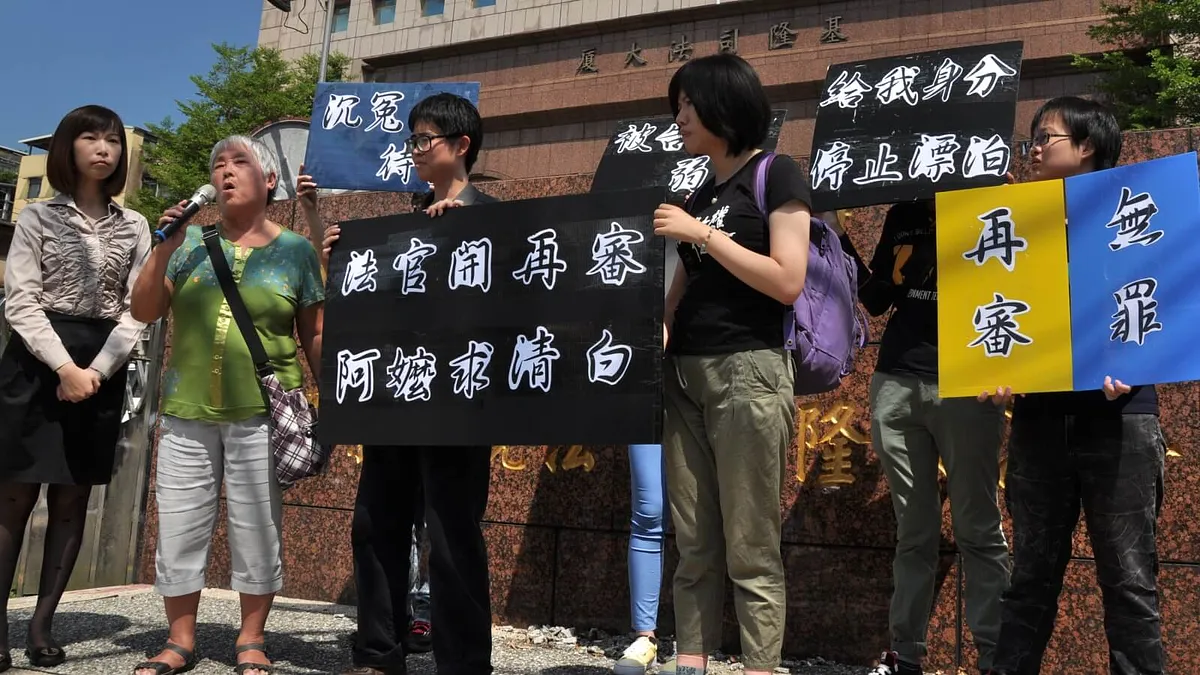
Keelung District Court Holds First Retrial to Vindicate Septuagenarian Woman--Press Conference on the First Retrial Hearing of Mei Fu-an's Case
Last edited: 2026-08-28
The Keelung District Court originally rendered criminal judgments (99th Year, Ji-Jian-Zi No. 1726, and 100th Year, Jian-Shang-Zi No. 1号) finding Ms. Mei Fu-an guilty of embezzlement. The conviction was based on the premise that she intended to sell a water heater and a washing machine belonging to the estate of her deceased husband, Chia Yu-wang, and because this estate was jointly owned by her and Chan Ming-chang (the son acknowledged by Chia Yu-wang), she was sentenced to twenty days of detention.
However, after the judgment in this case became final, the Keelung District Court rendered civil judgments (99th Year, Chin-Zi No. 121, and 100th Year, Chia-Shang-Zi No. 153) ruling that Chia Yu-wang's acknowledgment of Chan Ming-chang as his son was invalid, meaning there was no blood relationship between them, and consequently Chan Ming-chang had no right of inheritance to Chia Yu-wang's estate. The water heater and washing machine were therefore not part of the estate that Chan Ming-chang could inherit, thus creating an opportunity for a retrial in this case.
Today, the Keelung District Court will hear Ms. Mei Fu-an's retrial under case number 103st Year, Jian-Shang-Zai No. 1. This is the first retrial proceeding opened by the Keelung District Court in five years, and the presiding judge will decide whether to overturn Ms. Mei Fu-an's conviction for embezzlement.
The Foundation believes that Ms. Mei Fu-an was convicted of embezzlement simply because, after being driven out of her home by Chan Ming-chang, she returned to take a water heater and a washing machine that she had long used, intending to sell them to make a living. Throughout the judicial process, had prosecutors and judges shown a bit more empathy toward society's disadvantaged, the outcome could have been entirely different. Now that a retrial has finally been initiated, the Foundation expects the judiciary to take a different course of action and acquit Ms. Mei Fu-an.
Additionally, Ms. Mei Fu-an is a spouse from mainland China who has been unable to obtain an ID card due to a criminal record, plunging her into financial hardship while depriving her of access to basic social welfare. Article 17, Paragraph 5, Subparagraph 2 of the Act Governing Relations Between People of the Taiwan Area and the Mainland Area stipulates that the requirements for obtaining an ID card include "good moral character and no criminal record." However, "no criminal record" encompasses various petty offenses that have little to no bearing on public safety. The competent authorities should indeed review whether such petty offenses ought to be set as a threshold for obtaining an ID card.
Appendix
- Keelung District Court, 103rd Year, Sheng-Zai-Zi No. 1 Criminal Ruling
Press Contact
Lin Wei-ting, Executive Secretary, Judicial Reform Foundation
This article is an AI-generated translation of the original Chinese text. In the event of any discrepancy, the Chinese version shall prevail.