
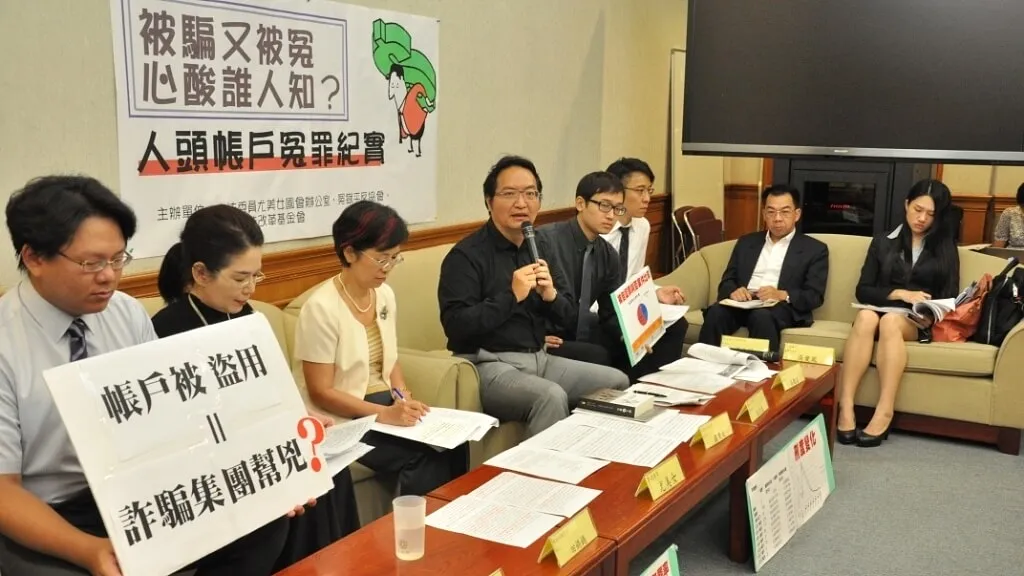
Scammed and Wronged: Who Understands the Heartbreak? Press Conference on Wrongful Convictions in Stolen-Account Cases
Last edited: 2026-08-28
Fraud cases are rampant, causing the public to lose their hard-earned money in vain. However, victims of fraud are not limited to those tricked into making transfers; there are also numerous cases where individuals are tricked into handing over their bank accounts and passwords to fraud syndicates, turning them into conduits for money transfers. In judicial practice, such dummy-account cases are mostly handled as aiding and abetting fraud. Even without evidence proving that the defendant sold their account, courts still maintain that the defendant should have had the common sense to know they must not provide their account and password, and that doing so constitutes indirect intent to aid and abet fraud. Ultimately, many economically disadvantaged job seekers and borrowers who had their accounts stolen find themselves convicted by the courts—scammed and wronged, with nowhere to turn for help.
Mr. Huang, a recent college graduate, posted his resume on a job bank website. Someone calling themselves "Manager Chou" asked if he was interested in working as a driver, and requested Mr. Huang to hand over his debit card and password so they could verify whether his account could be used. After Mr. Huang handed over his account and password, it was used by a fraud syndicate to have other victims transfer money to it. After noticing irregularities, a transferring victim reported it to the police, and investigations revealed that Mr. Huang's account had been used by the fraud syndicate to acquire illicit proceeds.
Mr. Huang proclaimed his innocence to the court, stating that he did not sell a dummy account to the fraud syndicate, that he was not an accomplice, and that he was also a victim of the fraud syndicate. However, the court held that Mr. Huang possessed indirect intent to aid and abet fraud, and convicted him without investigating any evidence. For his second instance, Mr. Huang retained an attorney who summoned witnesses and formally requested the court to investigate evidence seven times through written briefs and oral arguments, but the court refused all requests and dismissed the appeal.
After a pro bono lawyer from the Taiwan Association for Innocence filed for a retrial, the retrial court summoned a witness to appear, reviewed the case records, and acquitted Mr. Huang. With the exact same evidence, as long as the court is willing to investigate, the truth can be clarified, yet the original trial court stubbornly refused to do so.
After four years of judicial litigation, Mr. Huang was scammed and wronged, only to be exonerated later. Why must the judiciary put people through such torment?
My Account Was Scammed, Why Am I a Fraudster?
According to general social and life experience, if someone asks another person for their deposit account items, it is reasonable to expect that these account items might be used for illegal purposes such as fraud. Furthermore, the fact that bad actors utilize collected accounts to engage in crimes such as fraud has been widely reported by the media for many years and already constitutes common social sense.
One must have considerable awareness that items such as cash cards will fall into the hands of others and be easily utilized as crime tools related to property; yet, choosing to provide the account, hand over the debit card and password, and foreseeing that these financial materials will be used as a tool to deposit and withdraw illicitly obtained money from fraud—while such accounts are indeed subsequently used for others' crimes—does not run contrary to the defendant's original intent.
Jen Chun-i, a pro bono attorney for the Taiwan Association for Innocence, stated that courts adopt an interpretation of "indirect intent" for aiding and abetting fraud: as long as the defendant knows that fraud syndicates exist in society to scam money, providing an account is deemed to carry the indirect intent of fraud. However, this ignores the fact that many defendants actually handed over their accounts because they were deceived. Having their account and password stolen by a fraud syndicate is already distressing enough, but to be deemed an accomplice to the fraud syndicate by the court makes victims feel even more sorrowful and speechless before the heavens.

Judicial Class Discrimination: The Plight of Defendants Accused of Aiding Fraud
Fan Chih-cheng, a working committee member of the Judicial Reform Foundation, stated that passbooks that are lost, stolen, or scammed make their owners victims, just like those who are defrauded of their money. Once flagged as an alert account, all cash within every account under that person's name is frozen simultaneously, potentially plunging an ordinary citizen into living difficulties. Yet, for suffering the exact same deception, the court actually imposes criminal penalties on the person whose passbook was scammed, saddles them with a criminal record, and even exposes them to incidental civil lawsuits for damages filed by the victim who made the transfer. This is extremely unreasonable.

Attorney Fan believes that in dummy-account cases, it is observable that defendants generally possess lower organizational and narrative capabilities. Furthermore, since these cases are not subject to appeal to the third instance, when courts neglect to investigate evidence, defendants are often unable to further contest the court's violation of evidentiary rules before the court of final appeal. When handing over an account and password is equated to indirect intent, the court virtually operates on a presumption of guilt, making it difficult for innocent defendants to prove their innocence. Under minor crimes with light penalties, defendants are often even more prone to accept a guilty plea in exchange for probation to escape this judicial disaster as quickly as possible.
Lo Ping-cheng, Chairperson of the Taiwan Association for Innocence, stated that although the criminal responsibility is not heavy, judicial units must not take it lightly. Most individuals implicated in dummy-account aiding-and-abetting-fraud cases possess lower economic capabilities, such as fresh graduates seeking employment or borrowers in urgent need of money. The judiciary's excessive abuse of indirect intent to convict people will result in an incalculable number of wrongful convictions. If the judiciary does not face this cautiously, not only will it fail to realize judicial justice, but it will also foster class discrimination within society.

2013 Statistics on Aiding-and-Abetting-Fraud Cases in Five District Courts
Searches conducted by the Judicial Reform Foundation across the Taipei, New Taipei, Taoyuan, Taichung, and Kaohsiung District Courts for fraud cases in 2013 (using the keywords "defendant due to fraud case & accomplice & account") identified a total of 1,529 cases, among which 1,495 resulted in guilty verdicts, yielding a conviction rate of nearly 98%, with only 34 cases resulting in acquittals.

Table 1: Statistics of Guilty and Acquittal Verdicts in Aiding-and-Abetting-Fraud Cases Across Five District Courts
| Region | Taipei | New Taipei | Taoyuan | Taichung | Kaohsiung | Five Cities Total |
|---|---|---|---|---|---|---|
| Total Cases | 151 | 419 | 308 | 318 | 333 | 1529 |
| Guilty | 142 | 416 | 302 | 304 | 331 | 1495 |
| Acquitted | 9 | 3 | 6 | 14 | 2 | 34 |
| Acquittal Rate | 5.96% | 0.72% | 1.95% | 4.40% | 0.60% | 2.22% |
| Conviction Rate | 94.04% | 99.28% | 98.05% | 95.6% | 99.4% | 97.78% |
Figure 1: Conviction Rate Statistics Chart

Among these aiding-and-abetting-fraud cases, 1,176 cases (76.9%) were determined to have clear facts and were processed via summary judgments. These cases were reviewed solely through written documents by the court; among them, 601 defendants did not plead guilty, yet all ultimately resulted in guilty verdicts. In contrast, cases processed under ordinary trial procedures yielded 34 acquittals. Although it is impossible to know how many innocent cases were among those convicted via summary judgments, through ordinary trial procedures, innocent defendants undoubtedly have a greater opportunity to prove their innocence.
Table 2: Statistics of Summary and Ordinary Trial Procedures
| Summary Judgment Disposition | Ordinary Procedure | |
|---|---|---|
| Guilty | 1176 (601 of whom pleaded not guilty) |
319 |
| Acquitted | 0 | 34 |
| Total | 1176 | 353 |
Among the 34 acquittals, there were 11 instances where prosecutors applied for summary judgments, but judges changed the proceedings to ordinary trial procedures, allowing the defendants to clarify the truth and secure acquittals.
Figure 2: Sentencing and Proportions for Guilty Pleas versus Not Guilty Pleas

Looking at sentencing statistics, approximately 28% of defendants who pleaded guilty obtained probation sentences; however, when defendants pleaded not guilty, only 12% obtained probation. Pleading guilty helps in obtaining probation. If a defendant truly has no heart for litigation and gives up fighting for their innocence, pleading guilty indeed offers a better chance of trading for probation to bring the matter to a swift close.
Exploring further how these defendants accused of aiding fraud handed over their accounts, among the 921 cases that mentioned the method of account handover, job hunting was the most frequently claimed reason with 275 cases, followed by obtaining loans with 244 cases, and account loss with 225 cases.
Table 3: Reasons for Account Handover Stated by Parties Involved
| Type of Account Handover (Self-reported by parties) | Case Count |
|---|---|
| Unidentifiable | 608 |
| Job Hunting | 275 |
| Borrowing Money | 244 |
| Loss | 225 |
| Selling Account | 69 |
| Borrowed (Tricked) by Friends/Family | 68 |
| Scammed While Buying Online Auction Items | 19 |
| Other | 21 |
| Total | 1529 |
These statistics further illustrate that a considerable number of defendants entangled in aiding fraud cases did indeed hand over accounts due to job hunting or borrowing money. Under the court's widespread adoption of indirect intent for convictions, just how many wrongful cases and miscarriages of justice exist here? How many innocent, vulnerable people are being bullied by the judiciary? What actions should the government take so that the public is no longer scammed and wronged?
The Government Must Take Action
Legislator Yu Mei-nu called upon the National Police Agency to strengthen public awareness campaigns specifically targeting situations where dummy accounts are inadvertently handed over, thereby preventing the public from being scammed. The Ministry of Justice should also exercise greater caution in the investigation and prosecution of such cases. Let us not allow the judiciary to bring disaster upon the people. Lo Ping-cheng, Chairperson of the Taiwan Association for Innocence, urged prosecutorial agencies to re-examine dummy-account aiding-and-abetting-fraud cases where individuals were convicted, and to file for retrials or extraordinary appeals for the innocent. Whether it is probation or a light sentence, a day of wrongful conviction brings a lifetime of helplessness; the government must not turn a blind eye and leave the public scammed and wronged.

Attendees
Legislator / Yu Mei-nu
Family Member of Victim / Mother Tien
Pro Bono Lawyer, Taiwan Association for Innocence / Attorney Jen Chun-i
Working Committee Member, Judicial Reform Foundation / Attorney Fan Chih-cheng
CEO, Judicial Reform Foundation / Attorney Kao Jung-chih
Government Representatives / Representatives from the National Police Agency and the Ministry of Justice
Press Contacts
CEO, Taiwan Association for Innocence / Lo Shih-hsiang
Legislative Assistant, Congressional Office of Legislator Yu Mei-nu / Chu Wan-lin
This article is an AI-generated translation of the original Chinese text. In the event of any discrepancy, the Chinese version shall prevail.