
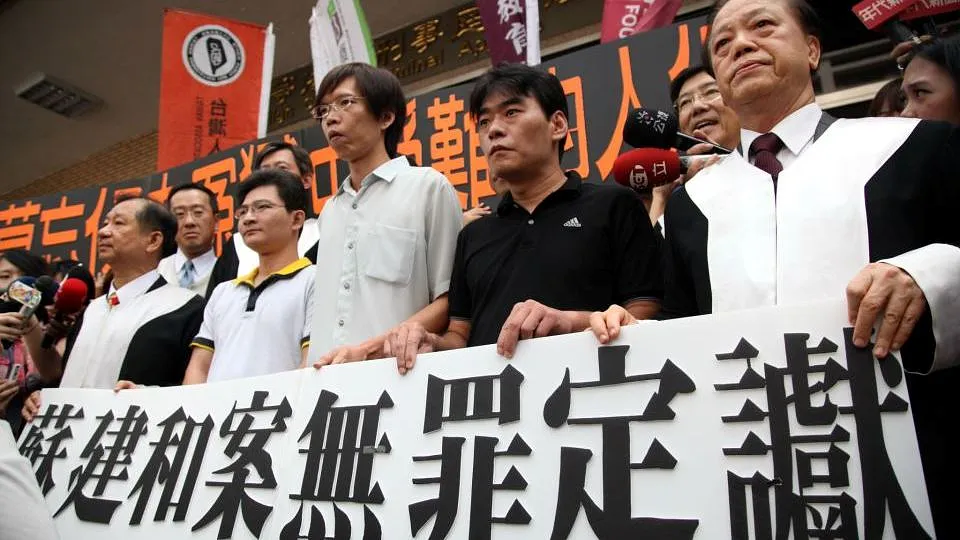
Do Not Forget Those Still Suffering in Wrongful Imprisonment! Statement by the Su Case Exoneration Action Team
Last edited: 2026-11-03
Today, Judges Chou Cheng-ta, Chao Wen-ching, and Hsu Yung-huang of the Taiwan High Court Criminal Division delivered the verdict in the 2010 Retrial Case No. 1 concerning the robbery case of Su Chien-ho and others, finding the three defendants not guilty. At the same time, invoking Article 8 of the Criminal Speedy Trial Act, the court declared that this case cannot be appealed to the Supreme Court. The Su Chien-ho case, which has been in litigation for 21 years, has finally been acquitted and finalized. In response, the Su Case Exoneration Action Team issues the following statement:
-
The Su Case has been exonerated through retrial, bearing witness with 21 years of youth to the slow progress of Taiwan's judiciary
Today's final acquittal in the Su Case marks the first instance in judicial history of an acquittal finalized through the criminal retrial procedure, shattering the myth of zero judicial miscarriages in death penalty cases. Since its establishment in 1995, the Death Row Inmates' (Su Case) Exoneration Action Team has spared no effort in rescuing Su Chien-ho, Liu Bing-lang, and Chuang Lin-xun, not only to prevent innocent people from being wrongfully executed, but also to establish a sound self-correcting mechanism within the judiciary. Because judges are not gods, judicial miscarriages, however terrifying, are difficult to avoid; yet a judiciary that refuses to admit its mistakes is truly terrifying.
Su Chien-ho, Liu Bing-lang, and Chuang Lin-xun twice declined a presidential pardon from President Ch'en Shui-bian in 2000 and 2008, believing that while the executive power of the presidency could balance judicial power, the judiciary should inherently possess the ability for institutional self-correction. Their exoneration through the retrial procedure, along with their perseverance and courage regarding the judicial system, deserves everyone's respect and bears witness to the slow progress of Taiwan's judiciary.
-
When the judiciary makes a mistake, each and every one of us is a victim
The errors committed by the police, prosecutors, and judges caused both the three defendants in the Su Case and the private prosecutors who trusted the police, prosecutors, and judges to waste 21 years of their lives in judicial litigation. In particular, to conceal their own mistakes, the police, prosecutors, and judges often intentionally or unintentionally invoke inconsistent judicial judgments to arbitrarily attack and accuse. Beyond inflicting secondary harm on both parties involved, this often exacerbates societal polarization.
A flawed judiciary harms everyone innocently drawn into it. Once the judiciary errs, the victims are not only the wrongfully accused defendants, but those who believe in the judiciary also suffer profoundly. The judiciary must have the courage to confront and handle its own mistakes so that everyone can dissolve and let go of the unwarranted hatred born therefrom.
-
Reform the criminal retrial system and establish an effective error-correction mechanism
The arduous journey of exoneration in the Su Case through retrial highlights the severe deficiencies in the criminal procedure retrial system. The current retrial system does not resemble a mechanism for correcting errors, but rather one for concealing them. The exoneration of the Su Case is merely the beginning of redressing wrongful convictions; the most urgent task is to reform the unreasonable criminal retrial system, and not to forget those still suffering in wrongful imprisonment who are crying out for freedom every moment and urgently awaiting rescue.
Members of the Su Case Exoneration Action Team
Humanistic Education Foundation
Taiwan Association for Human Rights
Taiwan Alliance to End the Death Penalty
Judicial Reform Foundation
Amnesty International Taiwan Section
This article is an AI-generated translation of the original Chinese text. In the event of any discrepancy, the Chinese version shall prevail.