
Dr. Henry Lee Testifies in the Su Case: Chronology and Key Points of the Appraisal Report
Last edited: 2026-07-27
1. Dr. Henry Lee's Testimony and Appraisal Process for the Su Case
On May 4, 2007, during the first retrial (更一審) of the Su case, Dr. Henry Lee appeared in court as an "expert." At that time, Dr. Lee pointed out the necessity of conducting a "crime scene reconstruction" for the Su case. However, because Dr. Lee appeared solely as an expert consultant rather than a formal appraiser, the prosecutor dismissed Dr. Lee's testimony on the grounds that "his status is not that of a witness under the Code of Criminal Procedure, and his testimony lacks probative value."
Following the verdict on June 29, 2007, the Su defense team actively requested Dr. Henry Lee to conduct a crime scene reconstruction for the case, which was approved by the court. On June 20, 2008, Dr. Lee officially arrived at the original Hsichih murder scene to conduct the reconstruction. This day felt like a major event in Taiwan's forensic history, with various parties gathering at the scene to observe. One year later, on July 30, 2009, the appraisal report was released.
In August 2010—another year after the release of the appraisal report, as the proceedings of the second retrial (更二審) in the Su case were gradually drawing to a close—the judge decided to summon the final witness before entering closing arguments: Dr. Henry Lee, to testify and explain the key points of the appraisal report in order to clarify the doubts of the prosecution and the court. After the court commissioned Dr. Henry Lee to conduct the scene reconstruction, Dr. Lee's status became that of an appraisal witness, and the probative value of his testimony became much more secure. Dr. Lee's testimony once again proved crucial to the outcome of this trial stage of the Su case.
2. What is Crime Scene Reconstruction?
Crime Scene Reconstruction is the process of determining the events that occurred at a crime scene based on the pattern and type of physical evidence, the location of physical evidence, and the results of laboratory physical evidence analysis. Reconstruction involves not only the analysis of scene science, the determination of pattern evidence, and laboratory analysis of physical evidence, but also the systematic analysis of relevant information and logical theories.
The rapid development of artificial intelligence and expert systems today has opened up a brand-new field for reconstruction work. These systems allow forensic personnel to simulate laboratory analysis results, set up crime scenes, reason, compare, and profile suspects, and draw reasonable inferences. With the advancement of hardware and software incorporating systematic problem-solving capabilities, computer technology enables users to communicate with expert systems to solve specific problems.
3. Main Purpose of Scene Reconstruction
The indictment issued in 1991 by the prosecutor at the Shihlin Branch of the Taipei District Prosecutors Office claimed that, in addition to Wang Wen-hsiao (王文孝), who had already been executed, Su Chien-ho (蘇建和), Liu Bing-lang (劉秉郎), and Chuang Lin-xun (莊林勳) also participated in the crime. However, apart from the confessions made at the time, there was no other direct evidence to prove that the other three individuals were present at the scene committing the crime.
By performing a scene reconstruction based on the clues within the room, all impossible scenarios are eliminated; what remains is the physical evidence closest to the facts at that time.
The scene reconstruction for the Su case aimed to explore the following two core questions:
- Can the scenario in which this case was committed jointly by multiple individuals be ruled out?
- Can the scenario in which this case was committed by a single individual alone be ruled out?
4. Main Appraisal Results and Prosecution Opinions
-
Doubts Regarding the Room Being Too Small for the Crime
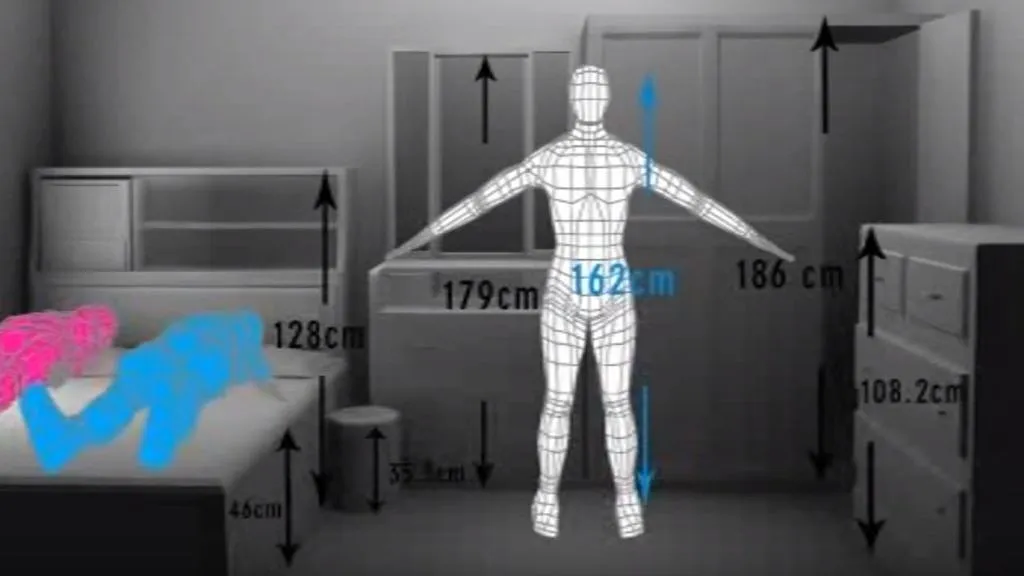
The size of the bedroom at the crime scene was only 12.56 square meters. After deducting the furniture, other irregular spaces, and the two victims, the area in which the perpetrators could move freely was less than 2 square meters.
Dr. Henry Lee believed that, judging from the bloodstain pattern and angles, if multiple people had committed the murder, the trajectory of the blood spatter would inevitably have been obstructed. However, the double bed, chest of drawers, and the floor along the walls all showed large and complete spatter patterns and dripping blood with no traces of human obstruction and no evidence of multiple people being present at the scene. Furthermore, if multiple people had hacked the victims simultaneously, they would have splattered one another and it would have been difficult to escape unscathed, yet none of the four individuals had any such injuries when arrested.
However, regarding this doubt, the Institute of Forensic Medicine of the Ministry of Justice (法務部法醫研究所)—which was commissioned by the court to submit an opinion on the scene reconstruction results—argued that on the day of the scene reconstruction, "in addition to Dr. Lee, there were four assistants, one photographer, two mannequins, as well as the judge, prosecutor, and lawyers entering and exiting, so the space of the master bedroom was large enough to accommodate four perpetrators and two victims." Nevertheless, the Institute of Forensic Medicine did not comment on the bloodstain spatter patterns at the scene.
-
Doubts Regarding Knife Marks
Regarding the knife wounds on the victims' bodies, there has always been a debate over how many murder weapons were used. The Institute of Forensic Medicine proposed a verification method based on knife marks, arguing that different knife marks have different angles, which can prove that multiple weapons were used to hack the victims.
However, Dr. Lee adopted a different forensic method, believing that the cleaver seized as evidence in this case could have caused the 79 knife wounds on the bodies of the victims through techniques such as "hacking," "cutting," "slicing," "cleaving," and "scratching," and that a single weapon could produce such wounds. Moreover, 79 was the combined total number of knife wounds on both victims. These 79 knife wounds did not represent 79 separate hacking actions (perhaps one strike caused multiple wounds). In addition, there were no injuries on the victims caused by police batons or other blunt instruments as described in the original indictment.
Domestic professional forensic pathologist Shih Tai-p'ing (石台平) also confirmed that the forensic method proposed by the Institute of Forensic Medicine was uniquely developed in Taiwan and did not exist abroad. Knife marks can only be used to judge the type and size of the weapon; the angle of the knife marks may change due to force, movement of the individuals, and other factors, and it is impossible to determine the weapon from the angles. Dr. Shih also stated that this appraisal method has not only never been used in other countries, but has also never been used in any other domestic cases besides the Su case.
-
Absence of Traces of Su Chien-ho and the Other Two at the Scene
Except for the hair of the victims and their family members, no traces of the other three individuals were found in the bathroom at the crime scene. The court believed this was because the other three had cleaned up the scene, taking away only their own hair while leaving behind the hair and the victims' and family members' hair. As for fingerprints at the crime scene belonging only to Wang Wen-hsiao alongside family members' fingerprints, the court believed it was because Wang Wen-hsiao wiped away other people's fingerprints while wiping his own, yet inadvertently left his own behind.
Dr. Henry Lee believed that there were no signs of multiple people washing themselves inside the bathroom at the scene. There were few leftover items in the trash can. The washbasin did not contain large amounts of hair or blood. The blood on the victims' clothes, the bed, and the sheets on the floor was all fresh blood, with no signs of washing or cleaning.
Furthermore, using common sense, distinguishing between hair and fingerprints is no easy task. If one were cleaning the scene, one would logically dispose of all hair; there would be no reason to run the risk of being discovered at the crime scene by deliberately picking out one's own hair. In reality, doing so is even harder to imagine. The court's arbitrary presumption ignoring the actual conditions at the scene is unacceptable.
-
Is It Possible for a Single Person to Have Committed the Crime?
The court believed that the victims were two adults, and if there were only one perpetrator, they might not have been able to subdue both simultaneously, thereby inferring that there were accomplices other than Wang Wen-hsiao. However, Wang Wen-hsiao had undergone military training and possessed physical stamina superior to that of the average person; judging from the forensic conditions at the scene, the injured parts of the victims were concentrated on their hands and upper bodies, and the wrist wounds were defensive rather than offensive, proving that the victims were struck down in a very short time. As for other wounds, such as the hacking injuries to the head, they were very likely inflicted through continuous attacks after the victims lost consciousness. Judging from the wounds, the multiple consecutive wounds on the victims' heads and the parallel knife wounds indicate that the relative positions of the victims and the perpetrator remained unchanged, and that the wounds were caused by continuous hacking within a very short time resulting in excessive trauma. Therefore, the perpetrator did not need to consist of multiple people; even a single person could have produced such wounds.
-
Were the Victims Raped?
The prosecution's indictment asserted that Wang Wen-hsiao and Su Chien-ho and his two companions committed rape against the female victim. However, the female victim's underwear was not torn, and the areas near the vaginal opening and buttocks of the underwear were clean without any blood stains, semen, or filth, showing no traces of sexual assault. Her scapular wounds were cutting and hacking wounds that the seized cleaver could have caused. The bloodstains on her clothing and pants were distinct, proving that the victim's clothes had not been changed. There is no evidence to prove that the female victim was raped.
5. Dr. Henry Lee's Appraisal Conclusion
Synthesizing the above evidence, the conclusions of the appraisal report are as follows:
- Judging from the actual situation of the scene, activity space, wound types and positions, potential weapons and bloodstain patterns involved, arm lengths and chest widths of the involved parties, and the orientation of the victims, it is inferred that the crime scene space was quite narrow. Although the scene could barely squeeze in six people, if four people were simultaneously wielding knives and clubs to hack and slash, given the visibility at the scene (around 4:00 AM) and the length of the weapons and arms, it was extremely unlikely that four people could simultaneously commit the crime and attack the two victims together with knives and clubs.
- Based on the blood distribution, the only bloody fingerprint and bloody footprint discovered, and the crime scene reconstruction, this case was most likely committed by Wang Wen-hsiao alone.
6. Conclusion
Of course, the contradictions between the court judgments, the report of the Institute of Forensic Medicine, and Dr. Henry Lee's on-site appraisal are not limited to the points mentioned above. However, judging from past judgments, the court still tends to rely primarily on the report of the Institute of Forensic Medicine, concocting possible reasons to exclude evidence favorable to the defendants. This completely violates the presumption of innocence principle under criminal law! We sincerely hope that the court can adopt the opinions of experts, let the evidence speak, practice science-based policing, and return a glimmer of hope to Taiwan's judiciary.
This article is an AI-generated translation of the original Chinese text. In the event of any discrepancy, the Chinese version shall prevail.